

Contact us
Call us at
Available 9 AM - 5 PM CET Business Days
Download
Download Manuals, Datasheets, Software and more:
Feedback
4 Series B MSO
Mixed Signal Oscilloscope Datasheet
More Information
- 4 Series B MSO Mixed Signal Oscilloscope
- Product Support
- Explore more Oscilloscope models
Read Online:
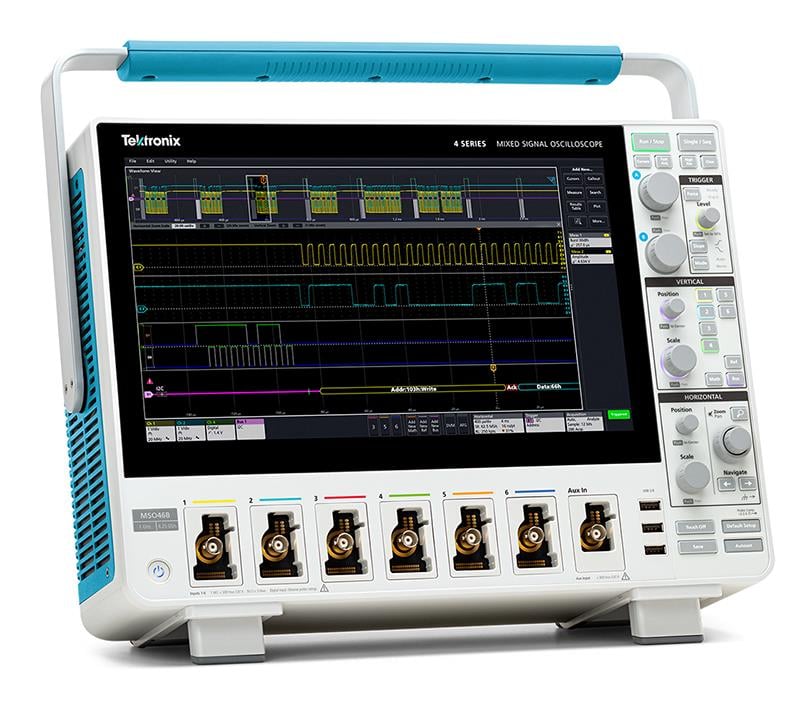
Key performance specifications
The 4 Series B MSO sets a new standard for performance, analysis capabilities and overall user experience in bench oscilloscopes -- ideal for debugging and validating embedded systems and power converters. The second generation of this instrument incorporates a new processing platform, more than doubling its responsiveness, and significantly accelerating measurements and data transfers with full support for remote operation and control. Models are available with 4 or 6 FlexChannel
Input channels
4 or 6 FlexChannel inputs
Each FlexChannel provides:
One analog signal that can be displayed as a waveform view, a spectral view, or both simultaneously
Eight digital logic inputs with TLP058 logic probe
Bandwidth (all analog channels)
200 MHz, 350 MHz, 500 MHz, 1 GHz, 1.5 GHz (upgradable)
Sample rate (all analog / digital channels)
Real-time: 6.25 GS/s
31.25 Mpoints standard (62.5 Mpoints optional upgrade)
Waveform capture rate
>500,000 waveforms/s
Vertical resolution
12-bit ADC
Up to 16 bits in High Res mode
Standard trigger types
Edge, Pulse Width, Runt, Timeout, Window, Logic, Setup & Hold, Rise/Fall Time, Parallel Bus, Sequence, Visual Trigger, Video (optional), RF vs. Time (optional)
Auxiliary Trigger ≤300 V
RMS (Edge Trigger only)
Standard analysis
Cursors: Waveform, V Bars, H Bars, V&H Bars
Measurements: 36
Spectrum View: Frequency-domain analysis with independent controls for frequency and time domains
FastFrame™: Segmented memory acquisition mode with maximum trigger rate >5,000,000 waveforms per second
Plots: Time Trend, Histogram, and Spectrum
Math: Basic waveform arithmetic, FFT, and advanced equation editor
Search: Search on any trigger criteria
Optional analysis
Advanced Spectrum View
RF vs. Time traces, triggers, Spectrograms, and IQ capture
Mask/Limit Testing
Advanced Power Measurements and Analysis
Three-Phase Electrical Analysis (6 channel model only)
Optional protocol trigger, decode, and analysis
I
Arbitrary/Function Generator (optional and upgradable)
Waveform Types: Arbitrary, Sine, Square, Pulse, Ramp, Triangle, DC Level, Gaussian, Lorentz, Exponential Rise/Fall, Sin(x)/x, Random Noise, Haversine, Cardiac
Digital voltmeter (free with product registration)
4-digit AC RMS, DC, and DC+AC RMS voltage measurements
Trigger frequency counter (free with product registration)
8-digit
Display
13.3 inch (338 mm) optically-bonded assembly
High Definition (1,920 x 1,080) resolution
Capacitive (multi-touch) touchscreen
Connectivity
USB 2.0 Host, USB 3.1 Host, USB 2.0 Device (6 USB ports total); LAN (10/100/1000 Base-T Ethernet); HDMI; Requires connection to high definition display (1,920 x 1,080 resolution)
Warranty
1 year
Dimensions
11.299 in (286.99 mm) H x 15.9 in (405 mm) W x 6.1 in (155 mm) D
Weight:
MSO44B : < 15.96 lbs (7.25 kg);MSO46B : < 16.55 lbs (7.5 kg)
Never let a lack of channels slow down your verification and debug process again!
The 4 Series B MSO offers better visibility into complex systems by offering four and six channel models with a 13.3-inch high-definition (1,920 x 1,080) optically-bonded display with superior contrast and viewing angle. Many applications, such as embedded systems, three-phase power electronics, automotive electronics, power supply design, and DC-to-DC power converters, require the observation of more than four analog signals to verify and characterize device performance, and to debug challenging system issues.
Most engineers can recall situations in which they were debugging a particularly difficult problem and wanted greater system visibility and context, but the scope they were using was limited to two or four analog channels. Using a second scope involves significant effort to align trigger points, difficulty in determining timing relationships across the two displays, and documentation challenges.
And while you might assume that a six channel oscilloscope would cost 50% more than a four-channel scope, you'll be pleasantly surprised to find that six channel models are only ~20% more than four channel models. The additional analog channels can pay for themselves quickly by enabling you to keep current and future projects on schedule.
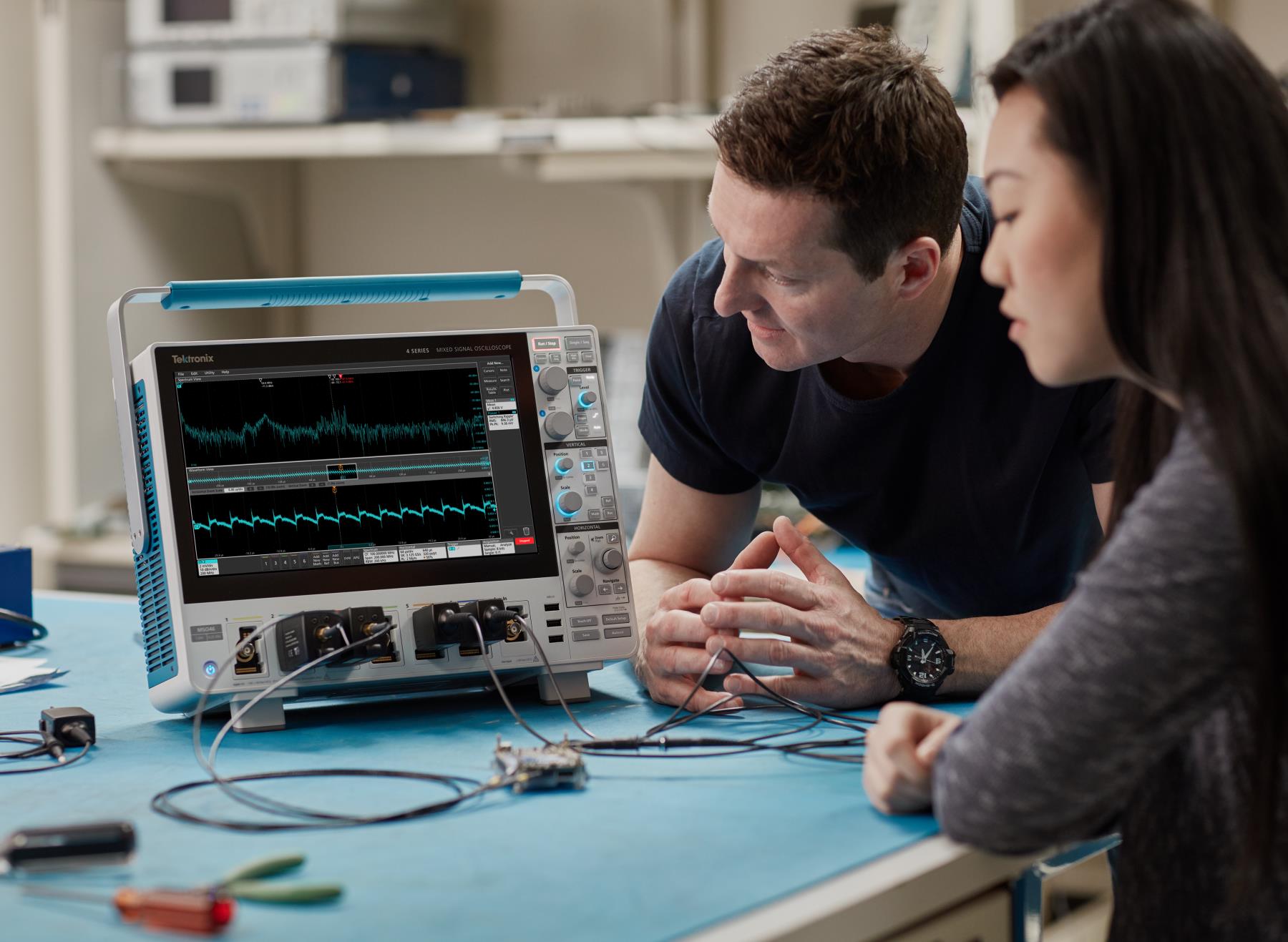
The following image shows voltage measurements on a switch-mode power supply showing the ripple voltage on one of the power rails.
FlexChannel technology enables maximum flexibility and broader system visibility
The 4 Series B MSO redefines what a Mixed Signal Oscilloscope (MSO) should be. FlexChannel® technology enables each channel input to be used as a single analog channel, eight digital logic inputs (with the TLP058 logic probe), or simultaneous analog and spectrum views with independent acquisition controls for each domain. Imagine the flexibility and configurability this provides.
With a six FlexChannel model, you can configure the instrument to look at six analog and zero digital signals. Or five analog and eight digital. Or four analog and 16 digital, three analog and 24 digital and so on. You can change the configuration at any time by simply adding or removing TLP058 logic probes, so you always have the right number of digital channels.
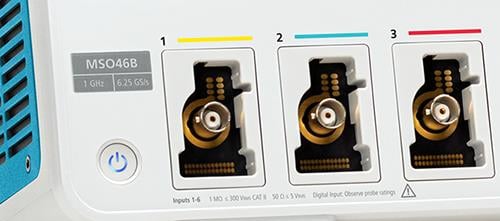
FlexChannel technology enables the ultimate in flexibility. Each input can be configured as a single analog or eight digital channels based on the type of probe you attach.
Previous-generation MSOs required tradeoffs, with digital channels having lower sample rates or shorter record lengths than analog channels. The 4 Series B MSO offers a new level of integration of digital channels. Digital channels share the same high sample rate (up to 6.25 GS/s), and long record length (up to 62.5

The TLP058 provides eight high performance digital inputs.
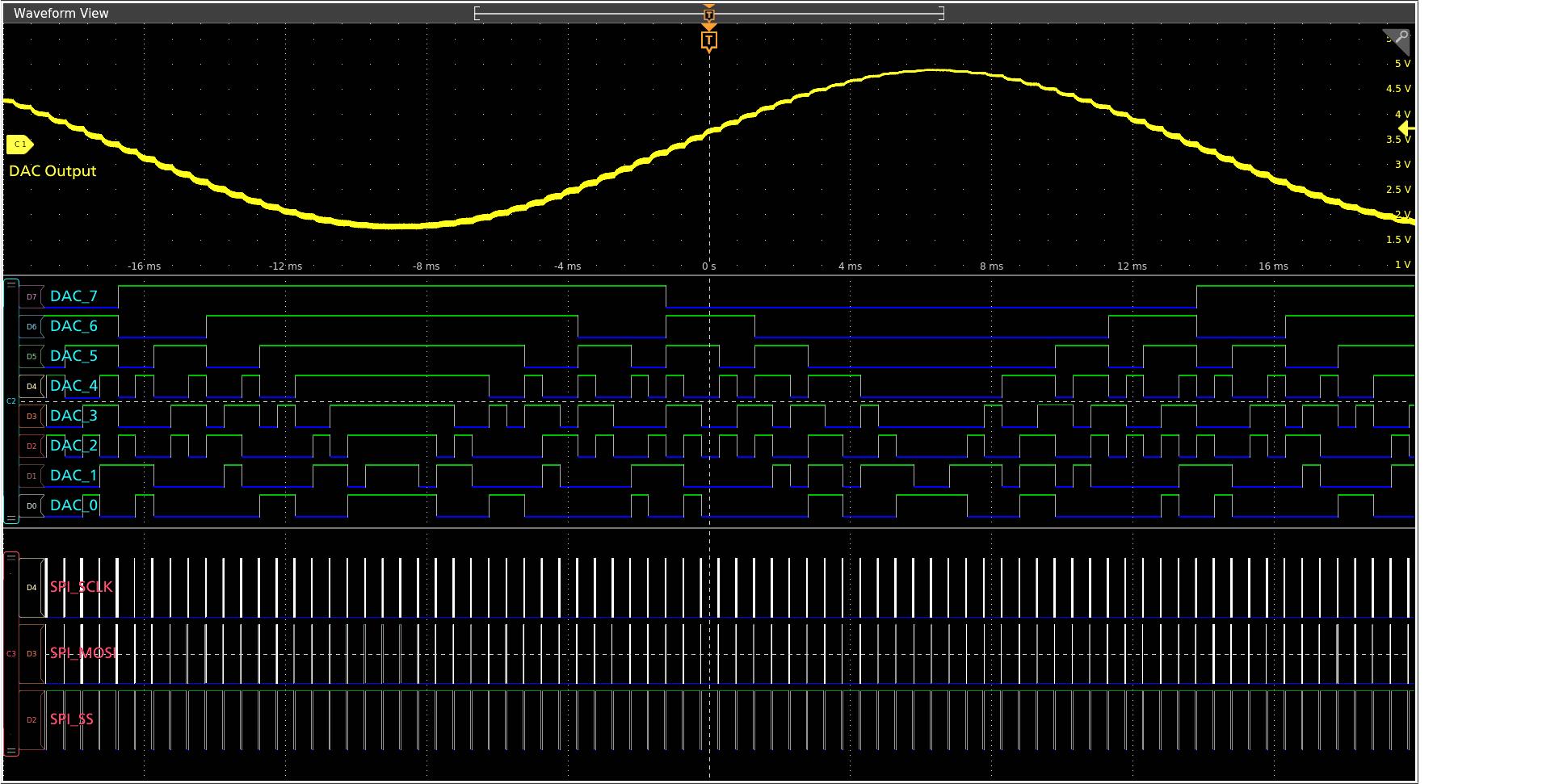
The preceding image shows that Channel 2 has a TLP058 Logic Probe connected to the eight inputs of a DAC. Notice the green and blue color coding, where ones are green and zeros are blue. Another TLP058 Logic Probe on Channel 3 is probing the SPI bus driving the DAC.
Another TLP058 Logic Probe on Channel 3 is probing the SPI bus driving the DAC. The white edges indicate higher frequency information is available by either zooming in or moving to a faster sweep speed on the next acquisition.
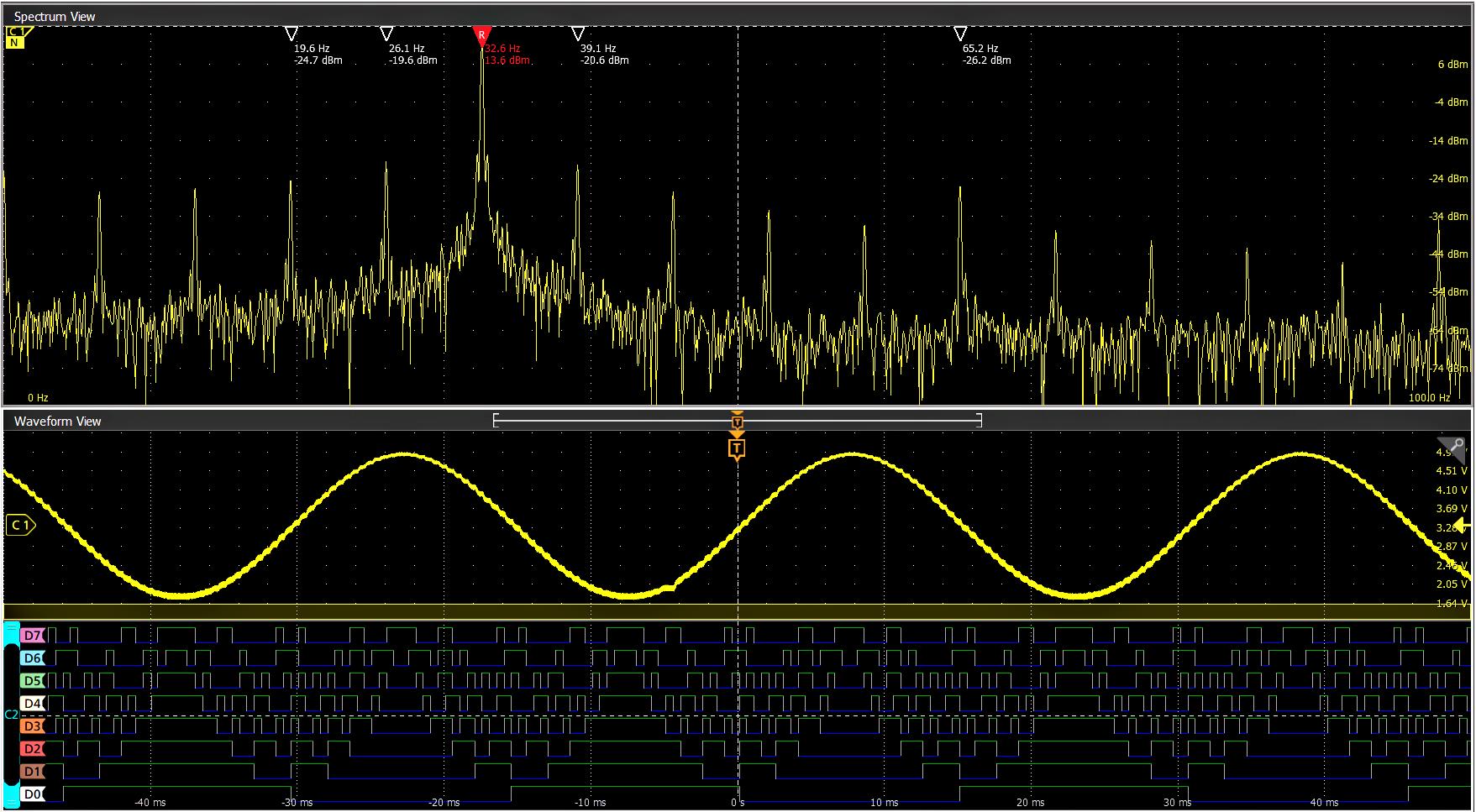
Beyond just analog and digital, FlexChannel inputs include Spectrum View. This Tektronix-patented technology enables you to simultaneously view both analog and spectral views of all your analog signals, with independent controls in each domain.
Unprecedented signal viewing capability
The stunning 13.3inch (338 mm) display is the largest display in its class..It is also the highest resolution display, with full HD resolution (1,920 x 1,080), enabling you to see many signals at once with ample room for critical readouts and analysis.
The viewing area is optimized to ensure that the maximum vertical space is available for waveforms. The Results Bar on the right can be hidden, enabling the waveform view to use the full width of the display.
Stacked display mode enables easy visibility of all waveforms while maintaining maximum ADC resolution on each input for the most accurate measurements.
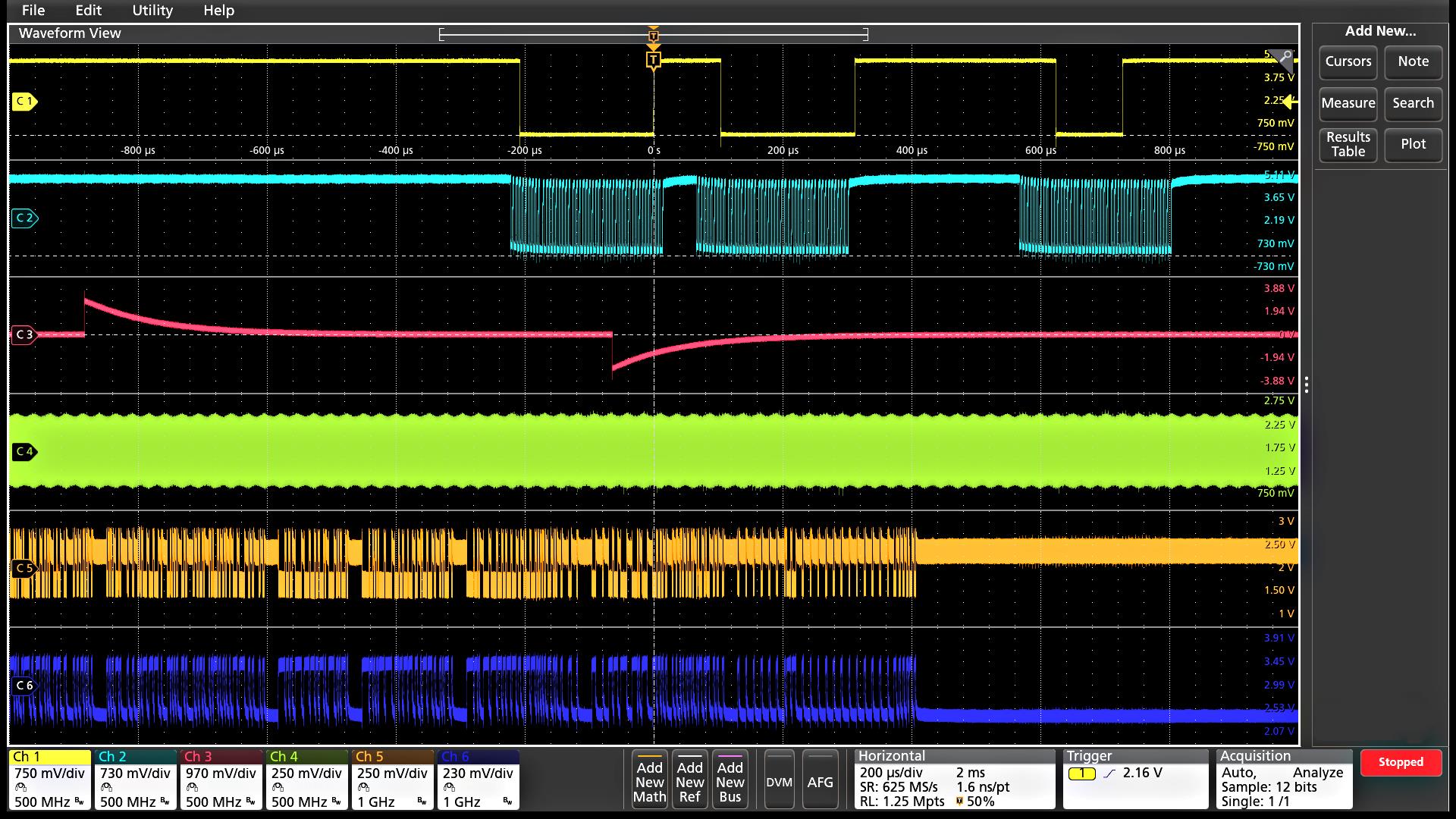
The 4 Series B MSO offers a revolutionary new Stacked display mode. Historically, scopes have overlaid all waveforms in the same graticule, forcing difficult tradeoffs:
To make each waveform visible, you vertically scale and position each waveform so that they don't overlap. Each waveform uses a small percentage of the available ADC range, leading to less accurate measurements.
For measurement accuracy, you vertically scale and position each waveform to cover the entire display. The waveforms overlap each other, making it hard to distinguish signal details on individual waveforms
The new Stacked display eliminates this tradeoff. It automatically adds and removes additional horizontal waveform 'slices' (additional graticules) as waveforms are created and removed. Each slice represents the full ADC range for the waveform. All waveforms are visually separated from each other while still using the full ADC range, enabling maximum visibility and accuracy. And it's all done automatically as waveforms are added or removed! Channels can easily be reordered in stacked display mode by dragging and dropping the channel and waveform badges in the Settings bar at the bottom of the display. Groups of channels can also be overlaid within a slice to simplify visual comparison of signals.
The large display also provides plenty of viewing area not only for signals, but also for plots, measurement results tables, bus decode tables and more. You can easily resize and relocate the various views to suit your application.
Viewing three analog channels, eight digital channels, a decoded serial bus waveform, decoded serial packet results table,four measurements,measurement histogram, measurements results table with statistics and search on serial bus events simultaneously!
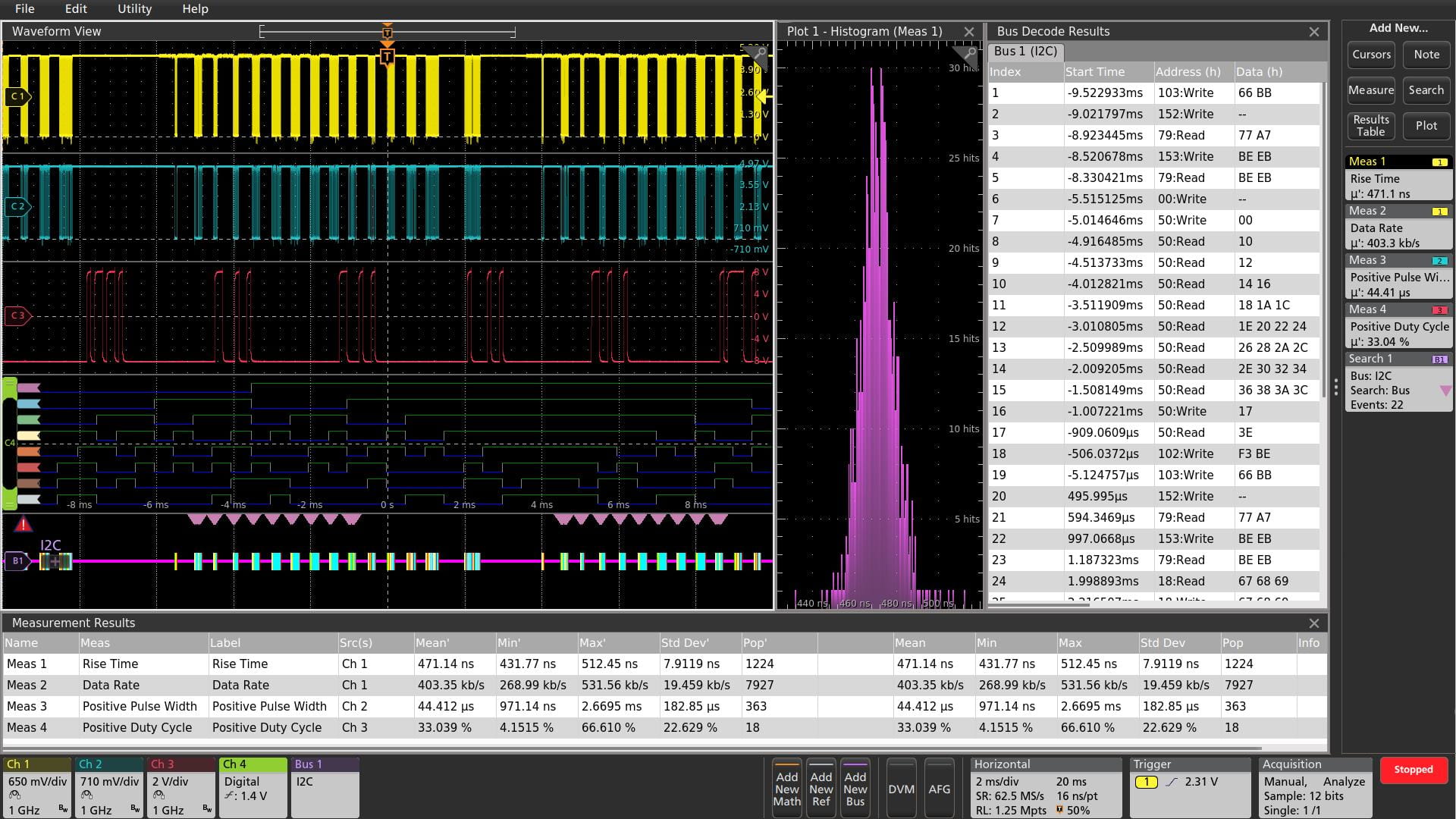
Exceptionally easy-to-use user interface lets you focus on the task at hand
The Settings Bar - key parameters and waveform management
Waveform and scope operating parameters are displayed in a series of “badges” in the Settings Bar that runs along the bottom of the display. The Settings Bar provides immediate access for the most common waveform management tasks. With a single tap, you can:
Turn on channels
Add math waveforms
Add reference waveforms
Add bus waveforms
Enable the optional integrated Arbitrary/Function generator (AFG)
Enable the optional integrated digital voltmeter (DVM)
The Results Bar - analysis and measurements
The Results Bar on the right side of the display includes immediate, one-tap access to the most common analytical tools such as cursors, measurements, searches, measurement and bus decode results tables, plots, and notes.
DVM, measurement and search results badges are displayed in the Results Bar without sacrificing any waveform viewing area. For additional waveform viewing area, the Results Bar can be dismissed and brought back at any time.
Configuration menus are accessed by simply double-tapping on the item of interest on the display. In this case, the Trigger badge was double-tapped to open the Trigger configuration menu.
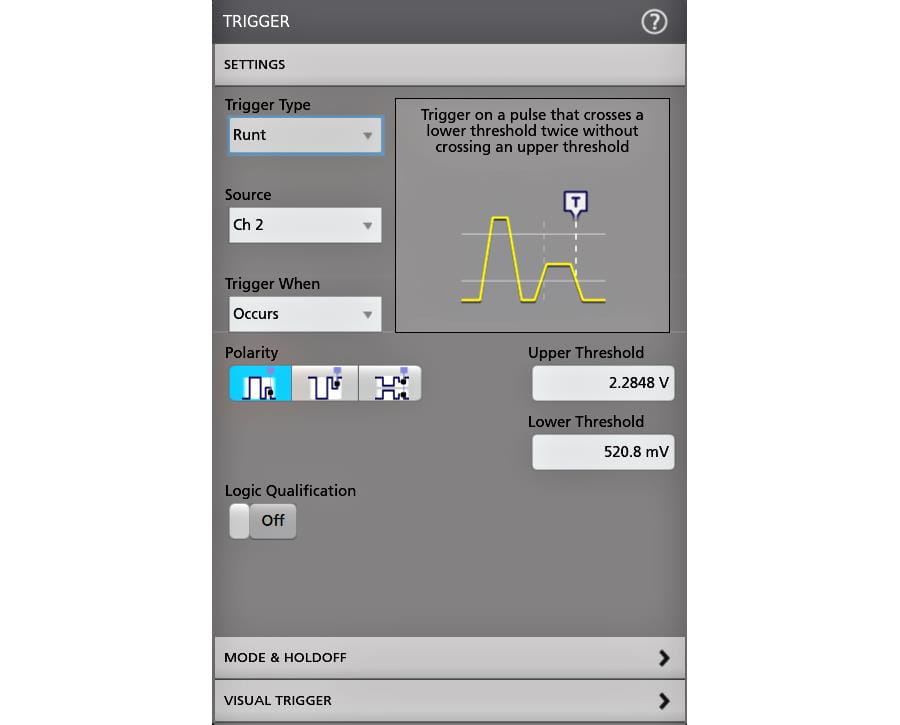
Touch interaction finally done right
Oscilloscopes have included touch screens for years, but the touch interface has been an afterthought. The 4 Series B MSO display includes a capacitive touchscreen and provides the industry's first oscilloscope user interface truly designed for touch.
The touch interactions that you use with phones and tablets, and expect in a touch-enabled device, are supported.
Drag waveforms left/right or up/down to adjust horizontal and vertical position or to pan a zoomed view
Pinch and expand to change scale or zoom in/out in either horizontal or vertical directions
Drag items off the edge of the screen to delete them
Swipe in from the right to reveal the Results Bar or down from the top to access the menus in the upper left corner of the display
Smooth, responsive front panel controls allow you to make adjustments with familiar knobs and buttons, and you can add a mouse or keyboard as a third interaction method.
Interact with the capacitive touch display in the same way you do on your phones and tablets.
Variable font size
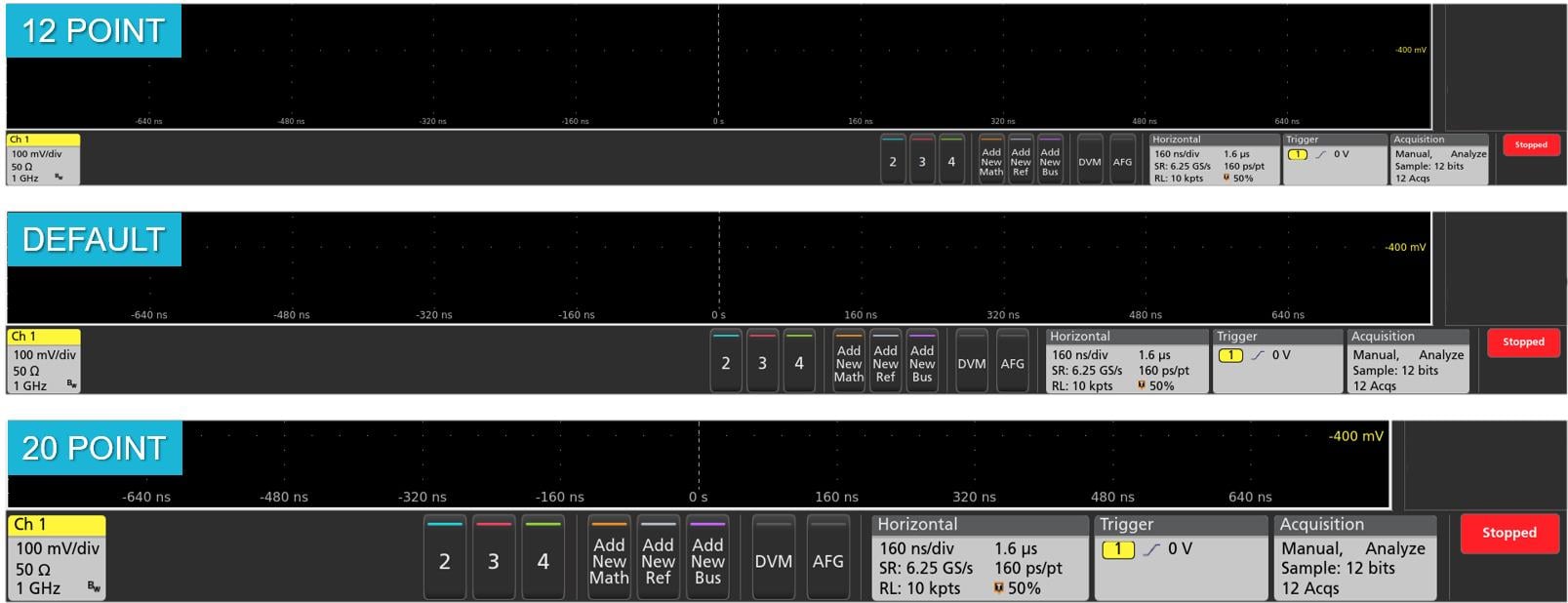
Historically, oscilloscope user interfaces have been designed with fixed font sizes to optimize viewing of waveforms and readouts. This implementation is fine if all users have the same viewing preferences, but they don't. Users spend a significant amount of time staring at screens, and Tektronix recognizes this. The 4 Series B MSO offers a user preference for variable font sizes; scaling down to 12 points or up to 20 points. As you adjust the font size, the user interface dynamically scales so you can easily choose the best size for your application.
The following image shows a comparison showing how the user interface scales as font size changes.
Attention to detail in the front-panel controls
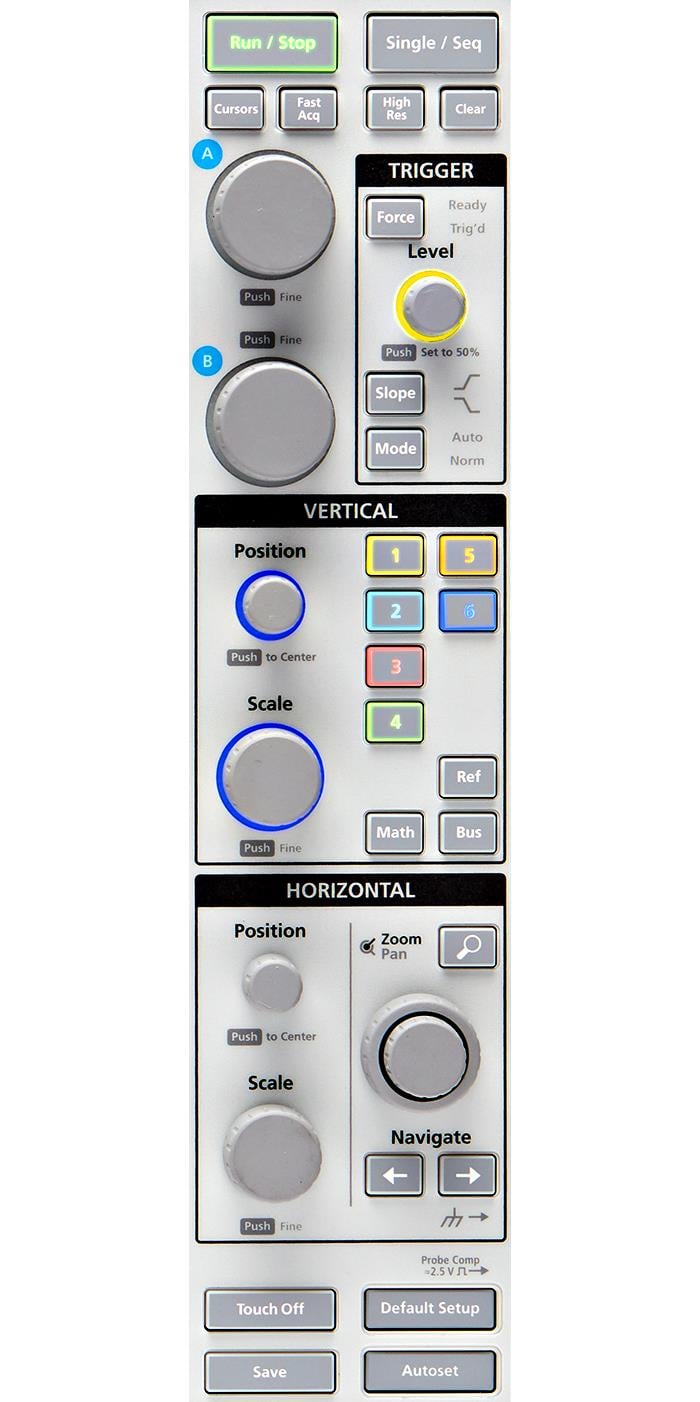
Traditionally, the front face of a scope has been roughly 50% display and 50% controls. The 4 Series B MSO display fills about 75% of the face of the instrument. To achieve this, it has a streamlined front panel that retains critical controls for simple intuitive operation, but with a reduced number of menu buttons for functions directly accessed via objects on the display.
Color-coded LED light rings indicate trigger source and vertical scale/position knob assignments. Large, dedicated Run/Stop and Single Sequence buttons are placed prominently in the upper right, and other functions like Force Trigger, Trigger Slope, Trigger Mode, Default Setup, Autoset and Quick-save functions are all available using dedicated front panel buttons.
The efficient and intuitive front panel provides critical controls while still leaving room for the high definition display.
Digital Phosphor technology with FastAcq high-speed waveform capture
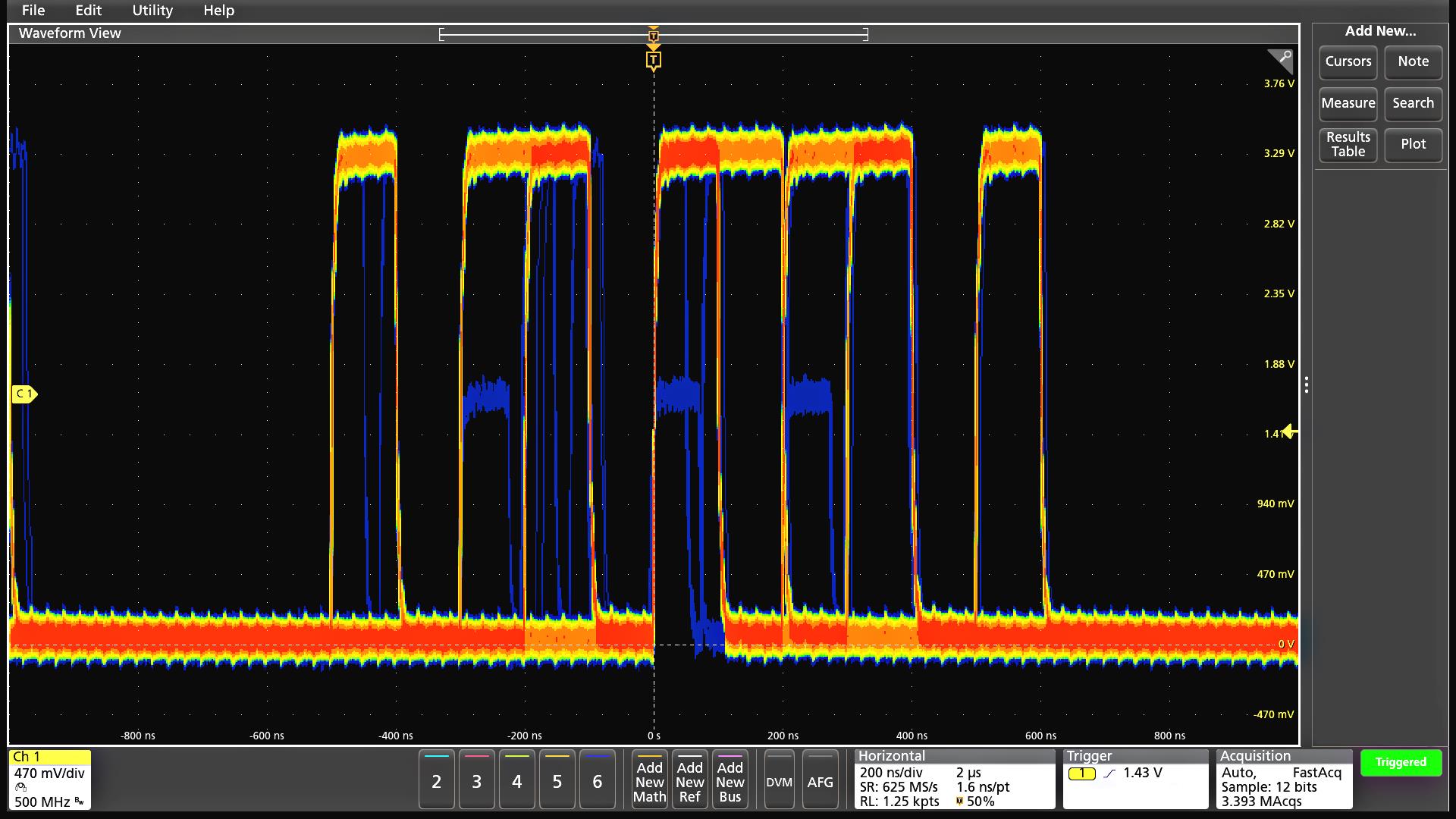
To debug a design problem, first you must know it exists. Digital phosphor technology with FastAcq™ provides you with fast insight into the real operation of your device. Its fast waveform capture rate - greater than 500,000 waveforms per second - gives you a high probability of seeing the infrequent problems common in digital systems: runt pulses, glitches, timing issues, and more. To further enhance the visibility of rarely occurring events, intensity grading indicates how often rare transients are occurring relative to normal signal characteristics.
FastAcq's high waveform capture rate enables you to discover infrequent problems common in digital design.
Industry leading vertical resolution{{start series(6Series 6BSeriesMSO)}} and low noise{{end}}
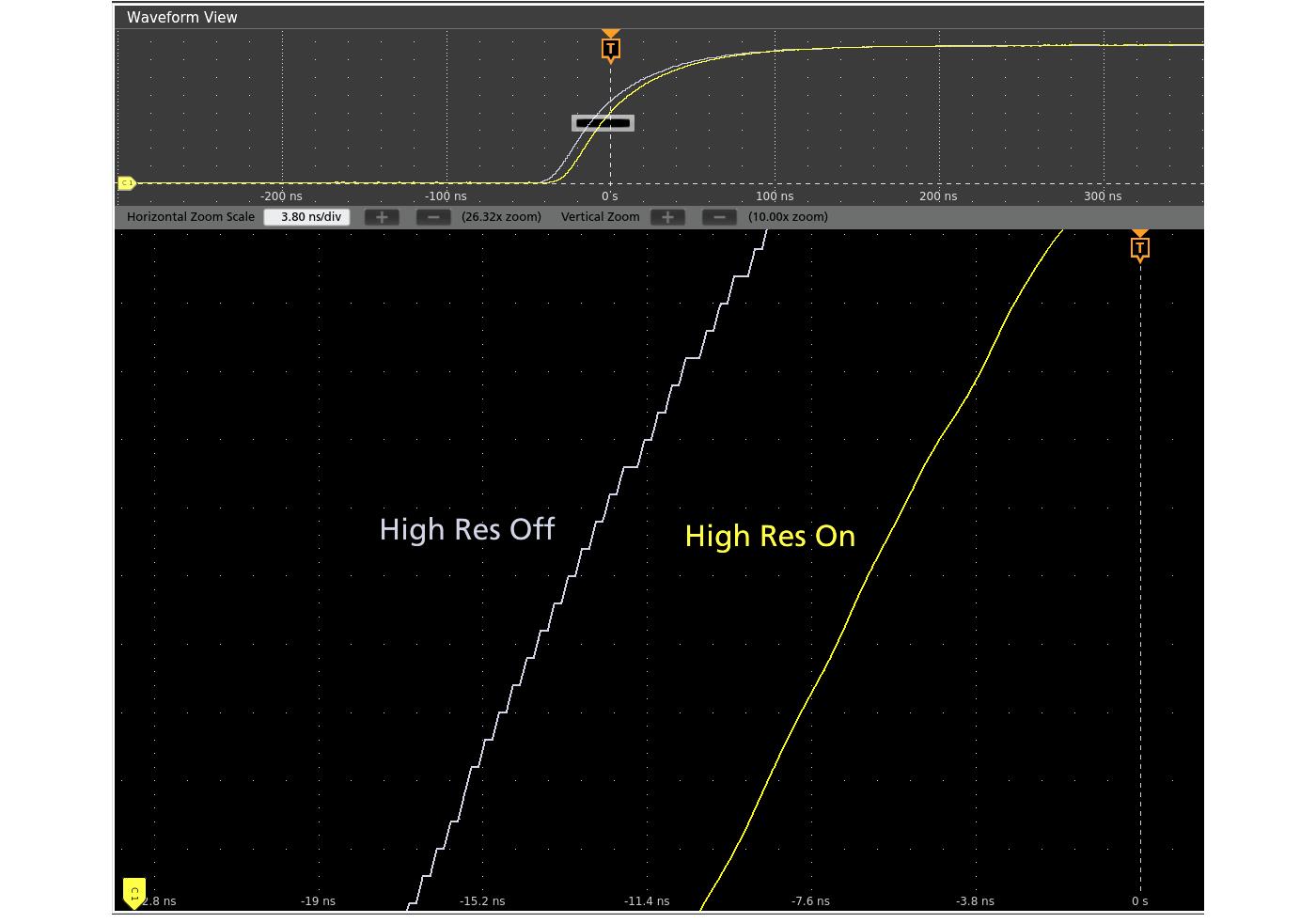
The 4 Series B MSO provides the performance to capture the signals of interest while minimizing the effects of unwanted noise when you need to capture high-amplitude signals while seeing smaller signal details. At the heart of the instrument are 12-bit analog-to-digital converters (ADCs) that provide 16 times the vertical resolution of traditional 8-bit ADCs.
A new High Res mode applies a hardware-based unique Finite Impulse Response (FIR) filter based on the selected sample rate. The FIR filter maintains the maximum bandwidth possible for that sample rate while preventing aliasing and removing noise from the oscilloscope amplifiers and ADC above the usable bandwidth for the selected sample rate. High Res mode always provides at least 12 bits of vertical resolution and extends all the way to 16 bits of vertical resolution at ≤125 MS/s sample rates.
New lower-noise front end amplifiers further improve your ability to resolve fine signal detail.
12-bit ADC, along with the new High Res mode, enable industry leading vertical resolution.
Triggering
Discovering a device fault is only the first step. Next, you must capture the event of interest to identify root cause. The 4 Series B MSO provides a complete set of advanced triggers, including:
Runt
Logic
Pulse width
Window
Timeout
Rise/Fall time
Setup and Hold violation
Serial packet
Parallel data
Sequence
Video
Visual Trigger
RF Frequency vs. Time
RF Magnitude vs. Time
RF vs. Time (optional)
With up to a 62.5 Mpoint record length, you can capture many events of interest, even thousands of serial packets in a single acquisition, providing high-resolution to zoom in on fine signal details and record reliable measurements.
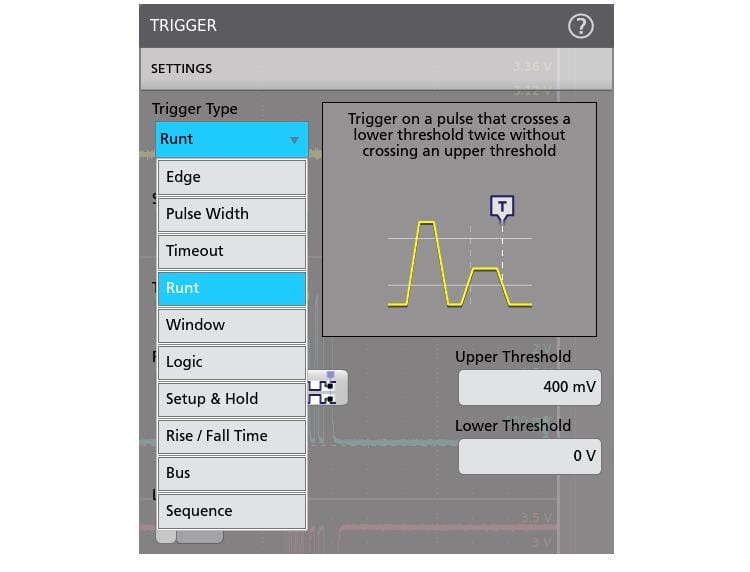
The wide variety of trigger types and context-sensitive help in the trigger menu make it easier than ever to isolate the event of interest.
Visual Trigger - finding the signal of interest quickly
Finding the right cycle of a complex bus can require hours of collecting and sorting through thousands of acquisitions for an event of interest. Defining a trigger that isolates the desired event speeds up debug and analysis efforts.
Visual Trigger extends the instrument's triggering capabilities by scanning through all waveform acquisitions and comparing them to on-screen areas (geometric shapes). You can create an unlimited number of areas using the mouse or touchscreen, and a variety of shapes (triangles, rectangles, hexagons, or trapezoids) can be used to specify the desired trigger behavior. Once shapes are created, they can be edited interactively to create custom shapes and ideal trigger conditions. Once multiple areas are defined, a Boolean logic equation can be used to set complex trigger conditions using on-screen editing features.
Visual Trigger areas isolate an event of interest, saving time by only capturing the events you want to see.
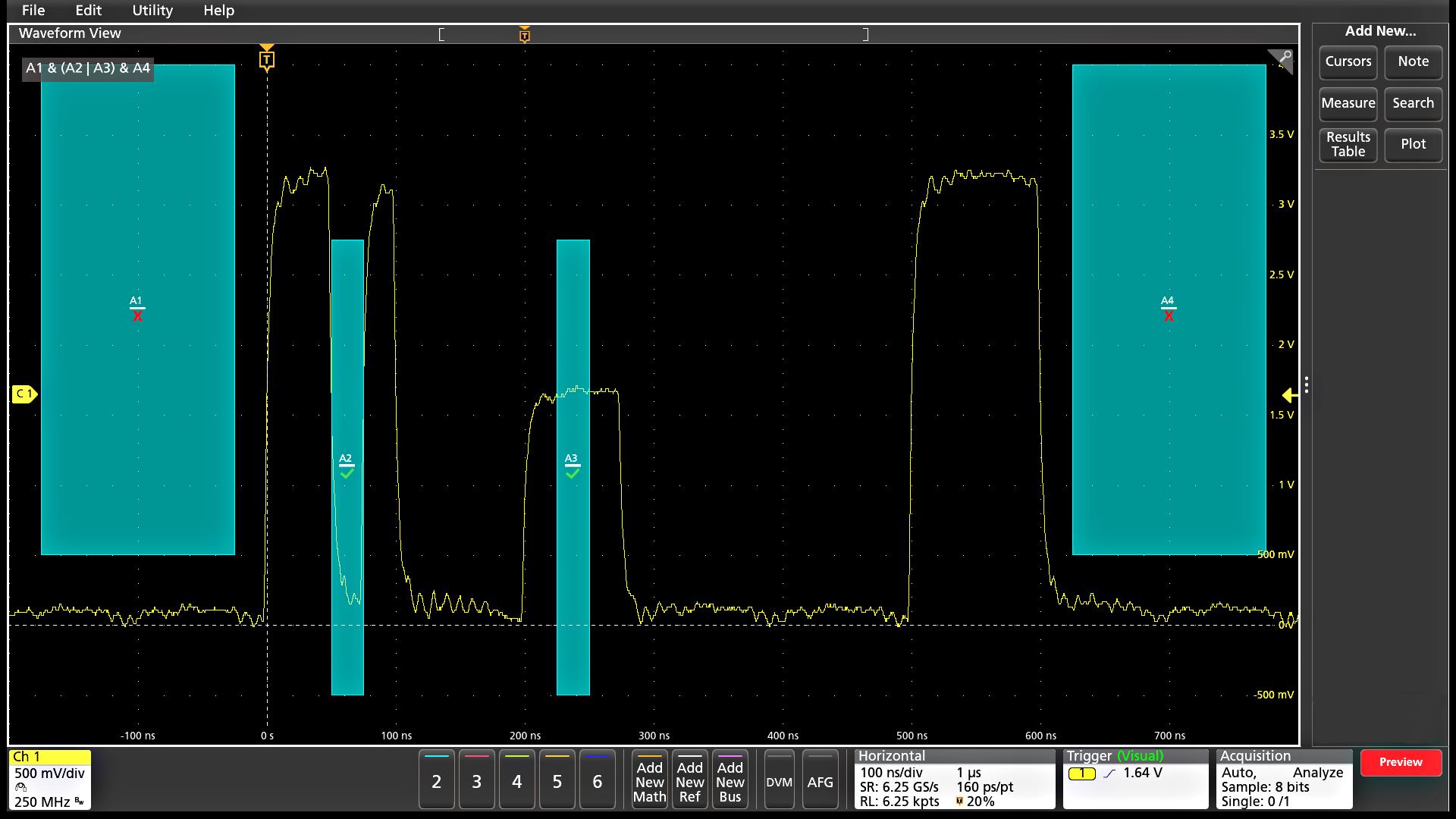
By triggering only on the most important signal events, Visual Trigger can save hours of capturing and manually searching through acquisitions. In seconds or minutes, you can find the critical events and complete your debug and analysis efforts. Visual Trigger even works across multiple channels, extending its usefulness to complex system troubleshooting and debug tasks.
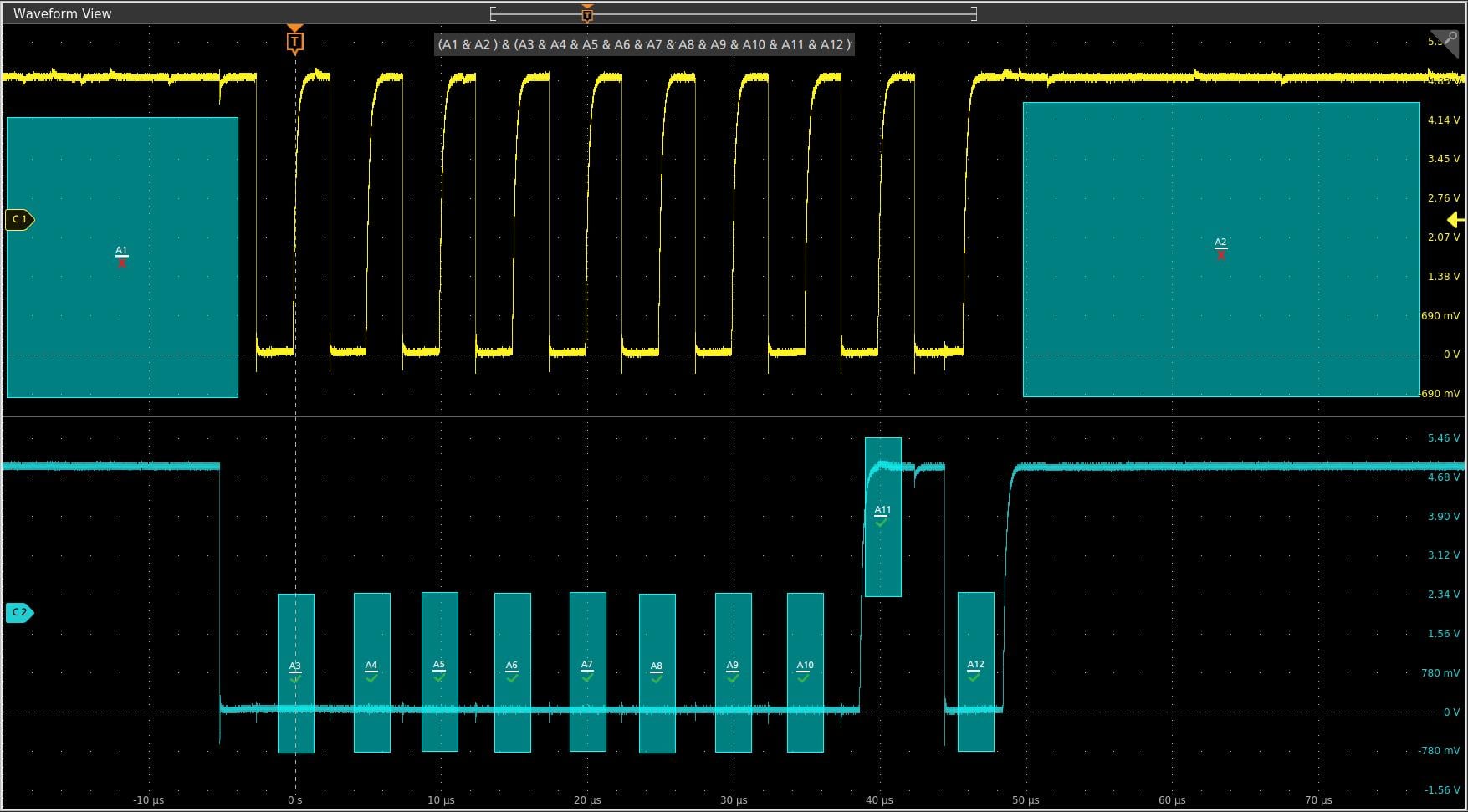
Visual Trigger areas can be associated with events spanning multiple channels, such as triggering on a specific burst-width on channel 1 and a specified bit pattern on channel 2.
{{start series(4BSeriesMSO 4Series 5Series)}}Accurate{{end}}{{start series(6Series 6BSeriesMSO)}}Convenient{{end}} high-speed {{start series(6Series 6BSeriesMSO)}}passive voltage {{end}}probing
The TPP Series passive voltage probes offer all the benefits of general-purpose probes - high dynamic range, flexible connection options, and robust mechanical design - while providing the performance of active probes. Up to 1 GHz analog bandwidth enables you to see high frequency components in your signals, and extremely low 3.9 pF capacitive loading minimizes adverse effects on your circuits and is more forgiving of longer ground leads.
An optional, low-attenuation (2X) version of the TPP probe is available for measuring low voltages. Unlike other low-attenuation passive probes, the TPP0502 has high bandwidth (500 MHz) as well as low capacitive loading (12.7 pF).
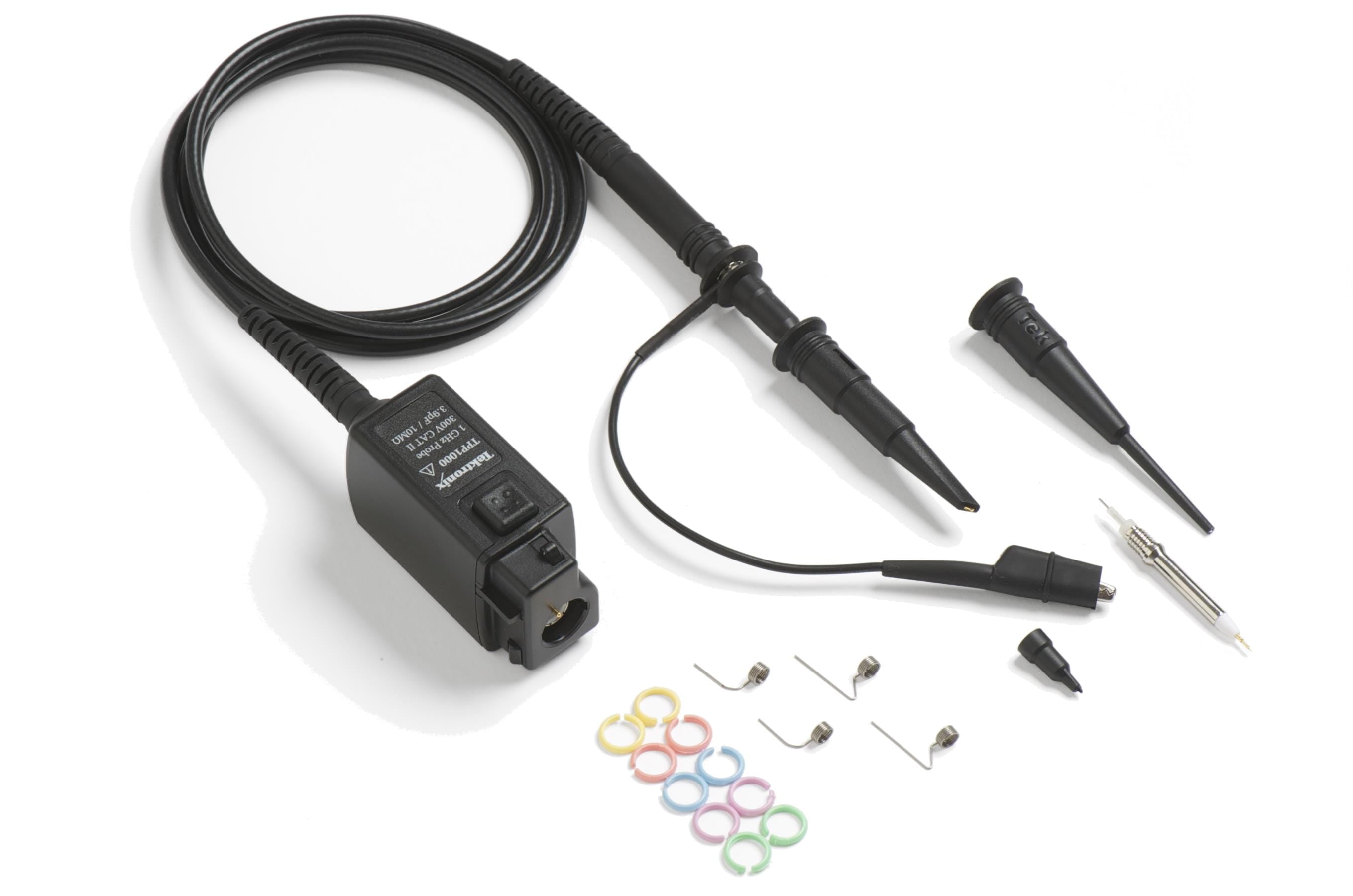
The instrument comes standard with one TPP0250 probe per channel on 200 MHz models, one TPP0500B per channel on 350 MHz and 500 MHz models, or one TPP1000 per channel on 1 GHz and 1.5 GHz models.”
TekVPI Probe Interface
The TekVPI
IsoVu Isolated Measurement System
Whether designing an inverter, optimizing a power supply, testing communication links, measuring across a current shunt resistor, debugging EMI or ESD issues, or trying to eliminate ground loops in your test setup, common mode interference has caused engineers to design, debug, evaluate, and optimize "blind" until now.
The revolutionary Tektronix IsoVu™ technology uses optical communications and power-over-fiber for complete galvanic isolation. When combined with the 4 Series B MSO equipped with the TekVPI interface, it is the first, and only, measurement system capable of accurately resolving high bandwidth, differential signals, in the presence of large common mode voltage with:
Complete galvanic isolation
Up to 1 GHz bandwidth
1 Million to 1 (120 dB) common mode rejection at 100 MHz
10,000 to 1 (80 dB) of common mode rejection at full bandwidth
Up to 2,500 V differential dynamic range
60 kV common mode voltage range

The Tektronix TIVP Series IsoVu™ Measurement System offers a galvanically isolated measurement solution to accurately resolve high bandwidth, differential signals up to 2,500 Vpk in the presence of large common mode voltages, with the best-in-class common mode rejection performance across its bandwidth.
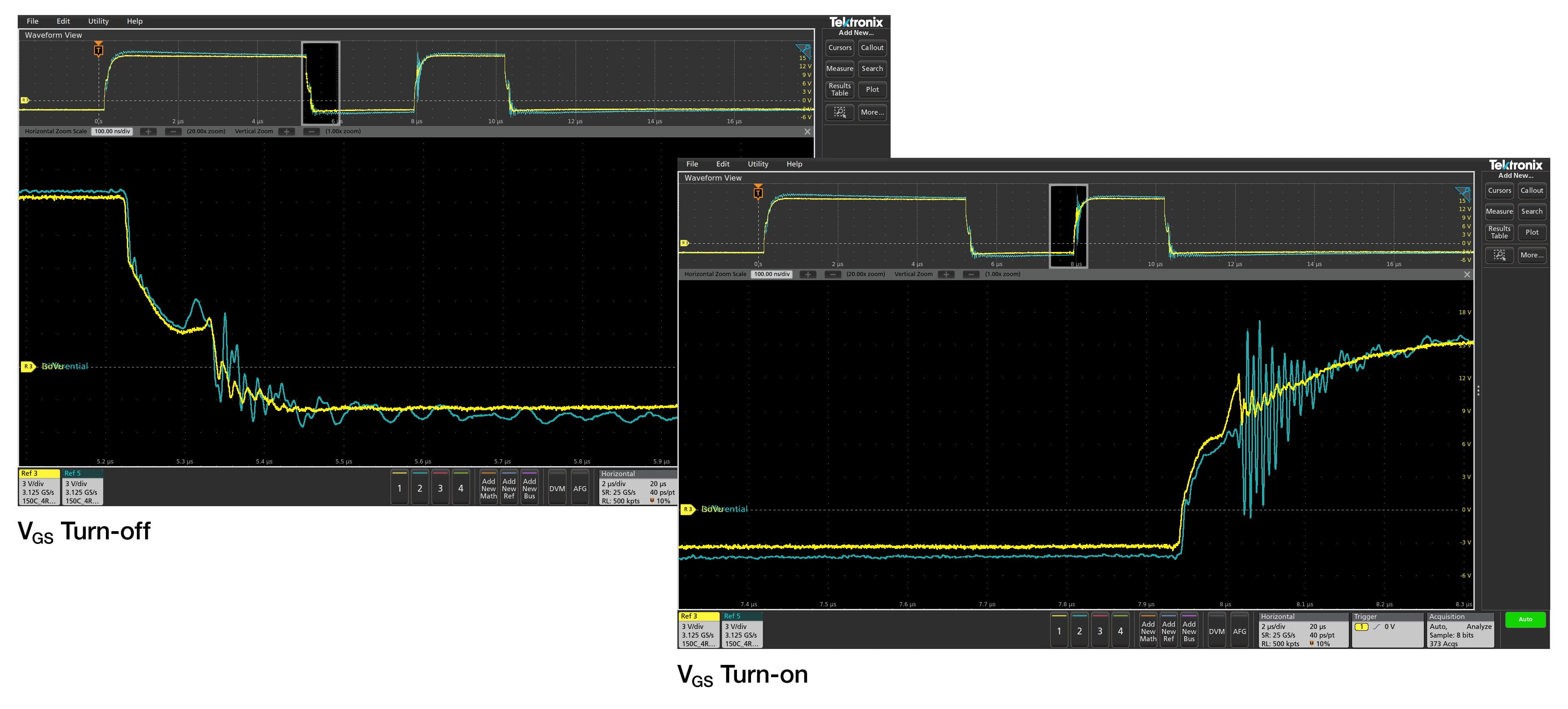
High-side gate voltage measurement with IsoVu
The following image shows a comparison of the high-side gate voltage for a standard differential probe versus an optically isolated probe. For both at turn-off and turn-on, high-frequency ringing can be seen on the gate after the device’s gate passes through the threshold region. Due to coupling between the gate and power loop, some ringing is expected. However, in the case of the differential probe, the ringing has a significantly higher amplitude than is measured by the optically isolated probe. This is likely due to the changing reference voltage inducing common mode currents within the probe and an artifact of a standard differential probe. While the waveform measured by the differential probe appears to pass the maximum gate voltage of the device, the more accurate measurement of the optically isolated probe makes it clear that the device is within specification. Application designers using standard differential probes for gate voltage measurements should use caution as it may not be possible to differentiate between the probing and measurement system artifact shown here and an actual violation of the device ratings. This measurement artifact may cause the designer to increase the gate resistance to slow down the switching transient and reduce the ringing. However, this would unnecessarily increase losses in the SiC device. For this reason, it is essential to have a measurement system that accurately reflects the actual dynamics of the device, in order to appropriately design the system and optimize performance.
The following image shows a Differential Probe (blue trace) vs. a IsoVu Optically Isolated Probe (yellow trace).
Basic waveform analysis
Verifying that your prototype's performance matches simulations and meets the project's design goals requires careful analysis, ranging from simple checks of rise times and pulse widths to sophisticated power loss analysis, characterization of system clocks, and investigation of noise sources.
The 4 Series B MSO offers a comprehensive set of standard analysis tools including:
Waveform- and screen-based cursors
36 automated measurements. Measurement results include all instances in the record, the ability to navigate from one occurrence to the next, and immediate viewing of the minimum or maximum result found in the record
Basic waveform math
Basic FFT analysis
Advanced waveform math including arbitrary equation editing with filters and variables
Spectrum View frequency domain analysis with independent controls for time and frequency domains
FastFrame™ Segmented Memory enables you to make efficient use of the oscilloscope’s acquisition memory by capturing many trigger events in a single record while eliminating the large time gaps between events of interest. View and measure the segments individually or as an overlay.
Standard amplitude and time measurements annotate the waveform display with visual bars and markers to indicate relative information. Measurement results tables provide comprehensive statistical views of measurement results with statistics across both the current acquisition and all acquisitions.
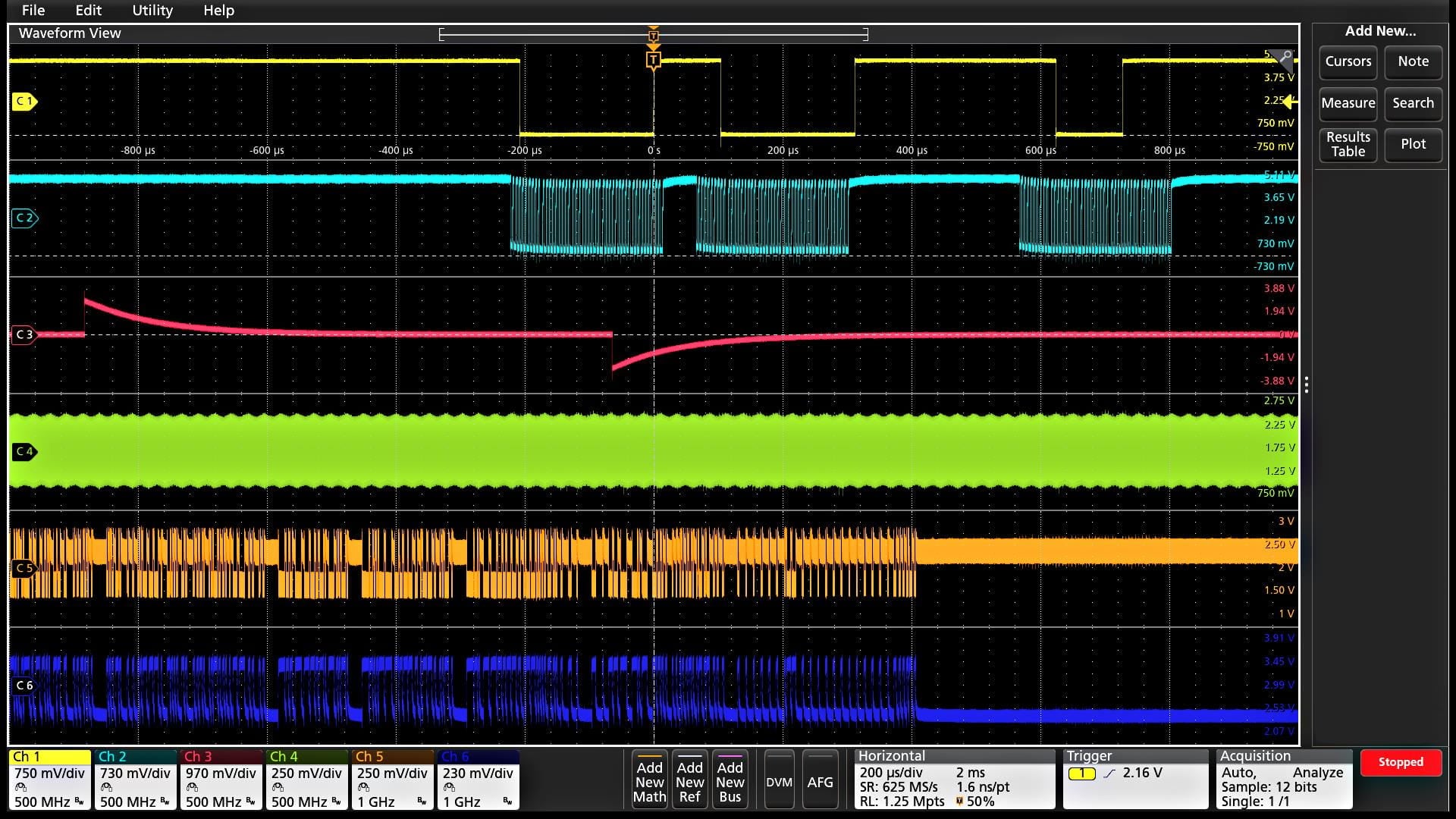
The following image shows using multiple channels to visualize multiple clock and data lines.
Callouts
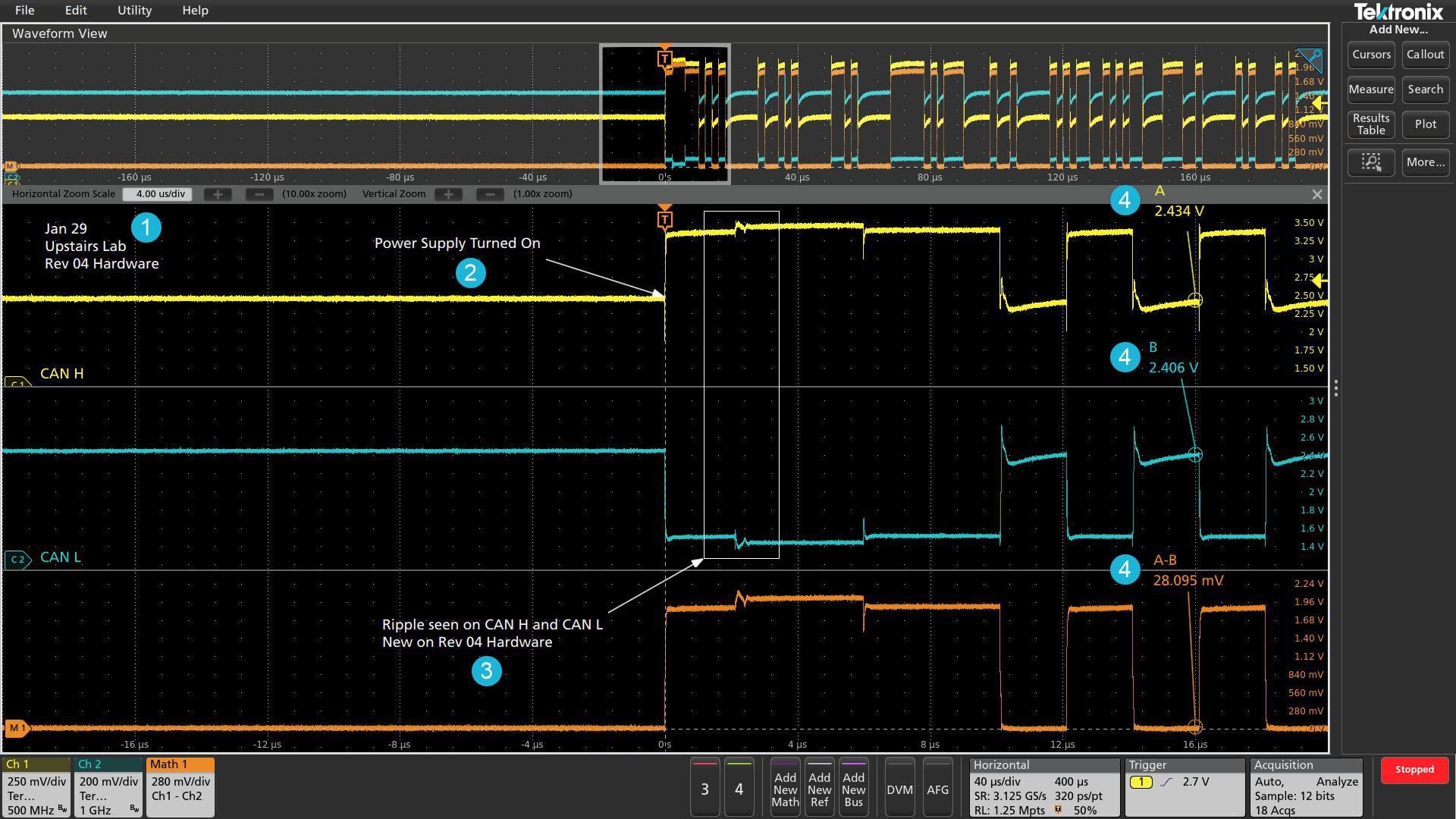
Note : Write and position a text box on the screen.Arrow : Write and position a text box, then add an arrow to a specific location on the screen.Rectangle : Write text and outline a specific region on the screen indicated by a resizable box.Bookmark : Create a dynamic readout at a specific time relevant to a trigger point. This readout includes text, magnitude of the signal, signal units, as well as a line and target indicating the bookmark reference point.
Documenting test results and methods is critical when sharing data across a team, recreating a measurement at a later date, or delivering a customer report. With a few taps on the screen, you can create as many custom callouts as needed; enabling you to document the specific details of your test results. With each callout, you can customize the text, location, color, font size, and font.
Navigation and search
Finding your event of interest in a long waveform record can be time-consuming without the right search tools. With today's record lengths of many millions of data points, locating your event can mean scrolling through literally thousands of screens of signal activity.
The 4 Series B MSO offers the industry's most comprehensive search and waveform navigation with its innovative Wave Inspector
The Search feature allows you to automatically search through your long acquisition looking for user-defined events. All occurrences of the event are highlighted with search marks and are easily navigated to, using the Previous ( ← ) and Next ( → ) buttons found on the front panel or on the Search badge on the display. Search types include edge, pulse width, timeout, runt, window, logic, setup and hold, rise/fall time and parallel/serial bus packet content. You can define as many unique searches as you like.
You can also quickly jump to the minimum and maximum value of search results by using the Min and Max buttons on the Search badge.
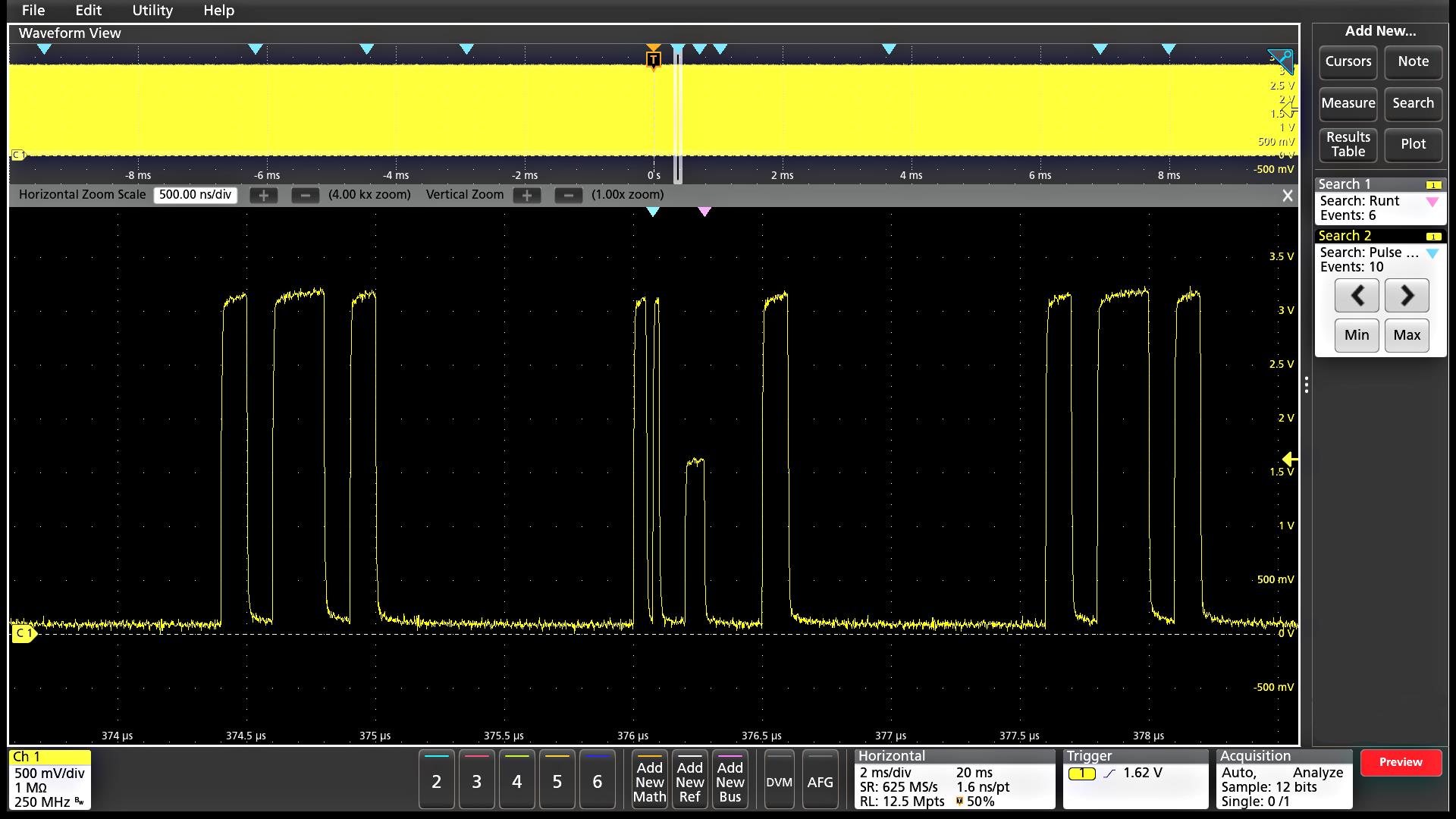
Earlier in this image, FastAcq revealed the presence of a runt pulse in a digital data stream prompting further investigation. In this acquisition, Search 1 reveals that there are six runt pulses in the acquisition.
Mask and limit testing (optional)
Whether you are focused on signal integrity or setting up pass/fail conditions for production, mask testing is an efficient tool to characterize the behavior of certain signals in a system. Quickly create custom masks by drawing mask segments on the screen. Tailor a test to your specific requirements and set actions to take when a mask hit is registered, or when a complete test passes or fails.
Limit testing is an insightful way to monitor the long-term behavior of signals, helping you characterize a new design or confirm hardware performance during production line testing. Limit tests compare your live signal to an ideal, or "golden" version of the same signal with user-defined vertical and horizontal tolerances.
You can easily tailor a mask or limit test to your specific requirements by:
Defining test duration in number of waveforms
Setting a violation threshold that must be met before considering a test a failure
Counting violations/failures and reporting statistical information
Setting actions upon violations, test failure, and test complete
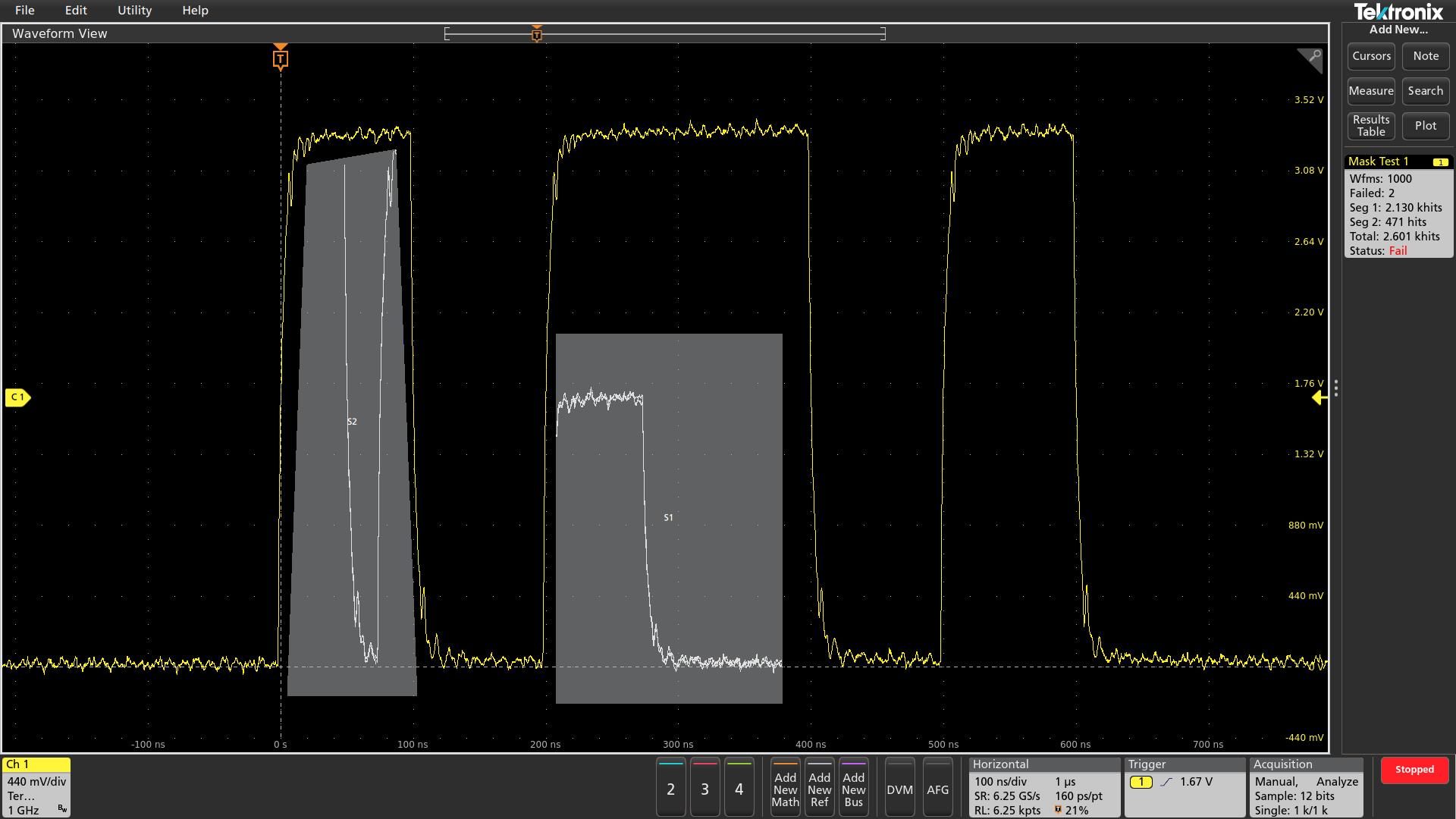
The following image shows a custom, multiple segment mask capturing the presence of a signal glitch and runt pulse in a waveform.
Protocol decode and analysis (optional)
During debugging, it can be invaluable to trace the flow of activity through a system by observing the traffic on one or more serial buses. It could take many minutes to manually decode a single serial packet, much less the thousands of packets that may be present in a long acquisition.
And if you know the event of interest that you are attempting to capture occurs when a particular command is sent across a serial bus, wouldn't it be nice if you could trigger on that event? Unfortunately, it's not as easy as simply specifying an edge or a pulse width trigger.
The following image shows triggering on a CAN serial bus.
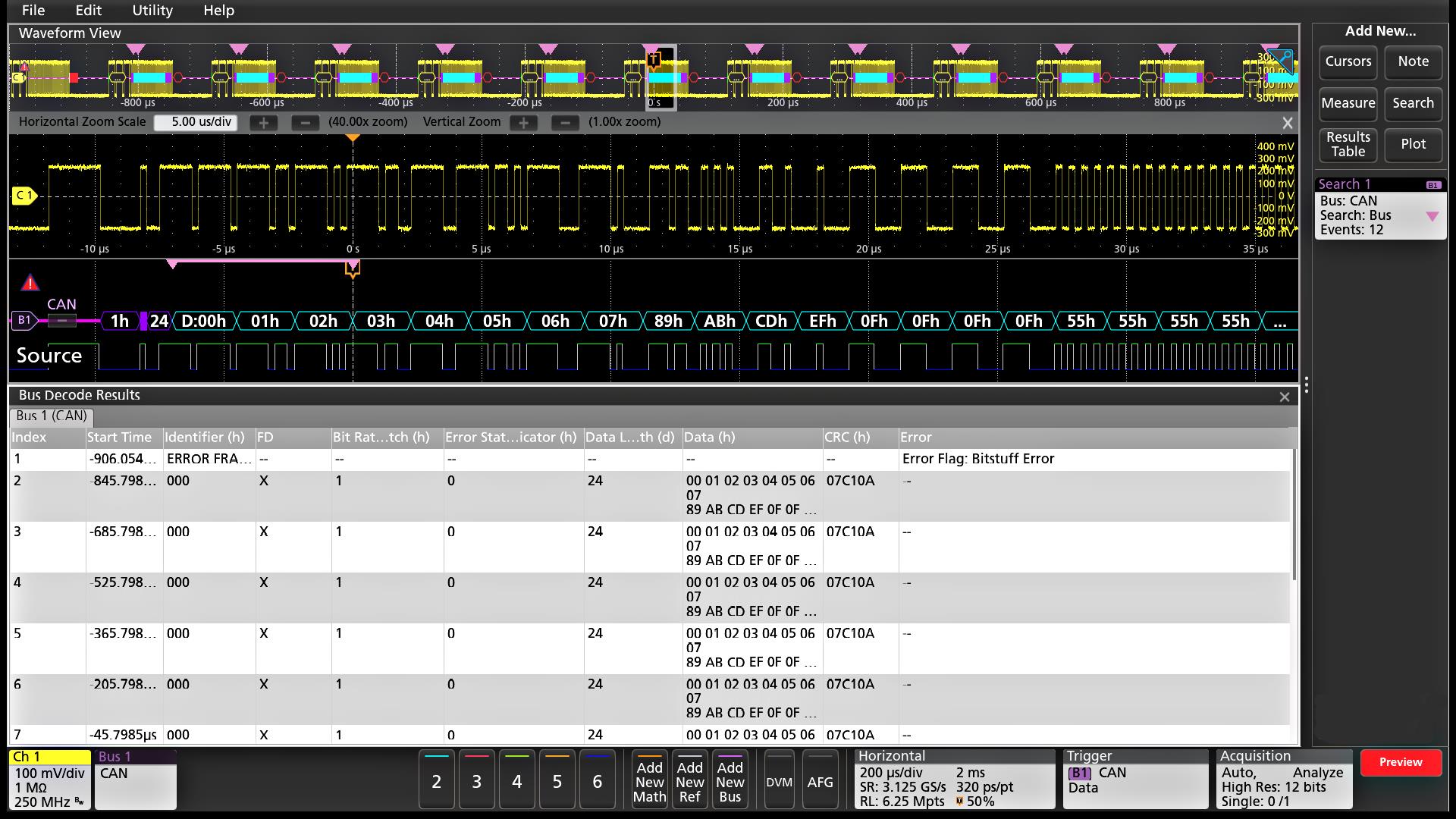
A bus waveform provides time-correlated decoded packet content including Start, Arbitration, Control, Data, CRC and ACK while the bus decode table presents all packet content from the entire acquisition.
The 4 Series B MSO offers a robust set of tools for working with the most common serial buses found in embedded design including I2C, SPI, eSPI, I3C, RS-232/422/485/UART, SPMI, SMBus, CAN, CAN FD, CAN XL, LIN, FlexRay, SENT, PSI5, CXPI, USB 1.0 (1.5 Mbps), USB 1.1 (12 Mbps), USB 2.0 (480 Mbps), eUSB2.0, Ethernet 10/100, EtherCAT, Audio (I2S/LJ/RJ/TDM), MIL-STD-1553, ARINC 429, SpaceWire, NRZ, Manchester, SVID, SDLC, 1-Wire, MDIO, and NFC.
Protocol search enables you to search through a long acquisition of serial packets and find the ones that contain the specific packet content you specify. Each occurrence is highlighted by a search mark. Rapid navigation between marks is as simple as pressing the Previous (
The tools described for serial buses also work on parallel buses. Support for parallel buses is standard in the instrument. Parallel buses can be up to 48 bits wide and can include a combination of analog and digital channels.
Serial protocol triggering lets you trigger on specific packet content including start of packet, specific addresses, specific data content, unique identifiers, and errors.
Bus waveforms provide a higher-level, combined view of the individual signals (clock, data, chip enable, and so on) that make up your bus, making it easy to identify where packets begin and end, and identifying sub-packet components such as address, data, identifier, CRC, and so on.
The bus waveform is time aligned with all other displayed signals, making it easy to measure timing relationships across various parts of the system under test.
Bus decode tables provide a tabular view of all decoded packets in an acquisition much like you would see in a software listing. Packets are time stamped and listed consecutively with columns for each component (Address, Data, and so on).
NFC decode and analysis (optional)
Evaluating the performance margins of NFC designs is often difficult due to an inability to trace the protocol-level result down to the parametric signal level. This means marginal passes may result in failures later in the test flow, especially when designs are susceptible to interference and signal integrity issues caused by design trade-offs or nearby electronics, requiring time-consuming debug across multiple instruments like a protocol analyzer and RF signal analyzer.
The NFC Protocol Decode and Search option on the 4 Series B MSO offers users the ability to view the transaction of the NFC link and trace the result through every step of signal manipulation in the standard, from the protocol-level down to the fundamental signal level to gain insight into exactly how your NFC chip, tag, reader, or mobile device is performing.
NFC transactions can be long. The software option uniquely uses the data coming from the hardware DDC used for Spectrum View, which allows for sample rate compression, saving transfer time and memory, allowing for 100s of milliseconds or even seconds of signal data to be captured and analyzed.
Additionally, because I/O signals are not always available to probe and trigger on from the device under test, triggering on the RF envelope itself is also a challenge considering NFC’s small modulation index. With Spectrum View, you can trigger on the 13.56 MHz envelope using RF vs. Time traces and triggers, which is also unique amongst instruments.
This capability simplifies up-front design validation and also provides a powerful debugging tool in a single instrument when failures do occur.
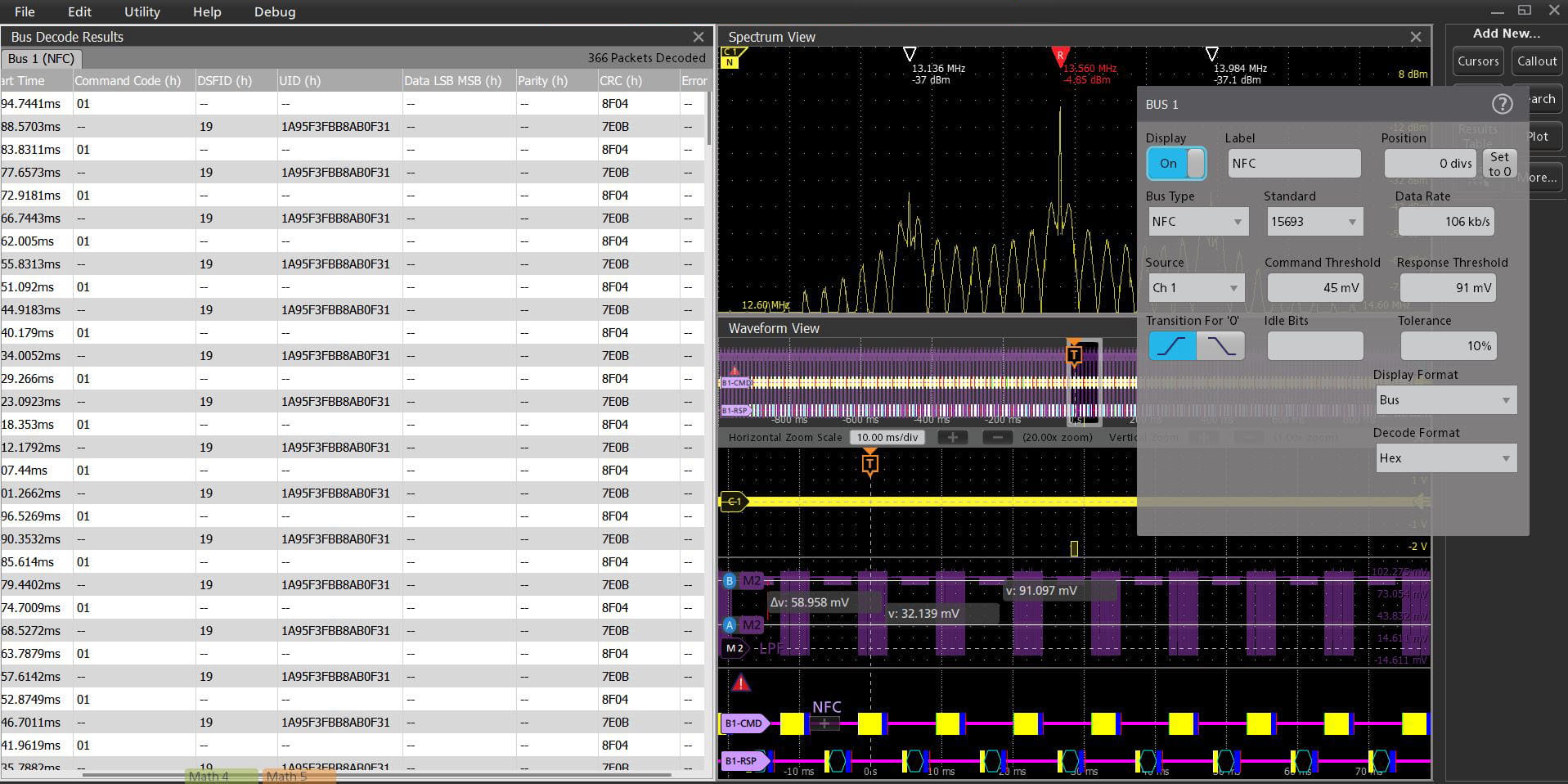
NFC software option allows you to decode and search through their digital NFC bit stream for performing NFC analog/RF and digital pre-conformance, debug, and troubleshooting in a single instrument.
Spectrum View
It is often easier to debug an issue by viewing one or more signals in the frequency domain. Oscilloscopes have included math-based FFTs for decades in an attempt to address this need. However, FFTs are notoriously difficult to use for two primary reasons.
First, when performing frequency-domain analysis, you think about controls like Center Frequency, Span, and Resolution Bandwidth (RBW), as you would typically find on a spectrum analyzer. But then you use an FFT, where you are stuck with traditional scope controls like sample rate, record length and time/div and have to perform all the mental translations to try to get the view you’re looking for in the frequency-domain.
Second, FFTs are driven by the same acquisition system that’s delivering the analog time-domain view. When you optimize acquisition settings for the analog view, your frequency-domain view isn’t what you want. When you get the frequency-domain view you want, your analog view is not what you want. With math-based FFTs, it is virtually impossible to get optimized views in both domains.
Spectrum View changes all of this. Tektronix’ patented technology provides both a decimator for the time-domain and a digital downconverter (DDC) for the frequency-domain behind each FlexChannel. The two different acquisition paths let you simultaneously observe both time- and frequency-domain views of the input signal with independent acquisition settings for each domain. Other manufacturers offer various ‘spectral analysis’ packages that claim ease-of-use, but they all exhibit the limitations described above. Only Spectrum View provides both exceptional ease-of-use and the ability to achieve optimal views in both domains simultaneously.
Traditionally, performing RF measurements, such as RF Channel Power (CHP), Adjacent Channel Power Ratio (ACPR), and Occupied Bandwidth (OBW), required a dedicated spectrum or signal analyzer or spectrum analyzer software. This additional hardware or software leads to more complexity and higher costs. Available standard with Spectrum View, integrated RF Measurements on each channel saves users time, bench space, and costs with the ability to validate RF transmitter CHP, ACPR, and OBW directly on the oscilloscope.
Additionally, the DDC significantly reduces the required sample rate to resolve a signal compared to a conventional FFT since it becomes a function of span rather than center frequency. This allows for reduced file sizes, improved frequency resolution, and faster spectrum update rates, leading to a more responsive and accurate solution capable of capturing tens of seconds of spectrum data.
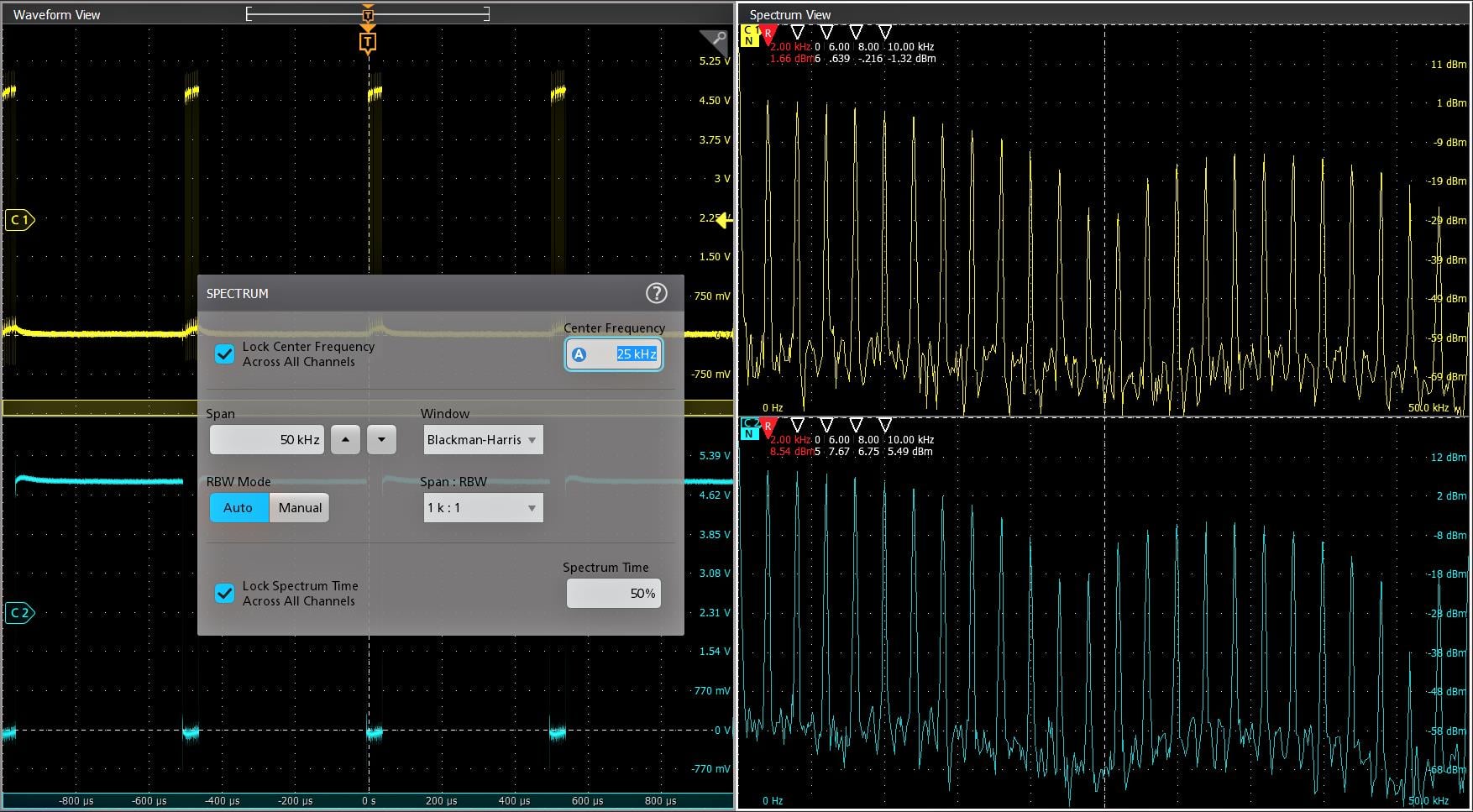
Intuitive spectrum analyzer controls like center frequency, span and resolution bandwidth (RBW), independent from time domain controls, provide easy setup for frequency domain analysis.
Up to 11 automated peak markers provide frequency and magnitude values of each peak. The Reference marker is always the highest peak shown and is indicated in red.
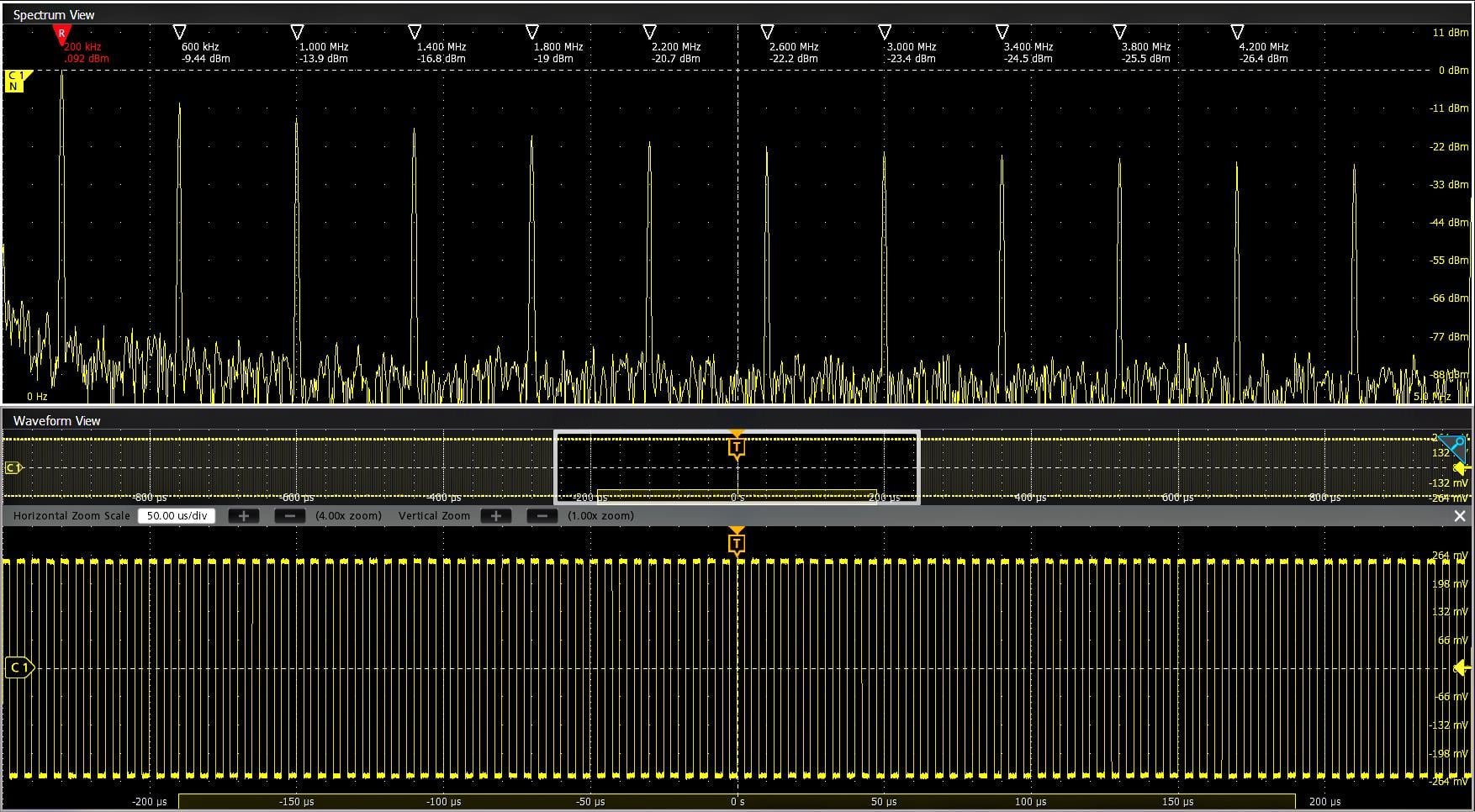
Spectrum Time gates the range of time where the FFT is being calculated. Represented by a small graphical rectangle in the time domain view, it can be positioned to provide time correlation with the time domain waveform. Perfect for conducting Mixed Domain Analysis.
Visualizing changes in the RF signal (optional)
RF time domain traces make it easy to understand what’s happening with a time-varying RF signal. There are three RF time domain traces that are derived from the underlying I and Q data of Spectrum View:
Magnitude – The instantaneous amplitude of the spectrum vs. time.
Frequency – The instantaneous frequency of the spectrum relative to the center frequency vs. time.
Phase – The instantaneous phase of the spectrum relative to the center frequency vs. time.
Each of these traces can be turned on and off independently, and all three can be displayed simultaneously.
The data is stored as in-phase and quadrature (I&Q) samples and precise synchronization is maintained between the time domain data and the I&Q data.
When RF vs. Time traces are activated, IQ data can be captured and exported to file for more advanced analysis within third-party applications.
With frequency on the x-axis, time on the y-axis, and power level indicated by variations in color, the Spectrogram display (included with option RFVT) offers enhanced insight into changes in signal amplitude and frequency content over time, allowing you to see where and when changes in spectral activity occur. This makes it ideal for displaying trends in spectral data such as when diagnosing complex spurious, frequency hopping, multi-channel, and dynamic signals.
Spectrogram benefits include:
Ability to view all spectrum activity in a given span and acquisition immediately, without having to specify FFT overlap or Spectrum Time
Quickly compare spectrum at different moments in time using time-correlated cursors and up to three overlaid spectrum traces
Pinch and zoom in on spectral activity of interest with display resolution and FFT overlap automatically optimized
Adjust center frequency, span, RBW, and amplitude color-scaling as needed to view all signals of interest
Simultaneously view trends in multi-channel or non-contiguous spectrum by activating spectrograms on each available oscilloscope channel and independently setting center frequency and amplitude scaling


Notice that the Spectrum Time is positioned during a transition from the lowest frequency to the middlefrequency, so the energy is spread across a number of frequencies. With the frequency vs. time trace, you can easily see the different frequency hops, simplifying characterization of how the device switches between frequencies.
Triggering on changes in the RF signal (optional)
Whether you need to find the source of electromagnetic interference or understand the behavior of a VCO, hardware triggers for RF versus time make it easy to isolate, capture, and understand the RF signal behavior. Trigger on edges, pulse widths, and timeout behavior of RF magnitude vs. time and RF frequency vs. time.
Power analysis (optional)
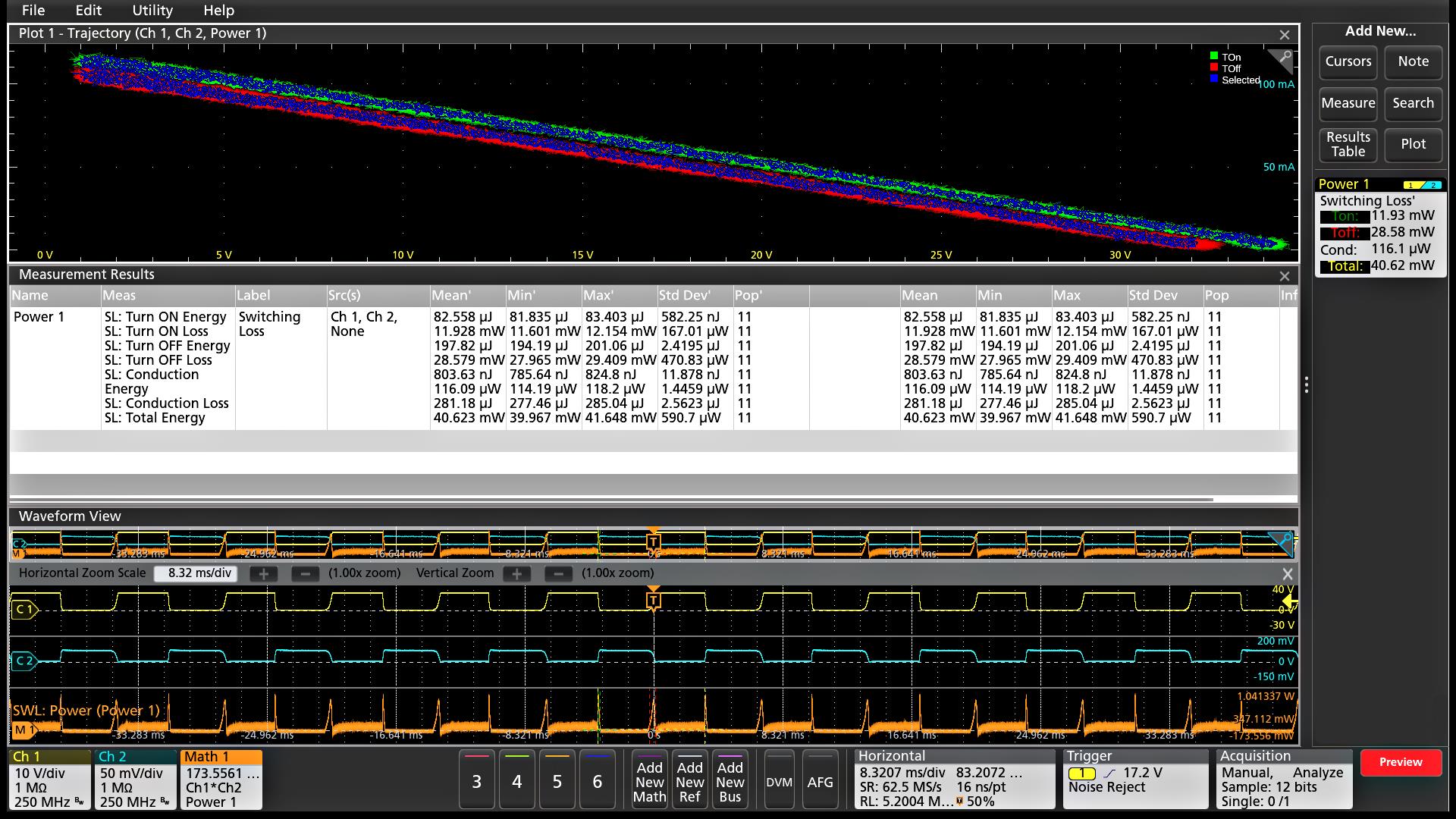
The 4 Series B MSO has also integrated the optional power analysis package into the oscilloscope automatic measurement system to enable quick and repeatable analysis of power quality, input capacitance, inrush current, harmonics, switching loss, safe operating area (SOA), modulation, ripple, efficiency, amplitude and timing measurements, and slew rate (dv/dt and di/dt).
Measurement automation optimizes the measurement quality and repeatability at the touch of a button, without the need for an external PC or complex software setup.
An optional advanced power analysis package provides all the measurements delivered by power analysis package plus Magnetic measurements, Control Loop Response (Bode Plot), and Power Supply Rejection Ratio (PSRR). See the ordering information section for more information.
Three-phase electrical analysis (optional)
Measurements and analysis of the three-phase power systems are inherently more complex than on the single-phase systems. Although oscilloscopes can capture voltage and current waveforms with high sample rates, further calculations are required to generate the key power measurements from the data. The oscilloscope based three-phase solution captures the three-phase voltage and current waveforms with the higher sample rates and longer record lengths using the High Res acquisition mode up to 16-bits. Also, the three-phase solution generates the key power test results with the support of automated measurements. The power converters based on the Pulse Width Modulation (PWM) can complicate measurements since it is very important to extract precise zero crossings for the PWM signals, thus making an oscilloscope a recommended test tool for validation and troubleshooting for designers.
The software is designed specially to automate the power analysis that simplifies the important three-phase power measurements on the PWM systems and helps the engineers to get faster insights into their designs. The three-phase analysis solution from Tektronix helps the engineer's design better and more efficient three-phase systems, taking full advantage of the advanced user interface, six analog input channels, and High Res mode (16 bits) on the instrument. The solution provides fast, accurate, and repeatable results for the supported electrical measurements. It can also be configured to measure DC to three-phase AC converters, such as those used in the electric vehicles.
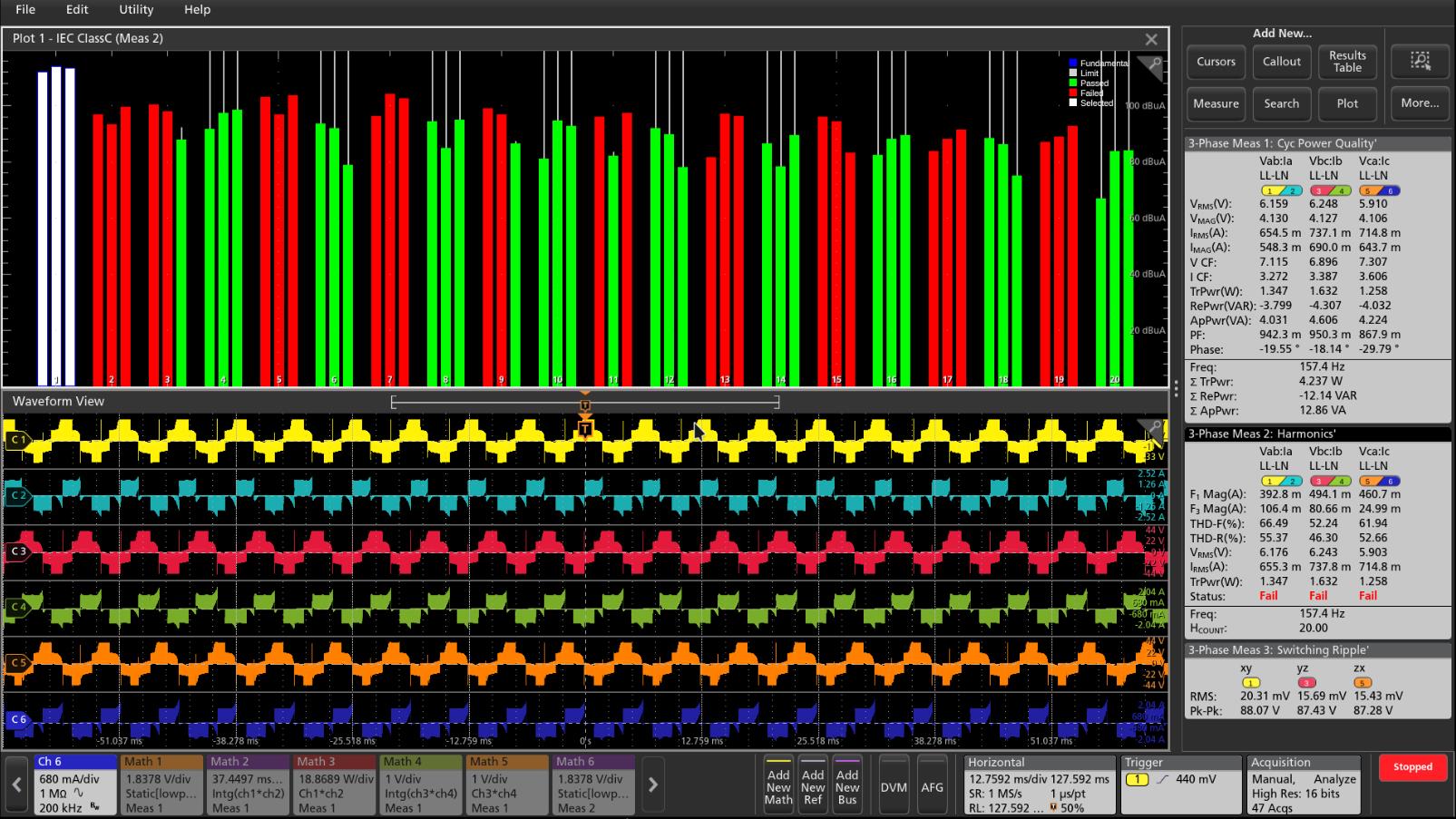
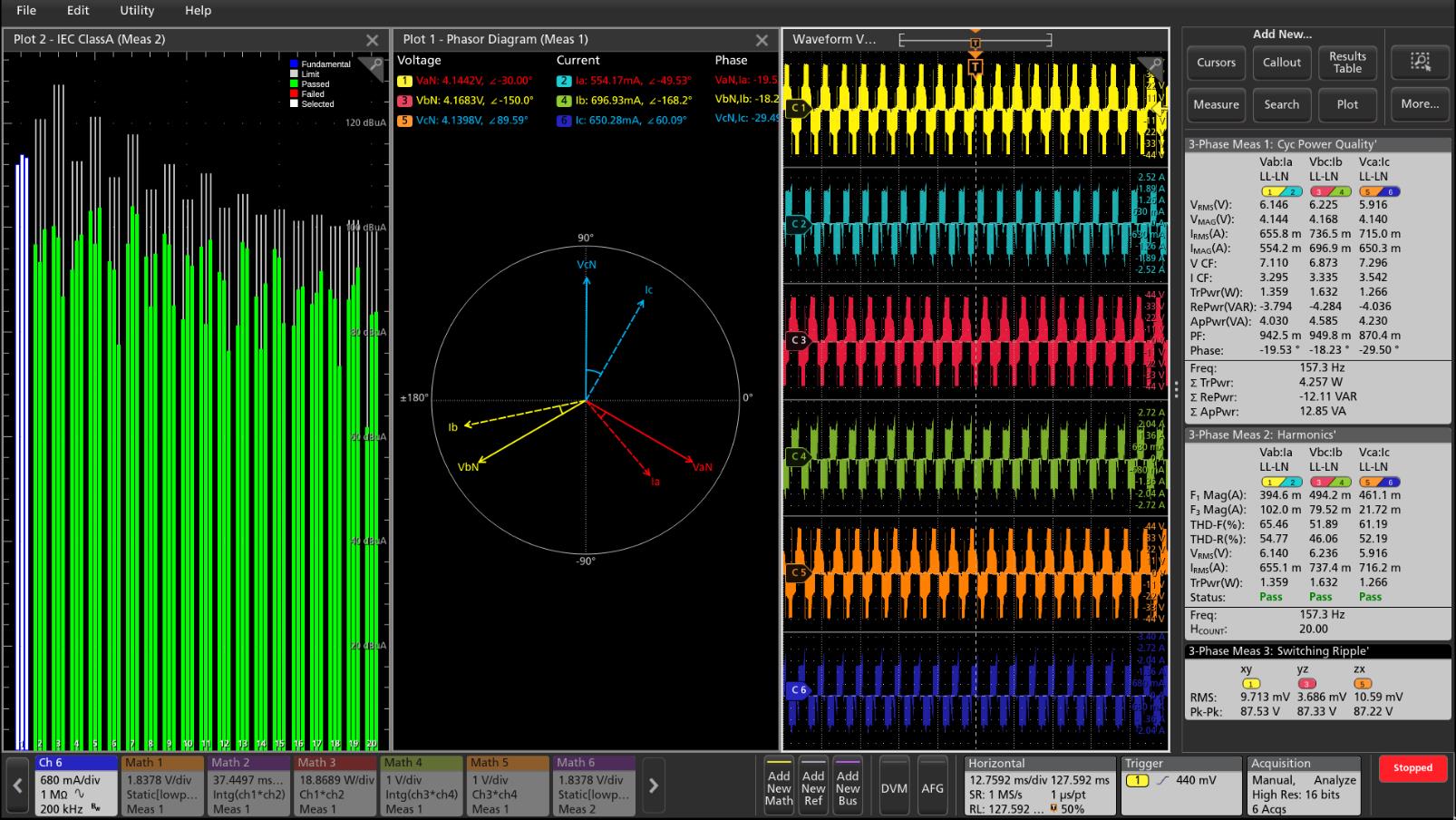
The harmonics plot indicates passing harmonics test results. Each set of bars contains results for phases A, B, and C for easy correlation. The set of green bars indicate a pass and the red bars indicate a fail.
Accurately analyze three-phase PWM signals.
Unique oscilloscope-based phasor diagrams indicate the VRMS, IRMS, VMAG, IMAG, and phase relationships at a glance for the configured wiring pairs.
Debug the three-phase designs by viewing the drive input / output voltage and current signals in the time domain simultaneously with the phasor diagram.
The Three-phase Autoset feature configures the oscilloscope for the optimal horizontal, vertical, trigger, and acquisition parameters for acquiring three-phase signals.
Measures three-phase harmonics as per the IEEE-519 standard or using custom limits.
Quickly add and configure measurements through the intuitive drag and drop interface on the 4 Series B MSO.
Analyze Inverter and automotive three-phase designs for DC-AC topology.
Displays the PWM filtered edge qualifier waveform during the analysis
Displays the test results per record, or per cycle mode during analysis for specific measurements.
Supports Time trend and Acquisition trend plots for specific measurements.
Supports mathematical conversion of Line-to-Line to Line-to-Neutral for specific wirings.
The three-phase analysis on the 4 Series B MSO automates key electrical measurements which are grouped into three categories:
Input analysis
Output analysis
Ripple analysis
Each of these sections includes key measurements that are critical to the three-phase applications.
Wide Bandgap Double Pulse Test (optional)
The Wide Bandgap Double Pulse Test application offers precise Wide Bandgap measurements that make device and the system validation easier. It has an ability to test SiC or GaN devices and also Si MOSFET and IGBTs. The application is compatible with all the Tektronix VPI probes and when used with the Tektronix IsoVu™ probes, it helps uncover all the hidden artifacts of SiC or GaN devices at the circuit level. The application offers automated measurements as per the JEDEC and IEC standards. It offers unique features such as per-cycle analysis with annotation, flexibility with custom reference level settings, configurable integration points, and power preset that can be set based on the DUT designs.
Following measurements are performed:
Low side switching parameters and High side diode reverse recovery measurements
Low side and High-side switching parameters
RDS(on) Dynamic Resistance
Parallel topology analysis
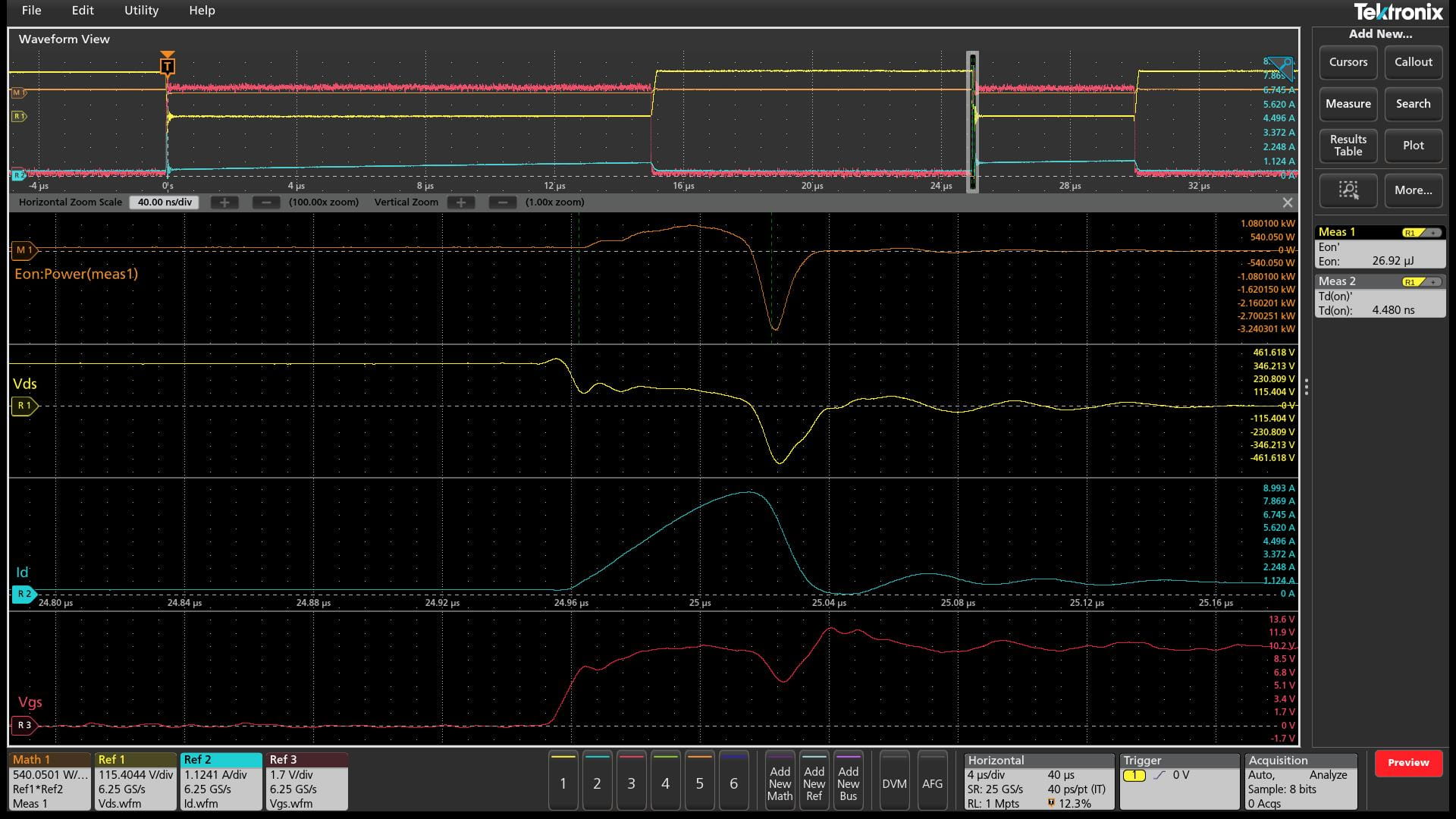
The image shows diode reverse recovery measurements with reverse recovery current and voltage captured on the high-side.
Connectivity
The 4 Series B MSO contains a number of ports which you can use to connect the instrument to a network, directly to a PC, or to other test equipment.
Three USB 2.0 ports on the front and two more USB 3.1 host ports on the rear panel enable easy transfer of screenshots, instrument settings, and waveform data to a USB mass storage device. A USB mouse and keyboard can also be attached to USB host ports for instrument control and data entry.
The rear panel USB Device port is useful for controlling the oscilloscope remotely from a PC.
The standard 10/100/1000BASE-T Ethernet port on the rear of the instrument enables easy connection to networks and provides LXI Core 2023 compatibility.
The HDMI port on the rear of the instrument let you duplicate the instrument display on an external monitor or projector with 1,920 x 1,080 resolution.
Remote operation to improve collaboration
Want to collaborate with a design team on the other side of the world?
Simply enter the IP address or network name of the oscilloscope and a web page will be served to the browser. Control the oscilloscope remotely in the exact same way that you do in-person using the built-in touchscreen.
The industry-standard TekVISA™ protocol interface is included for using and enhancing Windows applications for data analysis and documentation. IVI-COM instrument drivers are included to enable easy communication with the oscilloscope using LAN or USBTMC connections from an external PC.
PC-based analysis and remote connection to your oscilloscope
Get the analysis capability of an award-winning oscilloscope on your PC. Analyze waveforms anywhere, anytime. The basic license lets you view and analyze waveforms, perform many types of measurements and decode the most common serial buses - all while remotely accessing your oscilloscope. Advanced license options add capabilities such as multi-scope analysis, more serial bus decoding options, and power measurements.

TekScope PC analysis software runs on a Windows computer with the same award-winning user experience as the 4, 5, and 6 Series MSOs.
Key features of the TekScope PC analysis software include:
Connect to the instrument remotely and enable low-latency waveform updates using high-speed
TekHSI data transfers.Share the data remotely with your colleagues so that they can perform analysis and make measurements as if they were sitting in front of the oscilloscope
Synchronize waveforms from the multiple oscilloscopes in real-time
Perform advanced analysis even if your oscilloscope is not equipped with TekScope PC analysis software
Recall Tektronix oscilloscope sessions and waveform files from the equipment made by Tektronix and other vendors.
Waveform file formats supported include .wfm, .isf, .csv, .h5, .tr0, .trc, and .bin
TekDrive collaborative test and measurement workspace
Using TekDrive, you can upload, store, organize, search, download, and share any file type from any connected device. TekDrive is natively integrated into the instrument for seamless sharing and recalling of files - no USB stick is required. Analyze and explore standard files like .wfm, .isf, .tss, and .csv, directly in a browser with smooth interactive waveform viewers. TekDrive is purpose built for integration, automation, and security.
TekDrive collaborative workspace - save files directly from your instrument and share across your team.

Arbitrary Function Generator (AFG)
The instrument contains an optional integrated arbitrary/function generator, perfect for simulating sensor signals within a design or adding noise to signals to perform margin testing. The integrated function generator provides output of predefined waveforms up to 50 MHz for sine, square, pulse, ramp/triangle, DC, noise, sin(x)/x (Sinc), Gaussian, Lorentz, exponential rise/fall, Haversine, and cardiac. The AFG can load waveform records up to 128 k points in size from an internal file location or a USB mass storage device.
The AFG feature is compatible with Tektronix's ArbExpress PC-based waveform creation and editing software, making creation of complex waveforms fast and easy.
Digital Voltmeter (DVM) and Trigger Frequency Counter
The instrument contains an integrated 4-digit digital voltmeter (DVM) and 8-digit Trigger Frequency Counter. Any of the analog inputs can be a source for the voltmeter, using the same probes that are already attached for general oscilloscope usage. The Trigger Frequency Counter provides a very precise readout of the frequency of the trigger event on which you’re triggering.
Both the DVM and Trigger Frequency Counter are available for free and are activated when you register your product.
Built-in security controls
The 4 Series B MSO provides you with the option to protect company data through the Security menu. This includes the option to restrict access to the instrument by password-protecting remote network access, I/O ports, and firmware updates to ensure the security of the data. By default, the oscilloscope disables remote access on initial use and gives you the options to enable remote access with or without a password.
To clear user data, run TekSecure from the menu.

Help when you need it
Several helpful resources are included so you can get your questions answered rapidly without having to find a manual or go to a website:
Graphical images and explanatory text are used in numerous menus to provide quick feature overviews.
All menus include a question mark icon in the upper right that takes you directly to the portion of the integrated help system that applies to that menu.
A short user interface tutorial is included in the Help menu for new users to come up to speed on the instrument in a matter of a few minutes.
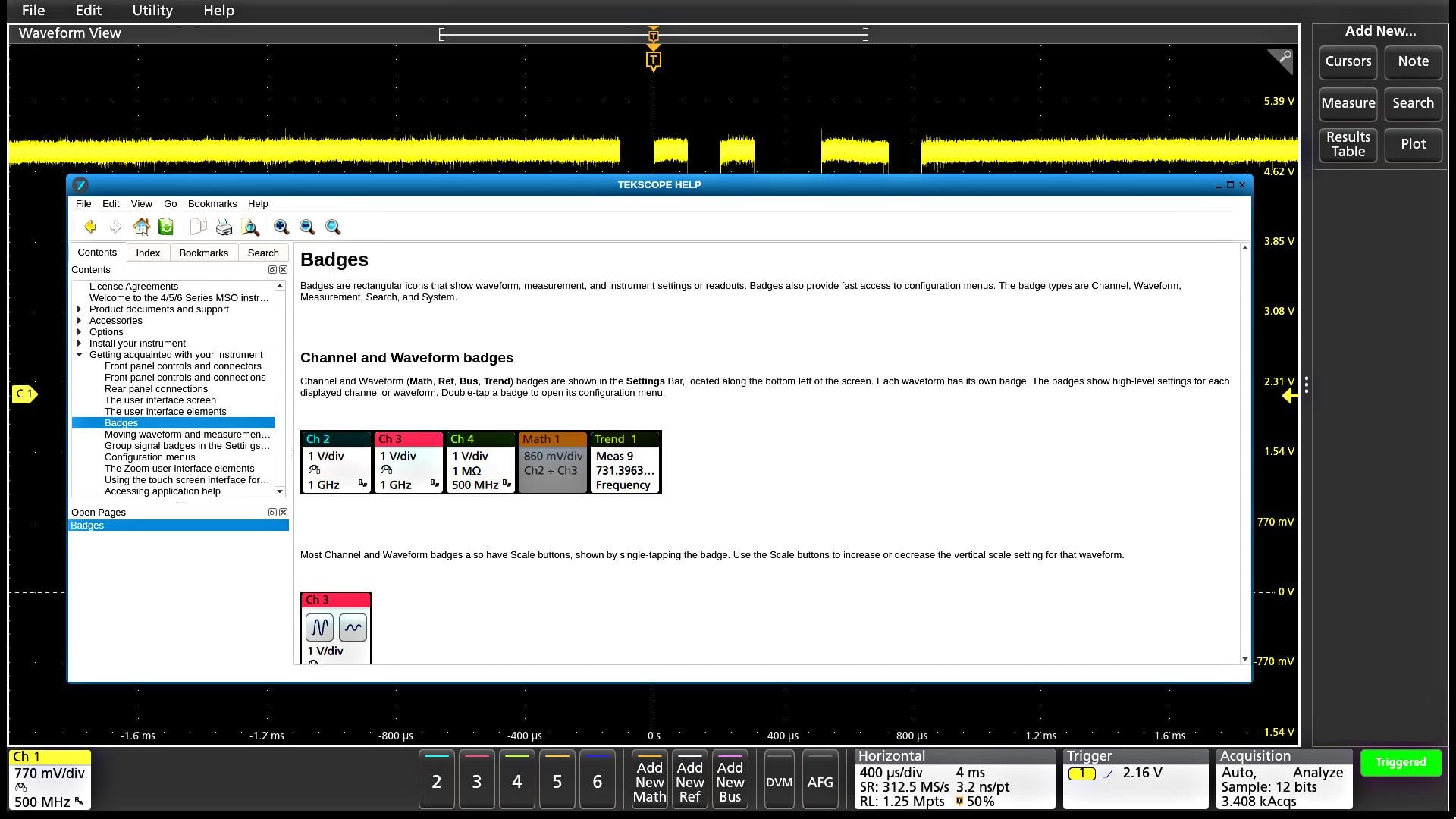
Integrated help answers your questions rapidly without having to find a manual or go to the internet.
Specifications
All specifications are guaranteed and apply to all models unless noted otherwise.
Model overview
Specification | 4 channel model | 6 channel model |
|---|---|---|
FlexChannel inputs | 4 | 6 |
Maximum analog channels | 4 | 6 |
Maximum digital channels (with optional logic probes) | 32 | 48 |
Auxiliary Trigger Input | ≤300 V | |
Bandwidth (calculated rise time) | 200 MHz (2.3 ns), 350 MHz (1.3 ns), 500 MHz (900 ps), 1 GHz (450 ps), 1.5 GHz (333 ps) | |
DC Gain Accuracy | 50 Ω: ±1.0%, (±2.5% at 1 mV/Div and 500 µV/Div settings), de-rated at 0.100%/°C above 30 °C | |
1 MΩ and 250 kΩ: ±1.0%, (±2.0% at 1 mV/Div and 500 µV/Div settings), de-rated at 0.100%/°C above 30 °C | ||
ADC Resolution | 12 bits | |
Vertical Resolution | 8 bits at 6.25 GS/s | |
12 bits at 3.125 GS/s | ||
13 bits at 1.25 GS/s (High Res) | ||
14 bits at 625 MS/s (High Res) | ||
15 bits at 250 MS/s (High Res) | ||
16 bits at ≤125 MS/s (High Res) | ||
Sample Rate | 6.25 GS/s on all analog / digital channels (160 ps resolution) | |
Record Length (std.) | 31.25 Mpoints on all analog / digital channels | |
Record Length (opt.) | 62.5 Mpoints on all analog / digital channels | |
Waveform Capture Rate, typical | >500,000 wfms/s | |
Arbitrary/Function Generator (opt.) | 13 predefined waveform types with up to 50 MHz output | |
DVM | 4-digit DVM (free with product registration) | |
Trigger Frequency Counter | 8-digit frequency counter (free with product registration) | |
NOTE: Warranted specification, immediately after SPC, add 2% for every 5 °C change in ambient temperature.
NOTE: Warranted specification, immediately after SPC, add 1% for every 5 °C change in ambient temperature. At full scale is sometimes used to compare to other manufacturers.
Vertical system, analog channels
Bandwidth selections
50 Ω: 20 MHz, 250 MHz, and the full bandwidth value of your model
1 MΩ: 20 MHz, 250 MHz, 500 MHz
Input coupling
DC, AC
Input impedance
50 Ω ±1%
1 MΩ ±1% with 13.0 pF ±1.5 pF
Input sensitivity range
1 MΩ 500 µV/div to 10 V/div in a 1-2-5 sequence
50 Ω 500 µV/div to 1 V/div in a 1-2-5 sequence
500 μV/div is a 2X digital zoom of 1 mV/div or a 4x digital zoom of 2 mV/div, depending on the instrument bandwidth configuration
Maximum input voltage
50 Ω: 5 VRMS, with peaks ≤ ±20 V (DF ≤ 6.25%)
1 MΩ: 300 VRMS
Derate at 20 dB/decade between 4.5 MHz and 45 MHz; derate 14 dB/decade between 45 MHz and 450 MHz. Above 450 MHz, 5.5 VRMS
Effective bits (ENOB), typical, high Res mode, 50 Ω, 10 MHzinput with 90% full screen
Bandwidth | ENOB |
1.5 GHz | 7.1 |
1 GHz | 7.6 |
500 MHz | 7.9 |
350 MHz | 8.2 |
250 MHz | 8.2 |
20 MHz | 8.9 |
Calculated rise time, typical
Model | 50 Ω | TP1000 Probe | TPP0500 Probe | TPP0250 Probe |
|---|---|---|---|---|
500 µV-1 V | 5 mV-10 V | 5 mV-10 V | 5 mV-10 V | |
1.5 GHz | 333ps | 450ps | 900ps | 1.8ns |
1 GHz | 450ps | 450ps | 900ps | 1.8ns |
500 MHz | 900ps | 900ps | 900ps | 1.8ns |
350 MHz | 1.3ns | 1.3ns | 1.3ns | 1.8ns |
200 MHz | 2.3ns | 2.3ns | 2.3ns | 2.3ns |
Random noise, RMS, typical
All models except 1.5 GHz, High Res mode (RMS), 50 Ω, typical
V/div | 1 GHz | 500 MHz | 350 MHz | 250/200 MHz | 20 MHz |
|---|---|---|---|---|---|
1 mV/div | 280 μV | 210 μV | 150 μV | 125 μV | 75 μV |
2 mV/div | 280 μV | 210 μV | 150 μV | 125 μV | 75 μV |
5 mV/div | 300 μV | 230 μV | 185 μV | 135 μV | 75 μV |
10 mV/div | 330 μV | 260 μV | 220 μV | 160 μV | 80 μV |
20 mV/div | 420 μV | 350 μV | 270 μV | 230 μV | 110 μV |
50 mV/div | 800 μV | 780 μV | 570 μV | 460 μV | 200 μV |
100 mV/div | 1.65 mV | 1.29 mV | 1.04 mV | 1.04 mV | 480 μV |
1 V/div | 13.0 mV | 10.0 mV | 8.95 mV | 8.95 mV | 3.78 mV |
All models, High Res mode (RMS), 1 MΩ, typical
V/div | 500 MHz | 350 MHz | 250/200 MHz | 20 MHz |
|---|---|---|---|---|
1 mV/div | 200 μV | 150 μV | 120 μV | 70 μV |
2 mV/div | 210 μV | 150 μV | 120 μV | 70 μV |
5 mV/div | 220 μV | 160 μV | 130 μV | 70 μV |
10 mV/div | 230 μV | 170 μV | 150 μV | 75 μV |
20 mV/div | 300 μV | 230 μV | 220 μV | 100 μV |
50 mV/div | 550 μV | 450 μV | 450 μV | 200 μV |
100 mV/div | 1.35 mV | 1.00 mV | 1.03 mV | 480 μV |
1 V/div | 15.0 mV | 11.5 mV | 11.5 mV | 5.80 mV |
±5 divisions
±(0.010 X | offset - position | + DC balance)
DC Balance is 0.2 div (0.4 div in 500 μV/div)
≥ 200:1 up to the rated bandwidth for any two channels having equal Volts/div settings
All models
Input signal cannot exceed maximum input voltage for the 50 Ω input path.
Volts/div Setting | Maximum offset range, 50 Ω Input |
500 µV/div - 99 mV/div | ±1 V |
100 mV/div - 1 V/div | ±10 V |
Volts/div Setting | Maximum offset range, 1 MΩ Input |
500 µV/div - 63 mV/div | ±1 V |
64 mV/div - 999 mV/div | ±10 V |
1 V/div - 10 V/div | ±100 V |
Position range
±5 divisions
Offset accuracy
±(0.010 X | offset - position | + DC balance)
DC Balance is 0.2 div (0.4 div in 500 μV/div)
Crosstalk (channel isolation),typical
≥ 200:1 up to the rated bandwidth for any two channels having equal Volts/div settings
Vertical system, digital channels
Number of channels
8 digital inputs (D7-D0) per installed TLP058 (traded off for one analog channel)
Vertical resolution
1 bit
Minimum detectable pulse width, typical
1 ns
Thresholds
One threshold per digital channel
Threshold range
±40 V
Threshold resolution
10 mV
Threshold accuracy
±[100 mV + 3% of threshold setting after calibration]
Input hysteresis, typical
100 mV at the probe tip
Input dynamic range, typical
30 Vpp for Fin ≤ 200 MHz, 10 Vpp for Fin >200 MHz
Absolute maximum input voltage,typical
42 V peak
Minimum voltage swing, typical
400 mV peak-to-peak
Input impedance, typical
100 kΩ
Probe loading, typical
2 pF
Horizontal system
Time base range
200 ps/div to 1,000 s/div
Sample rate range
1.5625 S/s to 6.25 GS/s (real time)
12.5 GS/s to 500 GS/s (interpolated)
Record length range
Standard: 1 kpoints to 31.25 Mpoints in single sample incrementsOptional: 62.5 Mpoints
Aperture uncertainty
≤ 800 fs + (10-11 * Measurement Duration) RMS, for measurements having duration ≤ 100 ms
Timebase accuracy
±2.5 x 10⁻⁶ over any ≥1 ms time interval
Description | Specification |
|---|---|
Factory Tolerance | ±12 ppb; at calibration, 25 °C ambient, over any ≥1 ms interval |
Temperature stability | ±20 ppb across the full operating range of 0 °C to 50 °C, after a sufficient soak time at the temperature; tested at operating temperatures |
Crystal aging | ±300 ppb; frequency tolerance change at 25 °C over a period of 1 year |
Delta-time measurement accuracy, nominal
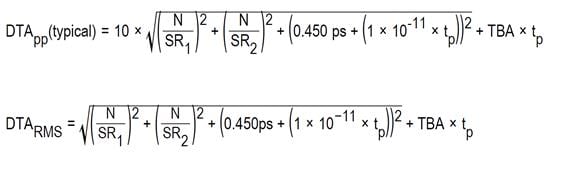
The formula to calculate delta-time measurement accuracy (DTA) for a given instrument setting and input signal assumes insignificant signal content above Nyquist frequency, where:
SR
SR
N = input-referred guaranteed noise limit (V
TBA = time-base accuracy or reference frequency error
t
Maximum duration at highest sample rate
5 ms (std.) or 10 ms (opt.)
Time base delay time range
-10 divisions to 5,000 s
Deskew range
-125 ns to +125 ns with a resolution of 40 ps (for Peak Detect and Envelope acquisition modes). -125 ns to +125 ns with a resolution of 1 ps (for all other acquisition modes).
Delay between analog channels, full bandwidth, typical
≤ 100 ps for any two channels with input impedance set to 50 Ω, DC coupling with equal Volts/div or above 10 mV/div
Delay between analog and digital FlexChannels, typical
3 ns when using a TLP058 and a passive probe matching the bandwidth of the scope, with no bandwidth limits applied
Delay between any two digital FlexChannels, typical
3 ns from bit 0 of a FlexChannel to bit 0 of any other FlexChannel
Delay between any two bits of a digital FlexChannel, typical
160 ps
≤ 800 fs + (10
Trigger system
Trigger modes
Auto, Normal, and Single
Trigger coupling
DC, HF Reject (attenuates > 50 kHz), LF Reject (attenuates < 50 kHz), noise reject (reduces sensitivity)
Trigger holdoff range
0 ns to 20 seconds
Edge-type trigger sensitivity, DC coupled, typical
Path | Range | Specification |
1 MΩ path (all models) | 0.5 mV/div to 0.99 mV/div | 4.5 div from DC to instrument bandwidth |
≥ 1 mV/div | The greater of 5 mV or 0.7 div | |
50 Ω path, all models | The greater of 5.6 mV or 0.7 div for frequencies between DC and 500 MHz or the instrument bandwidth (whichever is lower) | |
The greater of 7 mV or 0.8 div for frequencies above 500 MHz (if applicable) |
Trigger jitter, typical
≤ 7 psRMS for sample mode and edge-type trigger
Trigger level ranges
This specification applies to logic and pulse thresholds.
Source | Range |
|---|---|
Any Channel | ±5 divs from center of screen |
Aux In Trigger | ±5 V |
Line | Fixed at about 50% of line voltage |
Trigger types
Trigger type | Description |
|---|---|
Edge | Positive, negative, or either slope on any channel. Coupling includes DC, AC, noise reject, HF reject, and LF reject |
Pulse Width | Trigger on width of positive or negative pulses. Event can be time- or logic-qualified |
Timeout | Trigger on an event which remains high, low, or either, for a specified time period. Event can be logic-qualified |
Runt | Trigger on a pulse that crosses one threshold but fails to cross a second threshold before crossing the first again. Event can be time- or logic-qualified |
Window | Trigger on an event that enters, exits, stays inside or stays outside of a window defined by two user-adjustable thresholds. Event can be time- or logic-qualified |
Logic | Trigger when logic pattern goes true, goes false, or occurs coincident with a clock edge. Pattern (AND, OR, NAND, NOR) specified for all input channels defined as high, low, or don't care. Logic pattern going true can be time-qualified |
Setup and Hold | Trigger on violations of both setup time and hold time between clock and data present on any input channels |
Video | Trigger on all lines, odd, even, or all fields of NTSC, PAL, and SECAM video signals |
Rise/Fall Time | Trigger on pulse edge rates that are faster or slower than specified. Slope may be positive, negative, or either. Event can be logic-qualified |
Sequence | Trigger on B event X time or N events after A trigger with a reset on C event. In general, A and B trigger events can be set to any trigger type with a few exceptions: logic qualification is not supported, if A event or B event is set to Setup and Hold, then the other must be set to Edge, and Ethernet and High Speed USB (480 Mbps) are not supported. |
Visual trigger | Qualifies standard triggers by scanning all waveform acquisitions and comparing them to on-screen areas (geometric shapes). An unlimited number of areas can be defined with In, Out, or Don't Care as the qualifier for each area. A boolean expression can be defined using any combination of visual trigger areas to further qualify the events that get stored into acquisition memory. Shapes include rectangle, triangle, trapezoid, hexagon and user-defined. |
Parallel Bus | Trigger on a parallel bus data value. Parallel bus can be from 1 to 32 bits (from the digital and analog channels) in size. Supports Binary and Hex radices |
I | Trigger on Start, Repeated Start, Stop, Address (7 or 10 bit), Data, or Address and Data on I |
I | Trigger on Start, Repeated Start, Stop, Address, Data, I |
SPI Bus (option 4-SREMBD) | Trigger on Slave Select, Idle Time, or Data (1-16 words) on SPI buses up to 20 Mb/s |
RS-232/422/485/UART Bus (option 4-SRCOMP) | Trigger on Start Bit, End of Packet, Data, and Parity Error up to 15 Mb/s |
CAN Bus (option 4-SRAUTO) | Trigger on Start of Frame, Type of Frame (Data, Remote, Error, or Overload), Identifier, Data, Identifier and Data, End Of Frame, Missing Ack, and Bit Stuff Error on CAN buses up to 1 Mb/s. |
CAN FD Bus (option 4-SRAUTO) | Trigger on Start of Frame, Type of Frame (Data, Remote, Error, or Overload), Identifier (Standard or Extended), Data (1-8 bytes), Identifier and Data, End Of Frame, Error (Missing Ack, Bit Stuffing Error, FD Form Error, Any Error) on CAN FD buses up to 16 Mb/s. |
LIN Bus (option 4-SRAUTO) | Trigger on Sync, Identifier, Data, Identifier and Data, Wakeup Frame, Sleep Frame, and Error on LIN buses up to 1 Mb/s. |
FlexRay Bus (option 4-SRAUTO) | Trigger on Start of Frame, Indicator Bits (Normal, Payload, Null, Sync, Startup), Frame ID, Cycle Count, Header Fields (Indicator Bits, Identifier, Payload Length, Header CRC, and Cycle Count), Identifier, Data, Identifier and Data, End Of Frame, and Errors on FlexRay buses up to 10 Mb/s. |
SENT Bus (option 4-SRAUTOSEN) | Trigger on Start of Packet, Fast Channel Status and Data, Slow Channel Message ID and Data, and CRC Errors |
SPMI Bus (option 4-SRPM) | Trigger on Sequence Start Condition, Reset, Sleep, Shutdown, Wakeup, Authenticate, Master Read, Master Write, Register Read, Register Write, Extended Register Read, Extended Register Write, Extended Register Read Long, Extended Register Write Long, Device Descriptor Block Master Read, Device Descriptor Block Slave Read, Register 0 Write, Transfer Bus Ownership, and Parity Error |
USB 2.0 LS/FS/HS Bus (option 4-SRUSB2) | Trigger on Sync, Reset, Suspend, Resume, End of Packet, Token (Address) Packet, Data Packet, Handshake Packet, Special Packet, Error on USB buses up to 480 Mb/s |
Ethernet Bus (option 4-SRENET) | Trigger on Start of Frame, MAC Addresses, MAC Q-tag, MAC Length/Type, MAC Data, IP Header, TCP Header, TCP/IPV4 Data, End of Packet, and FCS (CRC) Error on 10BASE-T and 100BASE-TX buses |
Audio (I | Trigger on Word Select, Frame Sync, or Data. Maximum data rate for I |
MIL-STD-1553 Bus (option 4-SRAERO) | Trigger on Sync, Command (Transmit/Receive Bit, Parity, Subaddress / Mode, Word Count / Mode Count, RT Address), Status (Parity, Message Error, Instrumentation, Service Request, Broadcast Command Received, Busy, Subsystem Flag, Dynamic Bus Control Acceptance, Terminal Flag), Data, Time (RT/IMG), and Error (Parity Error, Sync Error, Manchester Error, Non-contiguous Data) on MIL-STD-1553 buses |
ARINC 429 Bus (option 4-SRAERO) | Trigger on Word Start, Label, Data, Label and Data, Word End, and Error (Any Error, Parity Error, Word Error, Gap Error) on ARINC 429 buses up to 1 Mb/s |
RF Magnitude vs. Time and RF Frequency vs. Time (option 4-SV-RFVT): | Trigger on edge, pulse width and timeout events |
Acquisition system
Sample
Acquires sampled values
Peak Detect
Captures glitches as narrow as 160 ps at all sweep speeds
Averaging
From 2 to 10,240 waveforms
Fast Hardware Averaging
An acquisition mode for acquiring a large number of averages in a short amount of time. Fast hardware averaging optimizes the acquisition path, reducing storage truncation error and smoothing out fine scale non-linearity imperfections via an optional offset dithering technique. This feature is available through programmatic interface commands.
From 2 to 1,000,000 waveforms
Maximum averaging speed = 32,000 waveforms/s
Envelope
Min-max envelope reflecting Peak Detect data over multiple acquisitions
High Res
Applies a unique Finite Impulse Response (FIR) filter for each sample rate that maintains the maximum bandwidth possible for that sample rate while preventing aliasing and removing noise from the oscilloscope amplifiers and ADC above the usable bandwidth for the selected sample rate.
High Res mode always provides at least 12 bits of vertical resolution and extends all the way to 16 bits of vertical resolution at ≤ 125 MS/s sample rates.
FastAcq
FastAcq® optimizes the instrument for analysis of dynamic signals and capture of infrequent events by capturing >500,000wfms/s (one channel active; >100K wfms/s with all channels active).
Roll mode
Scrolls sequential waveform points across the display in a right-to-left rolling motion, at timebase speeds of 40 ms/div and slower, when in Auto trigger mode.
History mode
Makes use of the maximum record length, allowing you to capture many triggered acquisitions, stop when you see something of interest, and quickly review all stored triggered acquisitions.
The number of available acquisitions stored in history is (Maximum record length) / (Current record length setting).
FastFrame™
Acquisition memory divided into segments.
5,000,000 waveforms per second
Minimum frame size = 50 points
Maximum Number of Frames: For frame size ≥ 1,000 points, maximum number of frames = record length / frame size.
For 50 point frames, maximum number of frames = 1,500,000
Waveform measurements
Cursor types
Waveform, V Bars, H Bars, V&H Bars, and Polar (XY/XYZ plots only)
DC voltage measurement accuracy, Average acquisition mode
Measurement Type | DC Accuracy (In Volts) |
|---|---|
Average of ≥ 16 waveforms | ±(DC Gain Accuracy * |reading - (offset - position)| + Offset Accuracy + 0.15 div + 0.6 mV) |
Delta volts between any two averages of ≥ 16 waveforms acquired with the same oscilloscope setup and ambient conditions | ±(DC Gain Accuracy * |reading| + 0.15 div + 1.2 mV) |
Automatic measurements
36, of which an unlimited number can be displayed as either individual measurement badges or collectively in a measurement results table
Amplitude measurements
Amplitude, Maximum, Minimum, Peak-to-Peak, Positive Overshoot, Negative Overshoot, Mean, RMS, AC RMS, Top, Base, and Area
Timing measurements
Period, Frequency, Unit Interval, Data Rate, Positive Pulse Width, Negative Pulse Width, Skew, Delay, Rise Time, Fall Time, Phase, Rising Slew Rate, Falling Slew Rate, Burst Width, Positive Duty Cycle, Negative Duty Cycle, Time Outside Level, Setup Time, Hold Time, Duration N-Periods, High Time, Low Time, Time to Minimum, and Time to Maximum
Measurement statistics
Mean, Standard Deviation, Maximum, Minimum, and Population. Statistics are available on both the current acquisition and all acquisitions
Reference levels
User-definable reference levels for automatic measurements can be specified in either percent or units. Reference levels can be set to global for all measurements, per source channel or signal, or unique for each measurement
Gating
Screen, Cursors, Logic, Search, or Time. Specifies the region of an acquisition in which to take measurements. Gating can be set to Global (affects all measurements set to Global) or Local (all measurements can have a unique Time gate setting; only one Local gate is available for Screen, Cursors, Logic, and Search actions).
Measurement plots
Histogram, Time Trend, Spectrum, Eye Diagram (TIE measurement only), Phase Noise (Phase Noise measurement only)
Measurement limits
Pass/fail testing for user-definable limits on measurement values. Actions for measurement value failures include Save Screen Capture, Save Waveform, System Request (SRQ), and Stop Acquisitions
Three-phase electrical analysis (option 4-3PHASE) adds the following:
Measurements
Input Analysis (Power Quality, Harmonics, Input Voltage, Input Current, Input Power)
Ripple analysis (Line ripple, Switching Ripple)
Output analysis (Phasor Diagram)
Measurement plots
Harmonics Bar Graph, Phasor Diagram
Power analysis (option 4-PWR-BAS) and advanced power analysis (option 4-PWR) adds the following:
Measurements
Input Analysis (Frequency, V
RMS , IRMS , voltage and current Crest Factors, True Power, Apparent Power, Reactive Power, Power Factor, Phase Angle, Harmonics, Inrush Current, Input Capacitance )Amplitude Analysis (Cycle Amplitude, Cycle Top, Cycle Base, Cycle Maximum, Cycle Minimum, Cycle Peak-to-Peak)
Timing Analysis (Period, Frequency, Negative Duty Cycle, Positive Duty Cycle, Negative Pulse Width, Positive Pulse Width)
Switching Analysis (Switching Loss, dv/dt, di/dt, Safe Operating Area, R
DSon )Output Analysis (Line Ripple, Switching Ripple, Efficiency, Turn-on Time, Turn-off Time)
Magnetic Analysis (Inductance, I vs. Intg(V), Magnetic Loss, Magnetic Property)
Frequency Response Analysis (Control Loop Response Bode Plot, Power Supply Rejection Ratio, Impedance)
Measurement Plots
Harmonics Bar Graph, Switching Loss Trajectory Plot, and Safe Operating Area
Measurement limits
Pass/fail testing for user-definable limits on measurement values. Actions for measurement value failures include Save Screen Capture, Save Waveform, System Request (SRQ), and Stop Acquisitions
Waveform math
Number of math waveforms
Unlimited
Arithmetic
Add, subtract, multiply, and divide waveforms and scalars
Algebraic expressions
Define extensive algebraic expressions including waveforms, scalars, user-adjustable variables, and results of parametric measurements. Perform math on math using complex equations. For example (Integral (CH1 - Mean(CH1)) X 1.414 X VAR1)
Math functions
Invert, Integrate, Differentiate, Square Root, Exponential, Log 10, Log e, Abs, Ceiling, Floor, Min, Max, Degrees, Radians, Sin, Cos, Tan, ASin, ACos, and ATan
Relational
Boolean result of comparison >, <, ≥, ≤, =, and ≠
Logic
AND, OR, NAND, NOR, XOR, and EQV
Filtering function (standard)
Loading of user-definable filters. Users specify a file containing the coefficients of the filter.
FFT functions
Spectral Magnitude and Phase, and Real and Imaginary Spectra
FFT vertical units
Magnitude: Linear and Log (dBm)
Phase: Degrees, Radians, and Group Delay
FFT window functions
Hanning, Rectangular, Hamming, Blackman-Harris, Flattop2, Gaussian, Kaiser-Bessel, and TekExp
Spectrum View
Center Frequency
Limited by instrument analog bandwidth
Span
18.6 Hz to 200 MHz (200 MHz model)
18.6 Hz to 312.5 MHz (350 MHz, 500MHz, 1 GHz, 1.5 GHz model)
18.6 Hz to 500 MHz (500MHz, 1GHz, 1.5GHz model with option 4-SV-BW-1)
RF Measurements
Channel Power (CHP), Adjacent Channel Power Ratio (ACPR), and Occupied Bandwidth (OBW) measurements on Spectrum View trace data and display
RF vs. Time Traces
Magnitude vs. time, Frequency vs. time, Phase vs. time (with option 4-SV-RFVT)
RF vs. Time Trigger
Edge, pulse width, and timeout trigger on RF Magnitude vs. Time and RF Frequency vs. Time (with option 4-SV-RFVT)
Spectrograms
RF Frequency vs. Time vs. Amplitude display with frequency on x-axis, time on y-axis, and power level indicated by variations in color (with option 4-SV-RFVT)
Resolution Bandwidth (RBW)
93 μHz to 10MHz (200 MHz model) or 15.625 MHz (all other models)
93 μHz to 25 MHz (with option 4-SV-BW-1 for 500 MHz, 1GHz, 1.5GHz models)
IQ capture
The data is stored as in-phase and quadrature (I&Q) samples and precise synchronization is maintained between the time domain data and the I&Q data.
When RF vs. Time traces are activated (with option 4-SV-RFVT), IQ data can be captured and exported to file for more analysis within third-party applications.
The maximum acquisition time varies with span and sample rate. At 25 GS/s and 2 GHz span, the maximum acquisition time is 0.086 seconds. For 1 GHz span, the maximum acquisition time is 0.172 seconds. For 40 MHz span, the maximum acquisition time is 2.749 seconds. For 1 MHz span, the maximum acquisition time is 87.961 seconds.
The max acquisition time varies with span and sample rate. At 6.25 GS/s and 500 MHz span, the max acquisition time is 0.021 seconds. For 312.5 MHz span, the max acquisition time is 0.043 seconds. For 40 MHz span, the max acquisition time is 0.172 seconds. For 1 MHz span, the max acquisition time is 10.995 seconds.
Window types and factors
Window type | Factor |
|---|---|
Blackman-Harris | 1.90 |
Flat-Top 2 | 3.77 |
Hamming | 1.30 |
Hanning | 1.44 |
Kaiser-Bessel | 2.23 |
Rectangular | 0.89 |
Spectrum Time
FFT Window Factor / RBW
Reference level
Reference level is automatically set by the analog channel Volts/div setting
Setting range: -42 dBm to +44 dBm
Vertical Position
-100 divs to +100 divs
Vertical units
dBm, dBµW, dBmV, dBµV, dBmA, dBµA
Vertical scalings
Linear, Log
Horizontal scaling
Linear, Log
Multi-channel spectrum analysis
Each FlexChannel input can be configured with Spectrum View, RF vs. Time traces (with option RFVT), and Spectrogram (with option RFVT).
Multiple RF measurements can be performed simultaneously across channels.
Spectrum Time and Center Frequency settings can be unlocked and moved independently from each other across channels. All Spectrum View channels must share the same Span, Resolution Bandwidth and Window Type.
Search
Number of searches
Unlimited
Search types
Search through long records to find all occurrences of user specified criteria including edges, pulse widths, timeouts, runt pulses, window violations, logic patterns, setup and hold violations, rise/fall times, and bus protocol events. Search results can be viewed in the Waveform View or in the Results table.
Number of searches
Unlimited
Search types
Search through long records to find all occurrences of user specified criteria including edges, pulse widths, timeouts, runt pulses, window violations, logic patterns, setup and hold violations, rise/fall times, and bus protocol events. Search results can be viewed in the Waveform View or in the Results table.
Save
Save
Save files directly to the oscilloscope or USB media, to a remote network drive, or to your TekDrive collaboration workspace.
Waveform type
Tektronix Waveform Data (.wfm), Comma Separated Values (.csv), MATLAB (.mat)
Waveform gating
Cursors, Screen, Resample (save every nth sample)
Screen capture type
Portable Network Graphic (*.png), 24-bit Bitmap (*.bmp), JPEG (*.jpg)
Setup type
Tektronix Setup (.set)
Report type
Adobe Portable Documents (.pdf), Single File web Pages (.mht)
Session type
Tektronix Session Setup (.tss)
Display
Display type
13.3 in. (338 mm) optically-bonded LCD display
Display resolution
1,920 horizontal × 1,080 vertical pixels
Display modes
Overlay: traditional oscilloscope display where traces overlay each other
Stacked: display mode where each waveform is placed in its own slice and can take advantage of the full ADC range while still being visually separated from other waveforms. Groups of channels can also be overlaid within a slice to simplify visual comparison of signals.
Zoom
Horizontal and vertical zooming is supported in all waveform and plot views.
Interpolation
Sin(x)/x and Linear
Waveform styles
Vectors, dots, variable persistence, and infinite persistence
Graticules
Movable and fixed graticules, selectable between Grid, Time, Full, and None
Color palettes
Normal and inverted for screen captures
Individual waveform colors are user-selectable
Format
YT, XY, and XYZ
Local Language User Interface
English, Japanese, Simplified Chinese, Traditional Chinese, French, German, Italian, Spanish, Portuguese, Russian, Korean
Local Language Help
English, Japanese, Simplified Chinese
Arbitrary function generator (optional)
Function types
Arbitrary, sine, square, pulse, ramp, triangle, DC level, Gaussian, Lorentz, exponential rise/fall, sin(x)/x, random noise, Haversine, Cardiac
Sine waveform
Frequency range: 0.1 Hz to 50 MHzFrequency setting resolution: 0.1 HzFrequency accuracy: 130 ppm (frequency ≤ 10 kHz), 50 ppm (frequency > 10 kHz). This is for Sine, Ramp, Square and Pulse waveforms only.Amplitude range: 20 mVpp to 5 Vpp into Hi-Z; 10 mVpp to 2.5 Vpp into 50 ΩAmplitude flatness, typical: ±1.0 dB at 1 kHz, ±1.5 dB at 1 kHz for < 20 mVpp amplitudesTotal harmonic distortion, typical: 1.5% for amplitude ≥ 200 mVpp into 50 Ω load, 3.5% for amplitude > 50 mV AND < 200 mVpp into 50 Ω load. This is for Sine wave only.Spurious free dynamic range, typical: 35 dB (Vpp ≥ 0.2 V), 50 Ω load
Square and pulse waveform
Frequency range: 0.1 Hz to 25 MHzFrequency setting resolution : 0.1 HzFrequency accuracy: 130 ppm (frequency ≤ 10 kHz), 50 ppm (frequency > 10 kHz)Amplitude range: 20 mVpp to 5 Vpp into Hi-Z; 10 mVpp to 2.5 Vpp into 50 ΩDuty cycle range: 10% - 90% or 10 ns minimum pulse, whichever is larger. Minimum pulse time applies to both on and off time, so maximum duty cycle will reduce at higher frequencies to maintain 10 ns off time.Duty cycle resolution: 0.1%Minimum pulse width, typical: 10 ns. This is the minimum time for either on or off duration.Rise/Fall time, typical: 6 ns, 10% - 90%Pulse width resolution: 100 psOvershoot, typical: < 6% for signal steps greater than 100 mVpp. This applies to overshoot of the positive-going transition (+overshoot) and of the negative-going (-overshoot) transition.Asymmetry, typical: ±1% ±5 ns, at 50% duty cycleJitter, typical: < 60 ps TIERMS , ≥ 100 mVpp amplitude, 40% to 60% duty cycle
Ramp and triangle waveform
Frequency range: 0.1 Hz to 500 kHzFrequency setting resolution: 0.1 HzFrequency accuracy: 130 ppm (frequency ≤ 10 kHz), 50 ppm (frequency > 10 kHz)Amplitude range: 20 mVpp to 5 Vpp into Hi-Z; 10 mVpp to 2.5 Vpp into 50 ΩVariable symmetry: 0% - 100%Symmetry resolution: 0.1%DC level range: ±2.5 V into Hi-Z, ±1.25 V into 50 ΩRandom noise amplitude range: 20 mVpp to 5 Vpp into Hi-Z, 10 mVpp to 2.5 Vpp into 50 Ω
Sin(x)/x
Maximum frequency: 2 MHz
Gaussian pulse, Haversine, and Lorentz pulse
Maximum frequency: 5 MHz
Lorentz pulse
Frequency range: 0.1 Hz to 5 MHzAmplitude range: 20 mVpp to 2.4 Vpp into Hi-Z, 10 mVpp to 1.2 Vpp into 50 Ω
Cardiac
Frequency range: 0.1 Hz to 500 kHzAmplitude range: 20 mVpp to 5 Vpp into Hi-Z, 10 mVpp to 2.5 Vpp into 50 Ω
Arbitrary
Memory depth: 1 to 128 kAmplitude range: 20 mVpp to 5 Vpp into Hi-Z, 10 mVpp to 2.5 Vpp into 50 ΩRepetition rate: 0.1 Hz to 25 MHzSample rate: 250 MS/s
Signal amplitude accuracy
±[ (1.5% of peak-to-peak amplitude setting) + (1.5% of absolute DC offset setting) + 1 mV ] (frequency = 1 kHz)
Signal amplitude resolution
1 mV (Hi-Z)
500 μV (50 Ω)
Sine and ramp frequency accuracy
1.3 x 10⁻⁴ (frequency ≤10 kHz)
5.0 x 10⁻⁵ (frequency >10 kHz)
DC offset range
±2.5 V into Hi-Z
±1.25 V into 50 Ω
DC offset resolution
1 mV (Hi-Z)
500 μV (50 Ω)
DC offset accuracy
±(0.010 X | offset - position | + DC balance)
DC Balance is 0.2 div (0.4 div in 500 μV/div)
Digital voltmeter (DVM)
Measurement types
DC, AC
Voltage resolution
4 digits
Voltage accuracy
DC: ±((1.5% * |reading - offset - position|) + (0.5% * |(offset - position)|) + (0.1 * Volts/div)). Derated at 0.100%/°C of |reading - offset - position| above 30 °C. Signal ± 5 divisions from screen center.AC: ± 3%(40 Hz to 1 kHz) with no harmonic content outside 40 Hz to 1 kHz range. AC, typical: ± 2% (20 Hz to 10 kHz). For AC measurements, the input channel vertical settings must allow the Vpp input signal to cover between 4 and 10 divisions and must be fully visible on the screen.
Trigger frequency counter
Resolution
8 digits
Accuracy
±(1 count + time base accuracy * input frequency)
The signal must be at least 8 mV
pp or 2 div, whichever is greater.
Maximum input frequency
10 Hz to maximum bandwidth of the analog channel. The signal must be at least 8 mV
Processor system
Host processor
Intel x6413E at 1.5 GHz (HFM) / 3.0 GHz (Turbo). Elkhart Lake 4-Core.
Operating system
Closed Linux
Internal storage
64 GB eMMC
Input-Output ports
HDMI video port
A 29-pin HDMI connector
Supported resolution: 1920 x 1080 @ 60Hz (only). The monitor must be attached before powering on the instrument
Probe compensator signal, typical
Connection: Connectors are located on the lower right-hand side of the instrumentAmplitude: 0 to 2.5 VFrequency: 1 kHzSource impedance: 1 kΩ
External reference input
The time-base system can phase-lock to an external 10 MHz reference signal (±14 ppm).
USB interface (Host, Device ports)
Front panel USB Host ports: Three USB 2.0 Hi-Speed ports
Rear panel USB Host ports: Two USB 3.1 SuperSpeed ports
Rear panel USB Device port: One USB 2.0 High Speed Device port providing USBTMC support
Ethernet interface
10/100/1000 Mb/s
Auxiliary output
Rear-panel BNC connector. Output can be configured to provide a positive or negative pulse output when the oscilloscope triggers, the internal oscilloscope reference clock output, or an AFG sync pulse
Characteristic | Limits |
|---|---|
Vout (HI) | ≥ 2.5 V open circuit; ≥ 1.0 V into a 50 Ω load to ground |
Vout (LO) | ≤ 0.7 V into a load of ≤ 4 mA; ≤0.25 V into a 50 Ω load to ground |
Kensington-style lock
Rear-panel security slot connects to standard Kensington-style lock
LXI
Class: LXI Core 2023
Version: 1.6
Power source
Power consumption
400 Watts maximum
Source voltage
100 - 240 V ±10% at 50 Hz to 60 Hz
Physical characteristics
Dimensions
Height: 286.99 mm, feet folded in, handle to back
Height: 351 mm feet folded in, handle up
Width: 405 mm from handle hub to handle hub
Depth: 155 mm from back of feet to front of knobs, handle up
Depth: 265 mm feet folded in, handle to the back
Weight
MSO44B: < 7.25 kgMSO46B: < 7.52 kg
Cooling
The clearance requirement for adequate cooling is 50.8 mm on the right side of the instrument (when viewed from the front) and on the rear of the instrument
Rackmount configuration
7U (with optional RM4 rackmount kit)
Environmental specifications
Temperature | +0 °C to +50 °C (32 °F to 122 °F) | -20 °C to +60 °C (-4 °F to 140 °F) |
Humidity | 5% to 90% RH up to +40 °C; 5% to 50% RH up to +50 °C, noncondensing; max WB +39 °C | 5% to 90% RH up to +40 °C; 5% to 50% RH up to +50 °C, noncondensing; max WB +39 °C |
Altitude | Up to 3,000 m (9,843 ft) | Up to 12,000 m (39,370 ft) |
Random vibration | 0.31 GRMS, 5-500 Hz, 10 minutes per axis, 3 axes (30 minutes total) | NA |
EMC, environmental, and safety
Safety certification
US NRTL Listed - UL61010-1 and UL61010-2-030
Canadian Certification - CAN/CSA-C22.2 No. 61010.1 and CAN/CSA-C22.2 No 61010.2.030
EU Compliance - Low Voltage Directive 2014-35-EU and EN61010-1.
International Compliance - IEC 61010-1 and IEC61010-2-030
Regulatory
CE marked for the European Union and UL approved for the USA and Canada
RoHS compliant
Electrical specification
Measurement CAT II (300V)
Software
IVI driver
Provides a standard instrument programming interface for common applications such as LabVIEW, LabWindows/CVI, Microsoft .NET, and MATLAB. Compatible with Python, C/C++/C# and many other languages through VISA.
LXI Web interface
Connect to the oscilloscope through a standard web browser by simply entering the oscilloscope's IP address or network name in the address bar of the browser. The Web interface enables viewing of instrument status and configuration, status and modification of network settings, and instrument control through a SCPI talker/listener.
Programming Examples
Programming with the 4/5/6 Series platforms has never been easier. With a programmer's manual and a GitHub site you have many commands and examples to help you get started remotely automating your instrument. See
Ordering information
Use the following steps to select the appropriate instrument and options for your measurement needs.
Select a model
Start by selecting a model based on the number of FlexChannel inputs you need. Each FlexChannel input supports 1 analog or 8 digital input signals, interchangeably.
Model | Number of FlexChannels |
|---|---|
4 | |
6 |
One passive analog probe per channel:
TPP0250 250 MHz probes with 200 MHz bandwidth models
TPP0500B 500 MHz probes with 350 MHz and 500 MHz bandwidth models
TPP1000 1 GHz probes with 1 GHz and 1.5 GHz models
One-year warranty covering all parts and labor on the instrument.
One-year warranty covering all parts and labor on included probes
Add an option bundle
Three classes of option bundles are offered (Starter, Pro, Ultimate), providing a range of options depending on your budget and application needs. For detailed information on the current contents of each bundle, please visit our website and view the software bundle brochure at
Starter bundle offers the most common serial bus decoding, protocol analysis, power measurements and analysis, and hardware enhancing options bundled together.
Pro bundles are application-specific (Serial trigger and decode, Power Integrity, Signal Integrity, Automotive, Military Government Aerospace) and, include all options from the Starter bundle.
Ultimate bundle includes all options from the Starter bundle in addition to the all options from all Pro bundles.
Permanent | Bundle description |
|---|---|
4-STARTER-FL | Includes I2C, SPI, RS-232/422/UART serial trigger and analysis, AFG (Arbitrary/Function Generator), and power measurements and analysis |
4-PRO-SERIAL-FL | Includes 4-STARTER plus 62.5 MS/ch record length and additional select serial analysis options |
4-PRO-POWER-FL | Includes 4-STARTER plus 62.5 MS/ch record length and select power analysis options |
4-PRO-AUTO-FL | Includes 4-STARTER plus 62.5 MS/ch record length and select automotive analysis options |
4-PRO-AERODEF-FL | Includes 4-STARTER plus 62.5 MS/ch record length and additional select serial analysis options |
4-ULTIMATE-FL | Includes 4-STARTER, all 4-PRO bundle options plus 62.5 MS/ch record length and RF vs Time traces, triggers, Spectrograms, and IQ capture, extended Spectrum View capture bandwidth, and video trigger options |
Each purchased bundle includes: A permanent license enables all features to the purchased bundle permanently. A permanent license includes updates and bug fixes to the bundle.
Add instrument functionality
Instrument functionality can be ordered with the instrument or later as an upgrade kit.
Instrument option | Built-in functionality |
|---|---|
4-RL-1 | Extend record length to 62.5 Mpoints/channel |
4-AFG | Add Arbitrary/Function Generator |
Add optional protocol triggering, decode, and search capabilities
Choose the protocol support you need today by choosing from these analysis options. You can upgrade later by purchasing an upgrade kit.
Instrument option | Protocols supported |
|---|---|
4-RFNFC | ISO/IEC 15693, 14443A, 14443B, and FeliCa (decode and search only) |
4-SRAERO | Aerospace (MIL-STD-1553, ARINC 429) |
4-SRAUDIO | Audio (I |
4-SRAUTO | Automotive (CAN, CAN FD, CAN XL, LIN, FlexRay, and CAN symbolic decoding) |
4-SRAUTOEN1 | 100Base-T1 and 10BASE-T1S Automotive Ethernet serial analysis |
4-SRAUTOSEN | Automotive sensor (SENT) |
4-SRCOMP | Computer (RS-232/422/485/UART) |
4-SRCXPI | CXPI (decode and search only) |
4-SREMBD | Embedded (I |
4-SRENET | Ethernet (10BASE-T, 100BASE-TX) |
4-SRESPI | eSPI (decode and search only) |
4-SRETHERCAT | EtherCAT (decode and search only) |
4-SRI3C | MIPI I3C |
4-SRMANCH | Manchester (decode and search only) |
4-SRMDIO | MDIO (decode and search only) |
4-SRNRZ | NRZ (decode and search only) |
4-SRONEWIRE | One wire (1-Wire decode and search only) |
4-SRPM | Power Management (SPMI) |
4-SRPSI5 | PSI5 (decode and search only) |
4-SRSDLC | Synchronous Data Link Control Protocol Decode & Search |
4-SRSMBUS | SMBus (decode and search only) |
4-SRSPACEWIRE | Spacewire (decode and search only) |
4-SRSVID | SVID |
4-SRUSB2 | USB (USB2.0 LS, FS, HS) |
4-SREUSB2 | eUSB2.0 (decode and search only) |
Differential serial bus? Be sure to check
Add optional analysis capabilities
Instrument option | Advanced analysis |
|---|---|
4-3PHASE | Three-phase electrical analysis (6 channel model only) |
4-PWR | Advanced Power Measurements and Analysis (includes all 4-PWR-BAS measurements,FRA, and Magnetics) |
4-MTM | Mask and Limit testing |
4-SV-RFVT | Spectrum View RF vs. Time traces, triggers, Spectrograms, and IQ capture |
4-TDR | Time Domain Reflectometry |
4-VID | NTSC, PAL, and SECAM video triggering |
4-PWR-BAS | Power Measurements and analysis (this option is not compatible with option 4-PS2 ) |
4-SV-BW-1 | Increase Spectrum View capture bandwidth to 500 MHz for 500 MHz model or above |
4-PS2 | Power Solution Bundle (4-PWR, THDP0200, TCP0030A, 067-1686-xx deskew fixture) |
4-WBG-DPT | Wide Bandgap SiC/GaN Double Pulse Test Measurements and Analysis |
Add digital probes
Each FlexChannel input can be configured as eight digital channels simply by connecting a TLP058 logic probe to a FlexChannel input. You can order TLP058 probes with the instrument or separately.
For this instrument | Order | To add |
|---|---|---|
MSO44B | 1 to 4 TLP058 Probes | 8 to 32 digital channels |
MSO46B | 1 to 6 TLP058 Probes | 8 to 48 digital channels |
Add analog probes and adapters
Add additional recommended probes and adapters
Recommended Probe / Adapter | Description |
|---|---|
TAP1500 | 1.5 GHz TekVPI® active single-ended voltage probe, ±8 V input voltage |
TAP2500 | 2.5 GHz TekVPI® active single-ended voltage probe, ±4 V input voltage |
TCP0020 | 20 A AC/DC TekVPI® current probe, 50 MHz BW |
TCP0030A | 30 A AC/DC TekVPI current probe, 120 MHz BW |
TCP0150 | 150 A AC/DC TekVPI® current probe, 20 MHz BW |
TRCP0300 | 30 MHz AC current probe, 250 mA to 300 A |
TRCP0600 | 30 MHz AC current probe, 500 mA to 600 A |
TRCP3000 | 16 MHz AC current probe, 500 mA to 3000 A |
TDP0500 | 500 MHz TekVPI® differential voltage probe, ±42 V differential input voltage |
TDP1000 | 1 GHz TekVPI® differential voltage probe, ±42 V differential input voltage |
TDP1500 | 1.5 GHz TekVPI® differential voltage probe, ±8.5 V differential input voltage |
THDP0100 | ±6 kV, 100 MHz TekVPI® high-voltage differential probe |
THDP0200 | ±1.5 kV, 200 MHz TekVPI® high-voltage differential probe |
TMDP0200 | ±750 V, 200 MHz TekVPI® high-voltage differential probe |
TPR1000 | 1 GHz, Single-Ended TekVPI® Power-Rail Probe; includes one TPR4KIT accessory kit |
TIVP02 | Isolated Probe; 200 MHz, ±5 V to ±2500 V depending on tip; 2 meter cable |
TIVP02L | Isolated Probe; 200 MHz, ±5 V to ±2500 V depending on tip; 10 meter cable |
TIVP05 | Isolated Probe; 500 MHz, ±5 V to ±2500 V depending on tip; 2 meter cable |
TIVP05L | Isolated Probe; 500 MHz, ±5 V to ±2500 V depending on tip; 10 meter cable |
TIVP1 | Isolated Probe; 1 GHz, ±5 V to ±2500 V depending on tip; 2 meter cable |
TIVP1L | Isolated Probe; 1 GHz, ±5 V to ±2500 V depending on tip; 10 meter cable |
TPP0502 | 500 MHz, 2X TekVPI® passive voltage probe, 12.7 pF input capacitance |
TPP0850 | 2.5 kV, 800 MHz, 50X TekVPI® passive high-voltage probe |
TPP1000 | 1 GHz, 10X TekVPI® passive voltage probe, 1.3 Meter cable, 3.9 pF input capacitance |
P6015A | 20 kV, 75 MHz high-voltage passive probe |
TPA-BNC | TekVPI® to TekProbe™ BNC adapter (recommended for connecting your existing TekProbe probes to this instrument) |
TEK-DPG | TekVPI deskew pulse generator signal source |
067-1686-xx | Power measurement deskew and calibration fixture |
TPA-20MHz | TekVPI 20MHz low-pass hardware filter |
Looking for other probes? Check out the probe selector tool at
Add accessories
Add traveling or mounting accessories
Optional Accessory | Description |
|---|---|
HC4 | Hard carrying case with instrument front protective cover |
RM4 | Rackmount kit |
SC4 | Soft carrying case with instrument front protective cover |
GPIB to Ethernet Adapter | Order model 4865B (GPIB to Ethernet to Instrument Interface) directly from ICS Electronics |
Select power cord option
Select power cord option | Description |
|---|---|
A0 | North America power plug (115 V, 60 Hz) |
A1 | Universal Euro power plug (220 V, 50 Hz) |
A2 | United Kingdom power plug (240 V, 50 Hz) |
A3 | Australia power plug (240 V, 50 Hz) |
A5 | Switzerland power plug (220 V, 50 Hz) |
A6 | Japan power plug (100 V, 50/60 Hz) |
A10 | China power plug (50 Hz) |
A11 | India power plug (50 Hz) |
A12 | Brazil power plug (60 Hz) |
A99 | No power cord |
Add extended service and calibration options
Service Option | Description |
|---|---|
T3 | Three-year Total Protection Plan, includes repair or replacement coverage from wear and tear, accidental damage, ESD or EOS. |
R3 | Standard warranty extended to 3 years. Covers parts, labor and 2-day shipping within country. Guarantees faster repair time than without coverage. All repairs include calibration and updates. Hassle free - a single call starts the process. |
C3 | Calibration service for 3 years. Includes traceable calibration or functional verification where applicable, for recommended calibrations. Coverage includes the initial calibration plus 2 years of calibration coverage. |
T5 | Five year Total Protection Plan, includes repair or replacement coverage from wear and tear, accidental damage, ESD or EOS |
R5 | Standard warranty extended to 5 years. Covers parts, labor and 2-day shipping within country. Guarantees faster repair time than without coverage. All repairs include calibration and updates. Hassle free - a single call starts the process. |
C5 | Calibration service for 5 years. Includes traceable calibration or functional verification where applicable, for recommended calibrations. Coverage includes the initial calibration plus 4 years of calibration coverage. |
D1 | Calibration data report |
D3 | Calibration data report 3 years (with Option C3) |
D5 | Calibration data report 5 years (with Option C5) |
Feature upgrades after purchase
You can easily add functionality after the initial purchase. Node-locked licenses permanently enable optional features on a single product. Floating licenses allow license-enabled options to be easily moved between compatible instruments.
Upgrade feature | Node-locked license upgrade | Floating license upgrade | Description |
|---|---|---|---|
Add instrument functions | SUP4-AFG | SUP4-AFG-FL | Add arbitrary function generator |
SUP4-RL-1 | SUP4-RL-1-FL | Extend record length to 62.5 Mpts / channel | |
Add protocol analysis | SUP4-RFNFC | SUP4-RFNFC-FL | ISO/IEC 15693 and ISO/IEC14443A (decode and search only) |
SUP4-SRAERO | SUP4-SRAERO-FL | Aerospace serial triggering and analysis (MIL-STD-1553, ARINC 429) | |
SUP4-SRAUDIO | SUP4-SRAUDIO-FL | Audio serial triggering and analysis (I | |
SUP4-SRAUTO | SUP4-SRAUTO-FL | Automotive serial triggering and analysis (CAN, CAN FD, CAN XL, LIN, FlexRay, and CAN symbolic decoding) | |
SUP4-SRAUTOEN1 | SUP4-SRAUTOEN1-FL | 100BASE-T1 and 10BASE-T1S Automotive Ethernet serial analysis | |
SUP4-SRAUTOSEN | SUP4-SRAUTOSEN-FL | Automotive sensor serial triggering and analysis (SENT) | |
SUP4-SRCOMP | SUP4-SRCOMP-FL | Computer serial triggering and analysis (RS-232/422/485/UART) | |
SUP4-SRCXPI | SUP4-SRCXPI-FL | CXPI serial decoding and analysis | |
SUP4-SREMBD | SUP4-SREMBD-FL | Embedded serial triggering and analysis (I | |
SUP4-SRENET | SUP4-SRENET-FL | Ethernet serial triggering and analysis (10Base-T, 100Base-TX) | |
SUP4-SRESPI | SUP4-SRESPI-FL | eSPI serial decoding and analysis | |
SUP4-SRETHERCAT | SUP4-SRETHERCAT-FL | EtherCAT serial decoding and analysis | |
SUP4-SRI3C | SUP4-SRI3C-FL | MIPI I3C serial trigger and analysis | |
SUP4-SRMANCH | SUP4-SRMANCH-FL | Manchester (decode and search only) | |
SUP4-SRMDIO | SUP4-SRMDIO-FL | Management Data Input/Output (MDIO) serial decoding and analysis | |
SUP4-SRNRZ | SUP4-SRNRZ-FL | NRZ serial analysis | |
SUP4-SRONEWIRE | SUP4-SRONEWIRE-FL | One wire (1-Wire) serial decoding and analysis | |
SUP4-SRPM | SUP4-SRPM-FL | Power Management serial triggering and analysis (SPMI) | |
SUP4-SRPSI5 | SUP4-SRPSI5-FL | PSI5 serial analysis | |
SUP4-SRSMBUS | SUP4-SRSMBUS-FL | SMBus serial decoding and analysis | |
SUP4-SRSPACEWIRE | SUP4-SRSPACEWIRE-FL | Spacewire serial analysis | |
SUP4-SRSDLC | SUP4-SRSDLC-FL | Synchronous Data Link Control | |
SUP4-SRSVID | SUP4-SRSVID-FL | Serial Voltage Identification (SVID) serial decoding and analysis | |
SUP4-SRUSB2 | SUP4-SRUSB2-FL | USB 2.0 serial bus triggering and analysis (LS, FS, and HS) | |
SUP4-SREUSB2 | SUP4-SREUSB2-FL | Embedded USB 2.0 (eUSB 2.0) serial decoding and analysis | |
Add advanced analysis | SUP4-3PHASE | SUP4-3PHASE-FL | Three-phase electrical analysis (6 channel model only) |
SUP4-MTM | SUP4-MTM-FL | Mask and Limit Testing | |
SUP4-PS2 | N/A | Power Solution Bundle (4-PWR, THDP0200, TCP0030A, 067-1686-xx deskew fixture) | |
SUP4-PWR-BAS | SUP4-PWR-BAS-FL | Power measurements and analysis | |
SUP4-PWR | SUP4-PWR-FL | Advanced power measurements and analysis (includes all SUP4-PWR-BAS measurements) | |
SUP4-SV-BW-1 | SUP4-SV-BW-1-FL | Increase Spectrum View capture bandwidth to 500 MHz for 500 MHz model or above | |
SUP4-SV-RFVT | SUP4-SV-RFVT-FL | Spectrum View RF vs. Time traces, triggers, Spectrograms, and IQ capture | |
SUP4-TDR | SUP4-TDR-FL | Time Domain Reflectometry | |
SUP4-VID | SUP4-VID-FL | NTSC, PAL and SECAM video triggering | |
SUP4-WBG-DPT | SUP4-WBG-DPT-FL | Wide Bandgap SiC/GaN Double Pulse Test Measurements and Analysis | |
Add digital voltmeter | N/A | N/A | Add digital voltmeter / trigger frequency counter (free with product registration at |
Bandwidth upgrades after purchase
Add bandwidth upgrades in the future
You can easily upgrade the analog bandwidth of products after initial purchase. Bandwidth upgrades are purchased based on the number of FlexChannel inputs, the current bandwidth, and the desired bandwidth.
All models can be upgraded in the field to any bandwidth.
Oscilloscope model owned | Bandwidth upgrade product | Upgrade option | Upgrade option description |
|---|---|---|---|
MSO44B | SUP4B-BW4 | 4B-BW2T3-4 | License; Bandwidth Upgrade; Upgrade from 200 MHz to 350 MHz bandwidth on a (4) FlexChannel model; Node Locked |
4B-BW2T5-4 | License; Bandwidth Upgrade; Upgrade from 200 MHz to 500 MHz bandwidth on a (4) FlexChannel model; Node Locked | ||
4B-BW2T10-4 | License; Bandwidth Upgrade; Upgrade from 200 MHz to 1 GHz bandwidth on a (4) FlexChannel model; Node Locked | ||
4B-BW2T15-4 | License; Bandwidth Upgrade; Upgrade from 200 MHz to 1.5 GHz bandwidth on a (4) FlexChannel model; Node Locked | ||
4B-BW3T5-4 | License; Bandwidth Upgrade; Upgrade from 350 MHz to 500 MHz bandwidth on a (4) FlexChannel model; Node Locked | ||
4B-BW3T10-4 | License; Bandwidth Upgrade; Upgrade from 350 MHz to 1 GHz bandwidth on a (4) FlexChannel model; Node Locked | ||
4B-BW3T15-4 | License; Bandwidth Upgrade; Upgrade from 350 MHz to 1.5 GHz bandwidth on a (4) FlexChannel model; Node Locked | ||
4B-BW5T10-4 | License; Bandwidth Upgrade; Upgrade from 500 MHz to 1 GHz bandwidth on a (4) FlexChannel model; Node Locked | ||
4B-BW5T15-4 | License; Bandwidth Upgrade; Upgrade from 500 MHz to 1.5 GHz bandwidth on a (4) FlexChannel model; Node Locked | ||
4B-BW10T15-4 | License; Bandwidth Upgrade; Upgrade from 1 GHz to 1.5 GHz bandwidth on a (4) FlexChannel model; Node Locked | ||
MSO46B | SUP4B-BW6 | 4B-BW2T3-6 | License; Bandwidth Upgrade; Upgrade from 200 MHz to 350 MHz bandwidth on a (6) FlexChannel model; Node Locked |
4B-BW2T5-6 | License; Bandwidth Upgrade; Upgrade from 200 MHz to 500 MHz bandwidth on a (6) FlexChannel model; Node Locked | ||
4B-BW2T10-6 | License; Bandwidth Upgrade; Upgrade from 200 MHz to 1 GHz bandwidth on a (6) FlexChannel model; Node Locked | ||
4B-BW2T15-6 | License; Bandwidth Upgrade; Upgrade from 200 MHz to 1.5 GHz bandwidth on a (6) FlexChannel model; Node Locked | ||
4B-BW3T5-6 | License; Bandwidth Upgrade; Upgrade from 350 MHz to 500 MHz bandwidth on a (6) FlexChannel model; Node Locked | ||
4B-BW3T10-6 | License; Bandwidth Upgrade; Upgrade from 350 MHz to 1 GHz bandwidth on a (6) FlexChannel model; Node Locked | ||
4B-BW3T15-6 | License; Bandwidth Upgrade; Upgrade from 350 MHz to 1.5 GHz bandwidth on a (6) FlexChannel model; Node Locked | ||
4B-BW5T10-6 | License; Bandwidth Upgrade; Upgrade from 500 MHz to 1 GHz bandwidth on a (6) FlexChannel model; Node Locked | ||
4B-BW5T15-6 | License; Bandwidth Upgrade; Upgrade from 500 MHz to 1.5 GHz bandwidth on a (6) FlexChannel model; Node Locked | ||
4B-BW10T15-6 | License; Bandwidth Upgrade; Upgrade from 1 GHz to 1.5 GHz bandwidth on a (6) FlexChannel model; Node Locked |