お問い合わせ
ダウンロード
マニュアル、データシート、ソフトウェアなどのダウンロード:
フィードバック
Optimize Workflows with a Programmable Power Supply
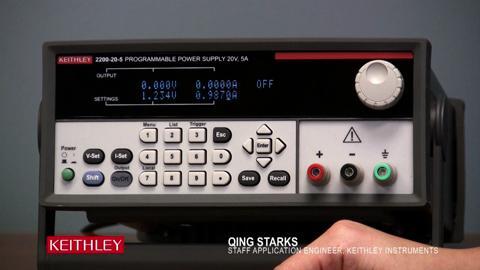
A programmable power supply delivers precise, adjustable voltage and current with automated control for circuit testing, validation, and production. With advanced programmability and remote operation, it ensures accurate, repeatable measurements in R&D, manufacturing, and automated test environments. Watch the video to see how it enhances your testing workflow.
.,'
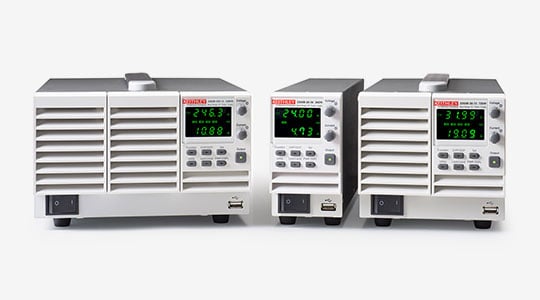
Keithley 2260B Series: High-Performance, Programmable
Power your tests with programmable voltage and current control in a compact benchtop design. With high accuracy, remote operation, and advanced sequencing, it’s built for automation and precision.
- Wide Power Range – Up to 800W total
- Programmable Control – Custom voltage and current profiles
- Remote Operation – Ethernet, USB, and GPIB connectivity
- Compact & Versatile – Ideal for R&D and automated testing
Find the Programmable Power Supply for Your Application


How Engineers Use Programmable Power Supplies

Automated Test and Validation
A programmable power supply integrates seamlessly into automated test setups, enabling engineers to run complex voltage sweeps, stress tests, and device characterization with precision and efficiency. Remote control and scripting capabilities reduce manual intervention and improve throughput.
Power Cycling and Stress Testing
With automated sequencing, a programmable power supply can simulate real-world conditions by cycling power, adjusting voltage profiles, and testing device limits. This is essential for reliability testing in industries like automotive, aerospace, and consumer electronics.
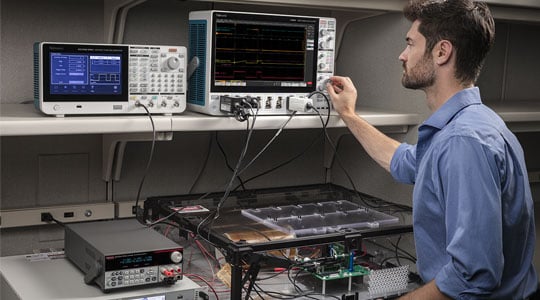

Battery Simulation for Device Testing
By mimicking real battery discharge profiles, a programmable power supply enables engineers to test battery-powered devices under controlled conditions. This ensures accurate performance evaluation for IoT devices, wearables, and portable electronics.
DC電源測定のヒント
設計の10ステップ
信頼性の高い電源の設計には、綿密な計画、正確な測定、そして適切なツールが不可欠です。テクトロニクスの「電源測定のヒント」ガイドでは、部品の選定からEMIのトラブルシューティング、最終的な検証まで、電源設計に欠かせない10のステップを順を追って解説しています。効率の最適化、規格への適合、あるいは不具合の解消など、どのような目的であっても、これらの専門的な知見はパフォーマンスの向上と製品開発期間の短縮を実現します。また、新しい電源を選定する際にも、これらのヒントが最適な選択をサポートします。最高の電源とは、単なる性能だけではなく、いかにテストを行い、設計を改善していくかによって決まるものだからです。