

Свяжитесь с нами
Живой чат с представителями Tektronix. С 9:00 до 17:00 CET
Позвоните нам
С 9:00 до 17:00 CET
Загрузить
Загрузить руководства, технические описания, программное обеспечение и т. д.:
Обратная связь
Using Step Load Response to Evaluate VRM Stability — Scope Embedded Power Integrity Analysis (SEPIA)
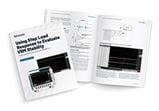
Using Step Load Response to Evaluate VRM Stability — Scope Embedded Power Integrity Analysis (SEPIA)
Voltage regulator module and power distribution network stability can be evaluated from the time-domain ringing produced by a fast load-current step. Scope Embedded Power Integrity Analysis (SEPIA) produces quantitative stability measurements without breaking the control loop, inserting an injection resistor, or performing a swept-frequency test.
This application note:
- Describes challenges associated with using Bode plots and small-signal swept measurements on modern multiphase and high-current power systems
- Explains how quality factor and equivalent phase margin are derived from a transient ringing waveform
- Shows how a fast step load, suitable probing, filtering, triggering, and waveform averaging are configured for stability analysis
- Demonstrates how equivalent inductance, capacitance, and resistance values are extracted for power distribution network modeling
- Explains how an equivalent-circuit netlist is generated for impedance, phase, and transient-response simulations
Measurements are performed on a 5 Series B Mixed Signal Oscilloscopes equipped with optional Power Distribution Network Measurement and Stability Analysis software. These measurements can also be performed on 4 Series B and 6 Series B MSOs using the same PDN application software. Power rail probes, isolated current probes, load steppers, and an arbitrary/function generator are discussed as components of the measurement system.