

Contact us
Call
Call us at
Available 6:00 AM – 5:00 PM (PST) Business Days
Download
Download Manuals, Datasheets, Software and more:
Feedback
DSA8300 Datasheet
Digital Serial Analyzer Sampling Oscilloscope
The products on this datasheet are no longer being sold by Tektronix.
View Tektronix Encore for reconditioned test equipment.
Check support and warranty status for these products.
Replacement Products
More Information
- DSA8300 Digital Sampling Oscilloscope (Discontinued)
- Explore more Oscilloscope models
Read Online:
Digital Serial Analyzer Sampling Oscilloscope
The DSA8300 is a state-of-the-art Equivalent Time Sampling Oscilloscope that provides the highest fidelity measurement and analysis capabilities for Communications Signal Analysis, Serial Data Network Analysis, and Serial Data Link Analysis applications.
Notice to EU customers
This product is not updated to comply with the RoHS 2 Directive 2011/65/EU and will not be shipped to the EU. Customers may be able to purchase products from inventory that were placed on the EU market prior to July 22, 2017 until supplies are depleted. Tektronix is committed to helping you with your solution needs. Please contact your local sales representative for further assistance or to determine if alternative product(s) are available. Tektronix will continue service to the end of worldwide support life.
Key performance specifications
- Low time base jitter:
- 425 fs typical on up to 8 simultaneously acquired channels
- <100 fs on up to 6 channels with 82A04B phase reference module
- Industry’s highest vertical resolution – 16 bit A/D
- Electrical resolution: <20 µV LSB (for 1 v full range)
- Optical resolution from <20 nW for the 80C07B (1 mW full range) to <0.6 µW for the 80C10C (30 mW full range)
- Optical bandwidths to >80 GHz
- Electrical bandwidths to >70 GHz
- Over 120 automated measurements for NRZ, RZ, and pulse signal types
- Automated mask testing with over 80 industry-standard masks
- Complex jitter/noise/BER/SER analysis (80SJNB), support for complex measurements TDECQ 1, SNDR 2 (applications)
1Transmitter and Dispersion Eye Closure Quaternary for PAM4.
2Signal-to-Noise-and-Distortion Ratio.
Key features
A wide variety of optical, electrical, and accessory modules support your specific testing requirements.
- Optical modules
- Optical modules that support optical data rates from 155 Mb/s to 10 Gb/s to 40 Gb/s to 100 Gb/s to PAM4 for 50G/100G/200G/400G
- Optical reference receivers (ORR) 1 support specified requirements for standards-mandated compliance testing
- High optical sensitivity, low noise, and wide dynamic range of the optical sampling modules allows accurate testing and characterization of short-reach to long-haul optical communications standards
- Fully calibrated clock recovery solutions – no need to manually calibrate for data pick-off losses
- Calibrated extinction ratio measurements and variable correction ER measurement ensure accuracy and repeatability
- Electrical modules
- Very low-noise electrical samplers (280 μV at 20 GHz, 450 μV at 60 GHz, typical)
- Selectable bandwidths 2 allow the user to trade-off sampler bandwidth and noise for optimal data acquisition performance
- Remote samplers or compact sampling extender module cables minimize signal degradation by allowing the sampler to be located in close proximity to the device under test
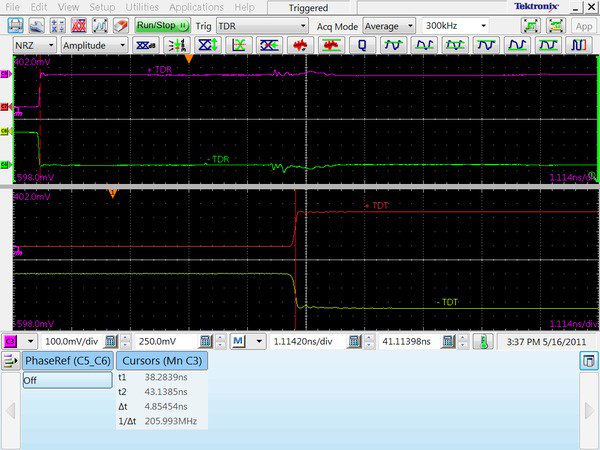
- High-performance integrated TDR (10 ps typical step rise time) supports exceptional impedance discontinuity characterization and high dynamic range for S-parameter measurements to 50 GHz
- Analysis
- Jitter, noise, and BER analysis of high-speed PAM4 and PAM2 NRZ serial data rates from <1 GBd to 60 GBd provides insight into precise causes of eye closure
Analysis of PAM4 signals with comprehensive jitter, noise and BER analysis for each individual PAM eye, and a set of global measurements that assess the overall PAM4 signal attributes
- 100G-SR4/Transmitter and Dispersion Eye Closure (TDEC) automation provides turn-key testing and debug of TX Optical properties key to the SR4 Short Reach Ethernet
- 80STDEC streamlines high performance Transmitter and Dispersion Eye Closure (TDEC) measurement making it ideal for manufacturing and conformance validation applications
- Automated mask testing with over 80 industry-standard masks. New masks can be imported into the DSA8300 to support new emerging standards. Users can define their own masks for automated mask testing
- Jitter, noise, BER, mask testing, and Serial Data Link Analysis (SDLA) are provided through the 80SJNB Essentials and Advanced Software Application Options
- Advanced TDR analysis, S-parameter measurements, simulation model extraction, and serial link simulation capabilities are provided by the IConnect® Software Application options
- 400G-M4 Optical Manufacturing Analysis Software provides Optical Transmitter and Dispersion Eye Closure Quaternary (TDECQ) analysis
- High test throughput
- High sample acquisition rate up to 200 kS/s per channel
- Efficient programmatic interface (IEEE-488, Ethernet, or local processor access) enables high test throughput
1Optical Reference Receiver (ORR) is a 4th-order Bessel-Thompson filter, with a frequency response and tolerances as defined by the standards. Tektronix optimizes the response for best nominal fit and highest quality mask test results.
2Refer to the 80E00 Electrical Sampling Modules datasheet for detailed descriptions of each available module.
Applications
- Design/Verification of telecom and datacom components and systems
- Manufacturing/testing for ITU/ANSI/IEEE/SONET/SDH compliance
- High-performance true-differential TDR measurements
- Impedance characterization and network analysis for serial data applications including S-parameters
- Advanced jitter, noise, BER and SDLA analysis
- Channel and eye diagram simulation and measurement-based modeling with IConnect.
Superior performance with extraordinary versatility
The DSA8300 Digital Serial Analyzer is the most versatile tool for developing and testing communications, computers, and consumer electronics which use multi-gigabit data transmission. It is used for optical and electrical transmitter characterization, as well as compliance verification for devices, modules, and systems used in these products.
In addition, the DSA8300 is well-suited for electrical signal path characterization, whether for packages, PCBs, or electrical cables. With exceptional bandwidth, signal fidelity, and the most extensible modular architecture, the DSA8300 provides the highest-performance TDR and interconnect analysis, most accurate analysis of signal impairments, and BER calculations for current and emerging serial data technology.
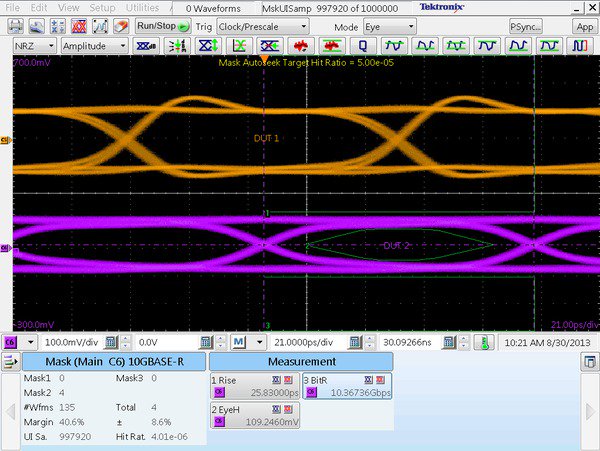
Optical eye diagram testing
Passive interconnect test
Finally, with its exceptional signal fidelity and resolution, the DSA8300 is the gold standard for electrical and optical applications which require ultra-high bandwidths, very fine vertical resolution, low jitter, and/or exceptionally low noise.
The DSA8300 provides unmatched measurement system fidelity with the lowest native instrument jitter floor (425 fs RMS, typical for serial data signals at rates >1.25 Gb/s) that ensures the most accurate acquisition of up to 8 high-bandwidth signals simultaneously. You get additional analysis benefits from acquisition jitter below 100 fs RMS when using the 82A04B Phase Reference module.
The multiprocessor architecture, with dedicated per-slot digital signal processors (DSPs), provides fast waveform acquisition rates, reducing the test times necessary for reliable characterization and compliance verification.
The DSA8300’s versatile modular architecture supports a large and growing family of plug-ins enabling you to configure your measurement system with a wide variety of electrical, optical, and accessory modules that best suit your application now and in the future. With 6 module slots, the DSA8300 can simultaneously accommodate a Clock Recovery module, a precision Phase Reference module, and multiple acquisition modules (electrical or optical), so you can match system performance to your evolving needs. The ability to swap sampling modules without powering down the DSA8300 (available for scopes with firmware versions 6.1 and later) provides additional flexibility in configuring your DSA8300 to changing test needs.
In addition, specialized modules supporting features such as single-ended and differential electrical clock recovery, electrostatic protection for electrical samplers, and connectivity to the popular TekConnect®probing system brings you the performance of state-of-the-art Tektronix probes for high-impedance and differential probing. Low-impedance probes for 50 Ω probing and for TDR probing are also available.
The raw acquisition performance of the DSA8300 and its sampling modules and accessories is further augmented by the comprehensive measurement and analysis capabilities of the DSA8300 and its associated software applications.
See the Ordering information for a list of currently available software applications and modules.
Measurement and analysis tools for optical testing applications
The DSA8300 includes a wide variety of measurement and analysis tools which specifically address optical testing applications. In addition to the standard amplitude and timing parametric measurements (such as rise/fall times, amplitude, RMS jitter, RMS noise, frequency, period, and so on), the measurement suite for the DSA8300 includes measurements specifically tailored to measuring optical signals (average optical power, extinction ratio, eye height, eye width, optical modulation amplitude (OMA), and so on). For a complete list of measurements, see theMeasurementsection of this datasheet.
The DSA8300 also includes standard compliance testing masks for all of the common optical standards from 155 Mb/s to 100 Gb/s. The DSA8300 mask testing system includes the ability to automatically fit standard and user masks to data acquired into a waveform database. The mask test system can also automatically determine the mask margin based either on the total number of mask violations or the "hit ratio" of mask violation to the number of samples acquired in the mask test unit interval. Users can also create custom masks for automated mask testing. Histograms and cursor measurements are also available to analyze optical signals acquired by the DSA8300.
Test solutions
The DSA8300, with its highly configurable mainframe and a wide variety of modules, provide complete test solutions with superior system fidelity.
- Optical modules
The Tektronix 80C00 family of optical sampling modules cover a range of wavelengths for both single- and multi-mode fibers. The various modules provide a range of features such as clock recovery, reference receiver filters, and a wide range of standards test solutions.
Refer to the Ordering information section for a list of currently available optical modules.
Refer to the 80C00 Optical Modules datasheet for detailed descriptions of each available module.
- Electrical modules
The Tektronix 80E00 family of electrical sampling modules provide a wide variety of capabilities, allowing the user to configure a test solution specifically adapted to their application. A wide variety of bandwidth solutions is available along with other features such as Time Domain Reflectometry or S-parameter testing.
Refer to the Ordering information section for a list of currently available electrical modules.
Refer to the 80E00 Electrical Sampling Modules datasheet for detailed descriptions of each available module.
- Utility modules
The Tektronix 80A00 and 82A00 families of modules provide additional capabilities such as phase reference and ESD protection.
Refer to the Ordering information section for a list of currently available utility type modules.
Refer the to the various utility module datasheets for detailed descriptions of each available module.
- 80A02 EOS ESD Isolation Module
- 82A04B Phase Reference Module
- 80A03 module extender
80B28G - a DSA8300 product bundle for 28 Gb/s applications
This bundle, when used with a DSA8300, provides all of the electrical sampling modules, accessories, and clock recovery capabilities needed to test applications at rates from 10 Gb/s to 28.6 Gb/s per lane. The bundle includes the following products:
- 1 ea. 80E09B: dual channel, 70 GHz Remote Electrical Sampling Module
- 1 ea. 82A04B: Phase Reference Module that supports sub-100 fs instrumentation jitter when used with the 80E09B
- 1 ea. CR286A with Option HS: 28.6 GHz clock recovery instrument that supports clock recovery at rates from 150 Mb/s to 28.6 Gb/s
- 1 ea. 80X01: 1-meter sampling module extender cable used to extend the phase reference module to connect directly to the clock recovery module
- 1 ea. 80A08 : accessory kit with all of the necessary cables, adapters, DC blocks and other accessories to configure a complete test solution
To extend this solution to test additional lanes in a multi-lane application, simply install additional 80E09B dual channel remote sampling modules.
Specifications
Product specifications and descriptions in this document are subject to change without notice.
All specifications are guaranteed unless noted otherwise. All specifications apply to all models unless noted otherwise.
Vertical system
- Rise Time / Bandwidth
- Determined by the sampling modules used
- Vertical Resolution
16 bits over the sampling modules' dynamic range
Electrical Resolution: <20 μV LSB (for 1 V full range)
Optical resolution depends on the dynamic range of the optical module – ranges from <20 nW for the 80C07B (1 mW full range) to <0.6 μW for the 80C10C (30 mW full range)
Horizontal system
- Main and Magnification View Time Bases, Horizontal Scale
- 100 fs/div to 1 ms/div, in 1-2-5 sequence or 100 fs increments
- Time Interval Accuracy
- Trigger Direct (Front Panel) Input
Horizontal scale >20 ps/div, right-most point of measurement interval <150 ns; Mean Accuracy: 0.1% of interval, STDEV: ≤1 ps
Horizontal scale ≤20 ps/div, right-most point of measurement interval <150 ns; Mean Accuracy: 1 ps + 0.5% of interval
- Clock Input/Prescale Trigger (Front Panel), Eye or Pattern Mode
- Mean accuracy determined by clock input accuracy STDEV: <0.7 ps (max); <0.1 ps (typical)
- Clock Input/Prescale Trigger (Front Panel), Other Mode
Horizontal scale >20 ps/div, right-most point of measurement interval <150 ns; Mean Accuracy: 0.1% of interval, STDEV: ≤3 ps
Horizontal scale ≤20 ps/div, right-most point of measurement interval <150 ns; Mean Accuracy: 1 ps + 0.5% of interval
- TDR Clock Trigger (Lock to External 10 MHz Clock)
- Horizontal scale >20 ps/div, right-most point of measurement interval <150 ns; Mean Accuracy: 0.01% of interval, STDEV: ≤1 ps (0.1 ps typical)
- Random Phase Corrected Mode (Clock Input to 82A04B)
Maximum timing deviation 0.1% of phase reference signal period, typical, relative to phase reference signal
For more information on phase reference modes of operation, see the “Phase Reference Module for the DSA8300 Sampling Oscilloscope” datasheet.
- Triggered Phase Corrected Mode (Clock Input to 82A04B)
Maximum timing deviation relative to phase reference signal:
>40 ns after trigger event: 0.2% of phase reference signal period, typical
≤40 ns after trigger event: 0.4% of phase reference signal period, typical
- Horizontal Deskew Range Available
SW: –500 ps to +100 ns on any individual channel in 100 fs increments, some limitations apply to software deskew TDR and sampling modules. Note that SW deskew implies acquiring another waveform, at a different horizontal position; a throughput penalty exists.
Mainframe channel delay (HW deskew):
Sample mode:
80E11 and 80E11x1: ±35 ps
80E07B, 80E08B, 80E09B, and 80E10B: ±150 ps
80C17, 80C18: +/- 65 ps
TDR mode:
80E08B and 80E10B: ±200 ps
- DSA8300 Record Length
- 50, 100, 250, 500, 1000, 2000, 4000, 8000, or 16000 samples (magnification views have maximum record length of 4000 samples)
- Longer Records Available
IConnect®: 1M samples
80SJNB Jitter, Noise, and BER Analysis Software: 10M samples (100k unit intervals, 100 samples per unit interval)
Trigger system
- Trigger Sources
Clock Input/Prescale Trigger (front panel)
TDR clock (generated internally)
Clock recovery triggers from Optical Sampling modules and Electrical Clock Recovery modules (internally connected)
Phase Reference (when using the 82A04B Phase Reference module) time base supports acquisitions without a trigger signal in its Free Run mode
Trigger Direct Input (front panel)
- Clock Input / Prescale Trigger Input
- Clock Input Sensitivity
150 mVp-pto 1 Vp-p, 0.15 GHz to 20 GHz (typical)
200 mVp-pto 1 Vp-p, 0.8 GHz to 15 GHz (guaranteed)
- Minimum Slew Rate
- ≥2 V/ns
- Clock Input Range
- 1.0 Vp-p (max) – AC coupled
- Pattern Lengths Supported (for Pattern Triggering with ADVTRIG Option)
- 2 to 223 (8,388,608) inclusive
- Clock Input Jitter in Clock-eye and Clock-pattern Trigger Modes (Typical)
0.15 - 0.40 GHz: 900 fs (RMS)
0.40 - 1.25 GHz: 800 fs
1.25 - 20 GHz: 425 fs
- Clock Input Jitter in Clock-eye and Clock-pattern Trigger Modes (Max)
0.80 - 1.25 GHz: 900 fs (RMS)
1.25 - 11.20 GHz: 500 fs
11.20 - 15.0 GHz: 600 fs
- TDR Trigger
- TDR Step Rate
Selectable from 25 to 300 kHz in 1 kHz steps
Actual TDR step rate may vary up to 2% from requested rate
- TDR Trigger Jitter
- 1.3 ps RMS (typical) 1.8 ps RMS (max)
- Phase Reference Time Base
- Phase Reference Input Range
Standard 82A04B: 8 - 32 GHz (guaranteed), 2 - 32 GHz (typical)
82A04B Option 60G: 8 - 60 GHz (guaranteed), 2 - 70 GHz (typical)
For non-sinusoidal clock at frequencies <8 GHz, it may be necessary to filter the clock input to eliminate harmonics from the clock signal (see accessories 020-2566-xx, 020-2567-xx, and 020-2568-xx)
- Phase Reference Input Sensitivity
- Best jitter performance is with the clock input to the 82A04B in the following range: 0.6 - 1.8 V. The phase reference time base remains operational to 100 mV (typical) with increased jitter
- Jitter
f ≥8 GHz: 100 fs RMS, on a 10 GHz or faster sampling module
2 GHz ≤ f ≤ 8 GHz: 140 fs RMS, typical on a 10 GHz or faster acquisition module
- Trigger Direct Input
- Trigger Sensitivity
50 mV, DC - 4 GHz (typical)
100 mV, DC - 3 GHz (guaranteed)
- Trigger Level Range
- ±1.0 V
- Trigger Input Range
- ±1.5 V
- Trigger Holdoff
- Adjustable 5 μs to 50 ms in 0.5 ns increments
- Trigger Direct Input Jitter
1.1 ps RMS + 5 ppm of horizontal position (typical)
1.5 ps RMS + 10 ppm of horizontal position (max)
Acquisition system
- Acquisition modes
- Sample (Normal), Envelope, and Average
- Number of sampling modules accommodated
Up to 4 dual-channel electrical; up to 2 optical sampling modules.
Population of the CH1/CH2 large slot with any module other than one requiring power only displaces functionality of the CH1/CH2 small slot; population of the CH3/CH4 large slot with any module other than one requiring power only displaces functionality of the CH3/CH4 small slot.
- Number of simultaneously acquired inputs
- 8 channels maximum
- Maximum acquisition rate
300 kS/s per channel in TDR mode
200 kS/s per channel in all other nonphase reference modes
120 kS/s per channel in phase reference modes
Waveform measurements
- System Measurement Rate
- The DSA8300 supports up to 8 simultaneous measurements, updated 3 times per second with optional display of per-measurement statistics (min, max, mean, and standard deviation)
- Measurement Set
- Over 120 automated measurements include RZ, NRZ, and pulse signal types, and the following measurement types:
- Amplitude Measurements
- High, Low, Amplitude, Peak-to-Peak, Max, Mid, Min, Mean, +Overshoot, –Overshoot, P-P, Average Optical Power (dBm, watts), Noise, RMS Noise, SNR, Eye Height, Eye Opening Factor, Extinction Ratio (Ratio, %, dB), Suppression Ratio (Ratio, %, dB), OMA, Q-factor, RMS, AC RMS, Cycle RMS, Cycle Mean, Gain, Crossing %, Crossing Level OMA, VMA
- Timing Measurements
- Rise, Fall, Period, Bit Rate, Bit Time, Frequency, Crossing Time, +Cross, –Cross, Jitter (P-P, RMS), Eye Width, +Width, –Width, Burst Width, +Duty Cycle, –Duty Cycle, Duty Cycle Distortion, Delay, Phase, Pulse Symmetry
- Area Measurements
- Area, Cycle Area
- Cursors
- Dot, vertical bar, and horizontal bar cursors
- Waveform Processing
- Up to 8 math waveforms can be defined and displayed using the following math functions: Add, Subtract, Multiply, Divide, Average, Differentiate, Exponential, Integrate, Natural Log, Log, Magnitude, Min, Max, Square Root, and Filter. In addition, measurement values can be utilized as scalars in math waveform definitions
- Mask Testing
- For many applications, standard masks are available as predefined, built-in masks. Many of the most commonly used standard masks are shown in the following supported standards list. Contact your local Tektronix representative to get a list of all available masks. Unless otherwise noted, file-based masks are used to distribute new, Tektronix factory-created, updated masks as a file loadable by the firmware. User-defined masks allow the user to create (through UI or PI) user masks
- Supported standards
Type Standard Ethernet 100BASE-LX10 125.0 Mb/s 100BASE-BX10 125.0 Mb/s
Gigabit Ethernet 1.250 Gb/s
1000BASE-KX 1.250 Gb/s
2 GBE 2.500 Gb/s 10GBASE-X4 3.125 Gb/s
10GBASE-W 9.95328 Gb/s
10GBASE-R 10.3125 Gb/s
FEC11.10 11.095728 Gb/s
10GBASE-LRM 10.31250 Gb/s
40GBASE-FR 41.25 Gb/s
40GBASE-LR4 10.3125 Gb/s
40GBASE-SR4 10.3125 Gb/s
100GBASE-ER4 25.71825 Gb/s
100GBASE-LR4 25.71825 Gb/s
100GBASE-SR10 10.3125 Gb/s
100GBASE-SR4 25.7185 Gb/sSONET/SDH OC-1/STM-0 51.84 Mb/s
OC-3/STM-1 155.52 Mb/s
OC-12/STM-4 622.08 Mb/s
OC-48/STM-16 2.48832 Gb/s
FEC2.666 2.6660571 Gb/s
OC-192/STM-64 9.95328 Gb/s
FEC10.66 10.6642 Gb/s
FEC10.71 10.709225 Gb/s
OTU4 27.95 Gb/s
OC-768/STM-256 39.81312 Gb/s
FEC42.66 42.6569 Gb/s
FEC43.02 43.018414 Gb/sFibre Channel Optical FC133 132.81 Mb/s
FC266 265.6 Mb/s
FC531 531.2 Mb/s
FC1063 1.0625 Gb/s
FC2125 2.125 Gb/s
FC4250 4.250 Gb/s
8GFC 8.500 Gb/s
10GFC 10.518750 Gb/s
FC11317 11.3170 Gb/s
16GFC MM r6.1 14.025 Gb/s
16GFC SM r6.1 14.025 Gb/s
32GFC 28.05 Gb/sFibre Channel Electrical FC133 132.81 Mb/s
FC266 265.6 Mb/s
FC531 531.2 Mb/s
FC1063 1.0625 Gb/s
FC2125E 2.125 Gb/s: Abs, Beta, Tx/Rx; Abs, Gamma, Tx/Rx
FC4250E 4.250 Gb/s: Abs, Beta, Tx/Rx; Abs, Gamma, Tx/Rx
FC8500E 8.500 Gb/s: Abs, Beta, Tx/Rx; Abs, Gamma, Tx/RxSATA G1 1.500 Gb/s Tx, Rx
G2 3.000 Gb/s Tx, Rx
G3 6.000 Gb/s Tx, Rx
Display system
- Touch Screen Display
- 264 mm / 10.4 in. diagonal, color, LCD
- Colors
- 16,777,216 (24 bits)
- Video Resolution
- 1024 horizontal by 768 vertical displayed pixels
- Magnification Views
- In addition to the main time base, the DSA8300 supports two magnification views. These magnifications are independently acquired using separate time-base settings which allow same or faster time/div than that of the main time base
Input output ports
- Front Panel
- USB 2.0 Port(s)
- One USB 2.0 connector (instruments shipped after 12/2012 have 3 USB ports on the front panel)
- Anti-static Connection
- Banana-jack connector, 1 MΩ
- Trigger Direct Input
- See Trigger System specification
- Clock Input / Prescale Trigger
- See Trigger System specification
- TDR Clock Output
- See Trigger System specification
- DC Calibration Output
- ±1.25 V maximum
- Rear Panel
- USB Ports
- 4 USB 2.0 connectors
- LAN Port
- RJ-45 connector, supports 10/100/1000BASE-T
- Serial Ports
- DB-9 COM1, COM2 ports
- GPIB
- IEEE488.2 connector
- DVI-I Video Port
DVI connector, female
Connect to show the oscilloscope display, including live waveforms on an external monitor or projector. The primary Windows desktop can also be displayed on an external monitor using these ports.
Alternatively, the DVI-I port can be configured to show the secondary Windows desktop (also called extended desktop or dual-monitor display).
DVI to VGA 15-pin D-sub connector adapter provided
- PS2 Serial Ports
- Mouse and keyboard inputs
- Audio Ports
- 1/8 in. microphone input and line output
Data storage
- Waveform Databases
- 4 independently accumulated waveform records of up to 4M waveform points each. Variable waveform database mode with true first-in/first-out of up to 2000 waveforms available on each of 4 waveform databases (2M samples maximum / waveform database)
- Hard Disk Drive
- Rear-panel, removable hard disk drive, 500 GB capacity
- Optical Drive
- Front-panel DVD Read Only / CD Read-Write drive with CD-creation software application
- Nonvolitile storage
- USB 2.0 flash memory
Computer system
- Operating System
- Microsoft Windows 7 Ultimate (32-bit)
- CPU
- 3 GHz Intel Core™ 2 Duo CPU
Power source
- Line voltage and frequency
90 V to 250 V
50 Hz to 400 Hz
- Power Consumption
205 W, typical, mainframe only
330 W, typical, fully loaded
600 W, maximum
Physical characteristics
- Dimensions
mm Inches Width 475 18.0 Height 343 13.5 Depth 419 16.5
kg lb Weight 21 46
EMC, environment and safety
- Temperature
- Operating
- +10 to +40 °C
- Nonoperating
- –22 to +60 °C
- Altitude
- Operating
- 3,048 m (10,000 ft.)
- Nonoperating
- 12,190 m (40,000 ft.)
- Relative Humidity
- Operating (CD-ROM not installed)
- 20% to 80% at or below 40 °C (upper limit de-rates to 45% relative humidity at 40 °C)
- Electromagnetic compatibility
- 2004/108/EC
- Safety
- UL3111-1, CSA1010.1, EN61010-1, IEC61010-1
Ordering information
For more detailed information about the DSA8300 Digital Serial Analyzer sampling oscilloscope, download theDSA8300 Digital Serial Analyzer, 80C00 Series Sampling Modules, 80E00 Series Sampling Modules, 80A00 Modules Specifications Technical Reference(Tektronix part number 077-0571-xx) from www.tek.com.
Models
- DSA8300
- Digital Serial Analyzer Sampling Oscilloscope
Standard accessories
- 071-2897-XX
- DSA8300 Digital Serial Analyzer Quick Start User Manual
- 119-7083-XX
- Keyboard
- 119-7054-XX
- Mouse
- 200-4519-XX
- Instrument front cover
- 016-1441-XX
- Accessory pouch
- 119-6107-XX
- Touch screen styluses (2)
- 006-3415-XX
- ESD wrist strap with 6 foot coiled cord
- 063-4356-XX
- DSA8300 Product Documentation CD
- Not orderable
- DSA8300 Online Help (part of application software)
- Not orderable
- DSA8300 Programmer Online Manual (part of application software)
- 020-3088-XX
- DSA8300 TekScope Product Software Install Kit
- Type dependent on selection during order placement
- Power cord
- 013-0347-XX
- VGA female to DVI male adapter
Instrument options
Options
- ADVTRG
- Add Advanced Trigger with Pattern Sync
- 80SSR4
- 100GBASE-SR4 Comprehensive Transmitter compliance testing
- 80STDEC
100GBASE-SR4 Transmitter and Dispersion Eye Closure (TDEC) testing
- 80S400G-TXO
- PAM4 Optical transmitter compliance package. Also enables the TDECQ measurement feature in the 80SJNB opt. PAM4 opt. Advanced.
- PAM4
- PAM4 Transmitter Analysis software (requires option JNB01 (80SJNB Advanced) or option JNB02 (80SJNB Advanced with SDLA Visualizer) software)
- CEI-VSR
- OIF CEI 3.0 Compliance Solution for DSA8300
- JNB
- Add 80SJNB Essentials. Any version of 80SJNB also includes 80SJARB and the RIN/RINxOMA applications.
- JNB01
- Add 80SJNB Advanced
- JNB02
- Add 80SJNB Advanced with SDLA Visualizer
- JARB
- Add 80SJARB (included with Option JNB, JNB01, or JNB02)
- ICMX
- IConnect® and MeasureXtractor Signal Integrity and Failure Analysis Software
- ICON
- IConnect® Signal Integrity and Failure Analysis Software
- SPAR
- IConnect® S-parameters Software
- DSA8300 400G-M4
- 400G Optical Manufacturing Analysis Software, 4-channel TDECQ analysis. This software is designed for use on a PC connected to the DSA8300 sampling oscilloscope. (Customers who already have a DSA8300 will need to purchase DSA83UP 400G-M4.)
Power plug options
- Opt. A0
- North America power plug (115 V, 60 Hz)
- Opt. A1
- Universal Euro power plug (220 V, 50 Hz)
- Opt. A2
- United Kingdom power plug (240 V, 50 Hz)
- Opt. A3
- Australia power plug (240 V, 50 Hz)
- Opt. A4
- North America power plug (240 V, 50 Hz)
- Opt. A5
- Switzerland power plug (220 V, 50 Hz)
- Opt. A6
- Japan power plug (100 V, 50/60 Hz)
- Opt. A10
- China power plug (50 Hz)
- Opt. A11
- India power plug (50 Hz)
- Opt. A12
- Brazil power plug (60 Hz)
- Opt. A99
- No power cord
Language options
- Opt. L0
- English manual
- Opt. L7
- Simplified Chinese manual
- Opt. L8
- Traditional Chinese manual
- Opt. L10
- Russian manual
Language options include translated front-panel overlay for the selected language(s).
Service options
- Opt. C3
- Calibration Service 3 Years
- Opt. C5
- Calibration Service 5 Years
- Opt. CA1
- Single Calibration or Functional Verification
- Opt. D1
- Calibration Data Report
- Opt. D3
- Calibration Data Report 3 Years (with Opt. C3)
- Opt. D5
- Calibration Data Report 5 Years (with Opt. C5)
- Opt. IF
- Upgrade Installation Service
- Opt. R3
- Repair Service 3 Years (including warranty)
- Opt. R5
- Repair Service 5 Years (including warranty)
Probes and accessories are not covered by the oscilloscope warranty and Service Offerings. Refer to the datasheet of each probe and accessory model for its unique warranty and calibration terms.
DSA83UP - DSA8300 upgrade kit
- ADVTRIG
- Add Advanced Trigger with Pattern Sync
- HDD8
- Additional hard disk drive complete with assembled mounting bracket, operating system, and oscilloscope application
- JARB
- Add 80SJARB (included with Option JNB, JNB01, or JNB02)
- JNB
- Add 80SJNB Essentials
- JNB01
- Add 80SJNB Advanced
- JNB02
- Add 80SJNB Advanced with SDLA Visualizer
- JNBTOJNB01
- Upgrade from JNB to JNB Advanced
- JNBTOJNB02
- Upgrade from JNB to JNB Advanced with SDLA Visualizer
- JNB01TOJNB02
- Upgrade JNB01 to JNB02 (Adds SDLA Visualizer)
- 80SSR4
- 100GBASE-SR4 Comprehensive Transmitter compliance testing (includes TDEC); recommend sampling modules 80C18 or 80C17, or 80C15 with Opt. CRTP
- 80STDEC
- 100GBASE-SR4 Transmitter and Dispersion Eye Closure (TDEC); recommend sampling modules 80C18 or 80C17, or 80C15 with Opt. CRTP
- 80S400G-TXO
- For PAM4 optical compliance tests and TDECQ measurement
- PAM4
- Upgrade 80SJNB: add PAM4 Transmitter Analysis capability; requires 80SJNB Advanced (JNB01) or 80SJNB Advanced+SDLA (JNB02) software
- CEI-VSR
- OIF CEI 3.0 Compliance Solution for DSA8300
- DSA83UP 400G-M4
- Upgrade for 400G Optical Manufacturing Analysis Software, 4-channel TDECQ analysis. For customers who already have a DSA8300.
DSA8300 Rack Mount
- 016-1791-02
- DSA8300 Rack Mount Kit
Optional Accessories
Optical modules
Optical modules plug directly into the large slot of the DSA8300 sampling oscilloscope mainframe. See the80C00 Optical Modulesdatasheet for more details.
All optical modules have FC/PC connectors installed. Other connector adapters available as options are: ST/PC, D4/PC, Biconic, SMA 2.5, SC/PC, DIN/PC, HP/PC, SMA, DIAMOND 3.5.
- 80C07B
- 2.5 GHz single-mode and multi-mode, amplified (750 to 1650 nm) optical module for multirate datacom and telecom applications w/ optional integrated clock recovery
- 80C08D
- 9 GHz optical channel; single-mode and multi-mode, amplified (750 to 1650 nm) optical module optimized for 8.5 to 12.5 Gb/s applications with optional integrated clock recovery
- 80C10C
- 55/70/80 GHz; single-mode (1290 to 1330 nm and 1520 to 1620 nm) optical module with reference receiver 1 filters for multirate datacom and telecom 40 Gb/s and 100 Gb/s (4 × 25 Gb/s) and PAM4 50G/100G/200G/400G at 25+GBd and 53+GBd applications with optional calibrated trigger pick-off for use with external clock recovery instruments (such as the CR286A)
- 80C11B
- 30 GHz, single-mode (100 to 1650 nm) optical module with reference receiver1 filters for 8.5 to 14.1 Gb/s telecom and datacom standards. Optional, integrated clock recovery for 8.5 to 12.6 Gb/s applications
- 80C12B
- 12 GHz optical channel; single-mode and multi-mode, amplified (750 to 1650 nm) optical module with optical reference receivers1 to support 155 Mb/s to 12.5 Gb/s applications with calibrated trigger pick-off for use with external clock recovery instruments (such as the 80A05 or CR125A)
- 80C14
- 12 GHz optical channel; single-mode and multi-mode, amplified (750 to 1650 nm) optical module optimized for 8.5 to 12.5 Gb/s applications with calibrated trigger pick-off for use with external clock recovery instruments (such as the CR175A or CR286A)
- 80C15
- 32 GHz, single-mode and multi-mode optical module with bandwidth filters for multirate datacom and telecom 25, 100 (4x25) Gb/s, and PAM4 for 50G/100G/200G/400G applications. Option CRTP provides a second, high-sensitivity optical input to drive Clock Recovery Trigger Pickoff (CRTP) electrical differential outputs for clock recovery (using the Tektronix CR286A) or error detection functions (using the Tektronix PED4001).
- 80C17, 80C18
- 32 GHz, single-mode and multi-mode, 1 and 2 channel, optical modules with bandwidth filters for multirate datacom and telecom 25, 100 (4x25) Gb/s, and PAM4 for 50G/100G/200G/400G applications.
- 80C20, 80C21
- 53 GHz, single-mode, 1 and 2 channel, optical modules with bandwidth filters for multirate datacom and telecom 40, 100 (4x25) Gb/s, and PAM4 for 50G/100G/200G/400G applications.
1Optical Reference Receiver (ORR) is a 4th-order Bessel-Thompson filter, with a nominal response and other details defined by standards. Details of the definition differ; Tektronix optimizes the response for best nominal fit and highest quality mask test results.
Electrical modules
Electrical modules plug directly into one of four small slots of the DSA8300 sampling oscilloscope mainframe. See the80E00 Electrical Sampling Modulesdatasheet for more details.
- 80E11
- 70/60/40 1 GHz electrical sampler, dual channel
- 80E11X1
- 70/60/401 GHz electrical sampler, single channel
- 80E10B
- Remote 2 Sampling Module – 50/40/301 GHz electrical, dual-channel with true-differential TDR capabilities
- 80E09B
- Remote2 Sampling Module – 60/40/301 GHz electrical, dual-channel
- 80E08B
- Remote2 Sampling Module – 30/201 GHz electrical, dual-channel with true-differential TDR capabilities
- 80E07B
- Remote2 Sampling Module – 30/201 GHz electrical, dual-channel
- 80E04
- 20 GHz electrical sampler, dual-channel with true-differential TDR capabilities. For remote sampling use the 80X01 or 80X02 Electrical Sampling Module Extender Cables
- 80E03
- 20 GHz electrical sampler, dual-channel. For remote sampling use the 80X01 or 80X02 Electrical Sampling Module Extender Cables
1User-selectable bandwidth.
2Each remote sampler/TDR generator is on a separate 2-meter remote cable for easy co-location with the device under test and best acquired signal fidelity.
Phase reference module
The 82A04B Phase Reference module, when installed in the DSA8300 and provided with a clock synchronous with the data to be acquired, provides a very low-jitter time base for acquiring signals from the device under test. It can accommodate clocks from 2 GHz 1 to >60 GHz.- 82A04B
- Phase Reference Module – Standard module supports clocks up to 32 GHz. With Option 60G it supports clocks to >60 GHz
1For clock frequencies <8 GHz, it may be necessary to filter the clock input to eliminate harmonics from the clock signal (see Other Accessories 020-2566-xx, 020-2567-xx, and 020-2568-xx).
Clock recovery module/instrument
- CR125A
- Electrical Clock Recovery instrument. CR125A recovers clocks from serial data streams for all of the most common electrical standards in the continuous 100 Mb/s to 12.5 Gb/s range. Applicable to electrical signals and for 80C12B
- CR175A
- Electrical Clock Recovery instrument. CR175A recovers clocks from serial data streams for all of the most common electrical standards in the continuous 100 Mb/s to 17.5 Gb/s range. Applicable to electrical signals and for 80C12B and 80C14
- CR286A-HS
- Electrical Clock Recovery instrument. CR286A recovers clocks from serial data streams for all of the most common electrical standards in the continuous 100 Mb/s to 28.6 Gb/s range. Applicable to electrical signals and for 80C12B, 80C14, and 80C10B/80C10C (for rates up to 28.6 Gb/s). Note: Option HS (High Sensitivity) is needed for most usage.
Product bundle for 10-28 Gb/s applications
- 80B28G
- Product bundle which includes one each of the following products: 80E09B Electrical Sampling Module; 82A04B Phase Reference Module; CR286A-HS 28.6 GHz Clock Recovery instrument; 80X01: 1-meter sampling module extender cable; and 80A08 28 Gb/s Measurements Accessory Kit.
Recommended Accessories
- 80A09
- 26 GHz ESD Protection Device (in-line always active)
- 80A02
- EOS/ESD isolation module for electrical static isolation of electrical sampling modules
- 80A03
- TEKConnect probe interface module
- 80A08
- Accessory kit for electrical measurements up to 28 Gb/s; includes electrical trigger pick-off with cables for CRU, all in 2.4 mm.
- 80X01
- 1-meter electrical sampling module extender cable
- 80X02
- 2-meter electrical sampling module extender cable
Calibration kits and accessories (3rd party)
For best S-parameter measurement results with the 80E10B, 80E08B, and 80E04 electrical TDR modules and IConnect® software, we recommend precision calibration kits, adapter kits, connector savers, airlines, torque wrenches, and connector gauges from Maury Microwave.
These components are compatible with the 2.92 mm, 2.4 mm, and 1.85 mm connectors of the 80E00 modules. Contact Maury Microwave (www.maurymw.com/tektronix.htm) to order calibration kits and other components.

Tektronix is registered to ISO 9001 and ISO 14001 by SRI Quality System Registrar. 85W-26988-21
