

Contact us
Call us at
Available 6:00 AM – 5:00 PM (PST) Business Days
Download
Download Manuals, Datasheets, Software and more:
Feedback

Reliable Spectrum and Signal Analysis Solutions
Tektronix Real-time Spectrum Analyzers (RSAs) and SignalVu analysis software enable accurate and reliable real-time RF measurements. Thanks to their architecture, Tektronix RSAs can record, stream, and analyze data in real time at full bandwidth to capture, isolate, and analyze even hard-to-find transient RF signals with confidence.
- Extensive Signal Analysis Tools: Tektronix RF Spectrum Analyzers feature a large set of RF analysis tools, facilitating streamlined test of many kinds of signals and waveforms, including wireless standards, radar pulses, and Electromagnetic Immunity and Compatibility (EMI/EMC).
- Accurate Results Supported by Proven Science: At Tek, we prioritize measurement integrity. Our analyzers implement established measurement science, ensuring reliable, precise, and repeatable results.
- Field-Ready Instruments: Recognizing the need for capturing signals outside of the lab, Tektronix spectrum analyzers include ruggedized, portable models that can operate for hours on batteries, ensuring high-fidelity RF data acquisition from the field.
Tektronix RF Spectrum Analyzers & Signal Analyzers


Spectrum Analyzer (Signal Analyzer) Software
Get the most out of your spectrum analyzer by pairing it with industry-leading signal recording and signal analysis application software from Tektronix.


How to Choose a Real-time Spectrum Analyzer (Signal Analyzer)
Selecting the right real-time spectrum analyzer is vital for efficient and accurate measurements of fast-moving RF signals in today’s crowded RF environment. Here are key factors to consider, illustrated with real applications:
-
Frequency Range: Identify the frequency range that your applications need. Additionally, consider the need to measure out-of-band emissions and harmonics. For instance, if you're working with Wi-Fi signals, you need a spectrum analyzer that covers not only the carrier frequencies at 2.4 GHz or 5 to 7 GHz, but also adjacent channels and 2nd, 3rd, or higher harmonics.
-
Instantaneous Bandwidth and Measurement Speed: RF applications such as real-time spectrum monitoring require very fast acquisition and high sampling rates over large sections of the spectrum, coupled with rapid signal processing to ensure that the spectrum analyzer can capture, process, and display fast transients and unexpected RF behaviors. Greater signal processing power leads to more favorable “Probability of Intercept” times (lower POI times), a measure of how fast a signal can appear and disappear with 100% probability of the spectrum analyzer capturing it.
-
Resolution Bandwidth (RBW): High-sampling rates and the ability to produce a lower RBW is crucial for discriminating and analyzing densely populated signal environments, like commercial wireless bands and satellite communications where signals are closely spaced.
-
Dynamic Range: For applications like radar system testing where the emitted signal and its echo have vastly different amplitudes, or when monitoring the RF spectrum for the presence of unauthorized transmitters, a higher dynamic range is essential to measure both strong and weak signals simultaneously without saturating the receiver.
-
Sensitivity: Sensitivity is vital for detecting low-level signals. Choose an analyzer with a low noise floor for sensitive applications like electronic warfare or remote sensing.
-
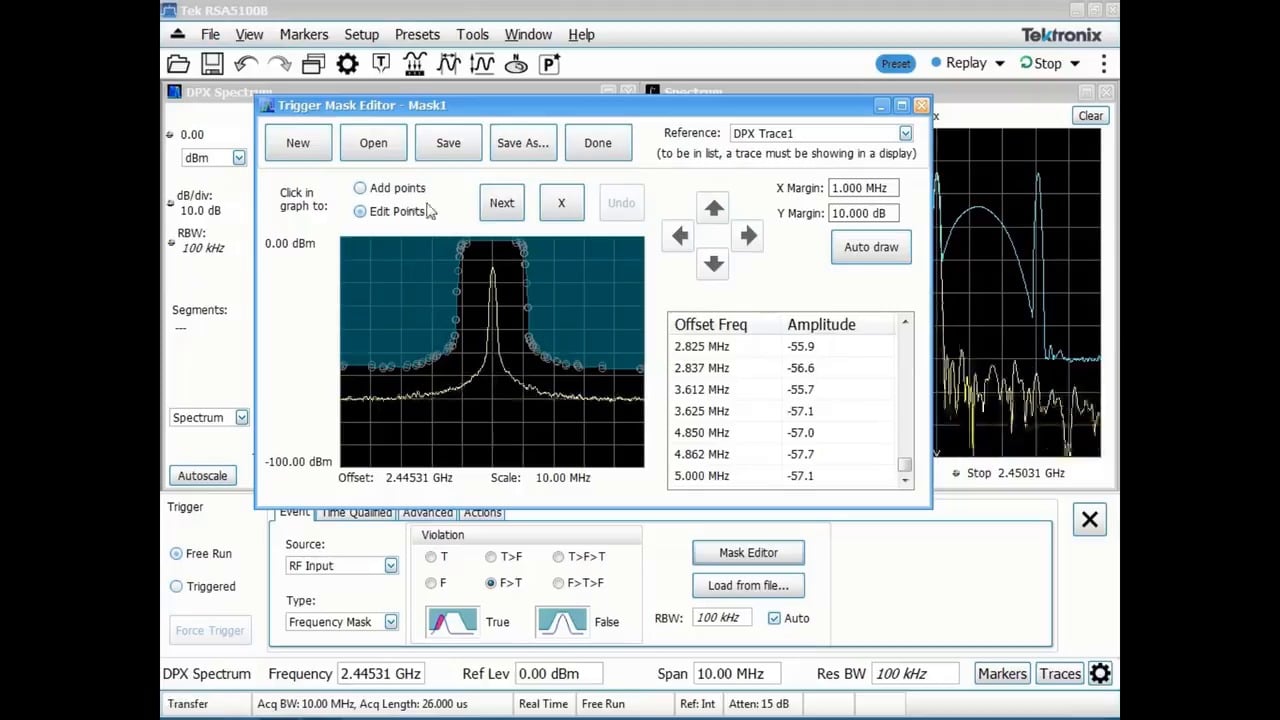
Specialized Triggers: Capturing fast RF transients, unforeseen signals, and rare RF effects requires new triggering capabilities on the RF data, such as triggering on power density over a particular area of the spectrum, applying customizable trigger masks over power and frequency, and deciding to capture data on specific pulse durations.
-
Powerful Visualization and Automation Software: Extensive analysis of today’s complex RF signals requires advanced RF software and measurement automation tools to speed up research, development, validation, and test of RF signals, devices, and systems. Furthermore, the ability to get new test and measurement capabilities through regular software updates amplifies the value of your spectrum analyzer.
-
Portability and Size: Engineers working on field validation and test of telecommunications, radar, and electronic warfare require portable, lightweight, low-power, rugged analyzers that can withstand harsh field conditions and operation while producing reliable RF data.
-
Calibration and Service: High-quality analyzers coupled with comprehensive calibration, maintenance, and repair services lead to greater measurement reliability, reduced downtime, and a more valuable long-term investment.
By carefully evaluating these factors, you can choose a spectrum analyzer that best fits your specific application and ensures reliable, accurate results.
Compare all signal and spectrum analyzers
Read the Fundamentals of Spectrum Analyzers »
Innovations Unveiled: High-Performance Spectrum Analyzers and Signal Analyzers
Unveiling Hidden Signals with DPX Technology
This video demonstrates Tektronix's patented Digital Phosphorus Technology (DPX), which uncovers hidden signals in spectrum analysis by transforming sample data into detailed pixel information, offering a live, color-graded view of RF signals distinguishable by time or power levels.


Discover a New Generation of Spectrum Analyzers
Powerful RF performance. Uncompromized quality.
Related Resources - Spectrum Analyzers (Signal Analyzers)


FAQs - Spectrum Analyzers and Signal Analyzers
What is a spectrum analyzer used for?
A spectrum analyzer measures the amplitude of an input signal versus frequency within the full frequency range of the instrument. The primary use is to measure the power of the spectrum of known and unknown signals.
From portable USB spectrum analyzers to benchtop real time spectrum analyzers, Tektronix has the solution to meet your RFanalysis needs. Tektronix spectrum analyzers can be used for:
- General purpose spectrum analysis
- RF record and playback
- EMC compliance testing and troubleshooting
- Spectrum monitoring
- Radiolocation and interference hunting
- Radar and electronic warfare
Tektronix offers a suite of powerful Radio Frequency (RF) signal analysis solutions delivering high fidelity and low noise to provide the RF situational awareness you need.
History of signal and spectrum analyzers
What Does a Spectrum/Signal Analyzer Do?
A spectrum/signal analyzer measures the amplitude of an input signal versus frequency within the frequency range of the instrument. Traditionally, this instrument measures the power vs. frequency of known and unknown signals. However, modern signal analyzers perform simultaneous assessments of magnitude and phase to enable measurements of complex signals and produce extensive insights into their modulation quality characteristics. A spectrum analyzer is indispensable in fields like telecommunications, RF engineering, and aerospace for tasks like signal characterization, interference tracking, and RF component and system performance evaluation and test.
What is the difference between a spectrum analyzer and a signal analyzer?
A traditional spectrum analyzer searches for signals within a spectral bandwidth and provides snapshots of the signal in the frequency or modulation domain. However, this is often not enough information to confidently describe the dynamic nature of modern RF signals.
A signal analyzer, however, includes additional functionality like digital signal processing (DSP) that detects, characterizes, and analyzes signals with complex digital modulation. Signal analyzers can be used to perform more complicated measurements and deeper analysis of RF modulated signals.
What are Real-Time Spectrum Analyzers (RSA / RTSA)?
Tektronix designs real-time spectrum analyzers (RTSA) to capture, process, and display the spectrum of frequencies in real-time, offering a comprehensive and instantaneous view of spectral activity, while preserving the time-domain information of the signal. This capability is critical for analyzing transient, rapidly evolving, or intermittent signals.
In contrast, non-real time spectrum analyzers usually take longer to sample and process their acquired waveform over a certain bandwidth. While processing these samples they can potentially miss brief, non-repetitive signals, which appear often in dynamic signal environments. Therefore, while traditional spectrum analyzers are effective for analyzing stable, cyclo-stationary signals, RSAs simplify the job of engineers working with applications requiring detailed, real-time observation of complex, and many times unpredictable signals.
What frequency range and resolution can I expect from a spectrum analyzer?
How do spurious-free dynamic range and sensitivity affect measurements?
What data handling features should I look for?
Are there portable options for field use?
What’s the cost-performance balance in spectrum/signal analyzers?
How can users upgrade their signal analysis capabilities in the future?
What kind of support and warranty do Tektronix RSAs have?
Tektronix offers comprehensive technical support and robust warranty, care, and calibration plans for our spectrum analyzers. This includes online resources, expert assistance, traceable calibration with rapid turnaround times, and repair or replacement coverage to ensure your peace of mind and continued productivity.
If you have more queries or need specific advice, feel free to reach out to our expert team!