USB Design Solutions
Signal Path Characterization
Chapter 7 of the USB 2.0 Specification details several new requirements for USB 2.0 compliant devices. One of these new requirements specifies differential impedance tolerance or loading that a compliant USB 2.0 device is permitted to apply to the USB bus.
USB 2.0 Includes Measurement Procedures
The specification outlines the measurement procedures that the device designer should use in determining compliance to the specification. As an example, the USB 2.0 specification requires the incident pulse rise time of the TDR differential measurement to be 400 picoseconds. This requires a TDR measurement instrument with the capability to adjust the rise time of the incident pulse.
- USB Design Solutions:
- Electrical Validation
- Compliance Testing
- Signal Path Charactarization
- Digital Validation and Debug
- USB-Implementers Forum

Termination Impedance is measured following the connector reference point (usually at the port connector) and following a measurement time where the impedance reading is disregarded. For an A type connector, the impedance (ZHSTERM) measurement time begins at the connector reference point plus 8 nanoseconds. Following the 8 nanoseconds, the measurement is considered valid and the device must meet USB 2.0 specifications. For a B type connector, the measurement is considered valid following 4 nanoseconds after the connector reference point. The specification requires the termination reference impedance to be 80 Ohm ≤ ZHSTERM ≤ 100 Ohm.
The ZHSTHRU is a measurement of the through impedance. This measurement is made 500 picoseconds before the connector reference point and must be 70 Ohm ≤ ZHSTHRU ≤ 110 Ohm.Unmatched TDR Capabilities
The DSA8200 Sampling Oscilloscope together with the 80E04 dual-channel Time Domain Reflectometry (TDR) Sampling Modules provide up to 23 ps incident and 28 ps reflected rise time. Each channel of these modules is capable of generating a fast impulse for use in TDR mode and the acquisition portion of the sampling module monitors the incident step and any reflected energy. The polarity of each channel's step can be selected independently. This allows for true differential or common-mode TDR or S-parameters testing of two coupled lines, in addition to the independent testing of isolated lines. The independent step generation for each channel allows true differential measurements, which ensures measurement accuracy of non-linear differential devices.
DSA8200 Series Sampling Oscilloscope Platform
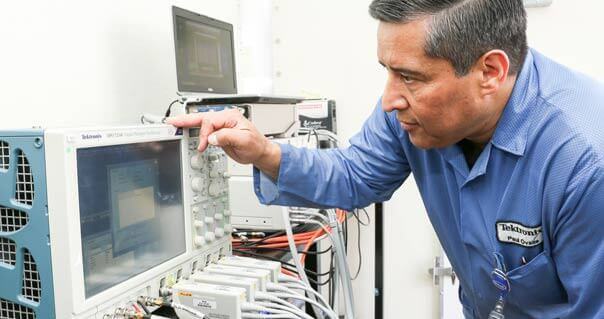
The DSA8200 Digital Serial Analyzer sampling oscilloscope is the most versatile tool for communication, computer and consumer electronics gigabit transmitter and signal path characterization, and compliance verification. With exceptional bandwidth, signal fidelity, and the most extensible modular architecture, the DSA8200 provides the highest performance TDR and interconnect analysis, most accurate analysis of signal impairments, and BER calculations for current and emerging serial data technology.
The DSA8200 provides unmatched measurement system fidelity with ultra-low jitter floor that ensures the most accurate acquisition of high-speed signals.