4. Merging the Transition Response with the Data Pattern

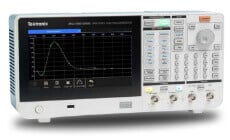
The final step is to combine the transition response with the write-current pattern (Figure 6). We will use the linear superposition assumption to combine the pulse responses with individual write-current transitions. In other words, we will convolve the write-current transition waveform with the transition response waveform. The AWG 2041's convolution function directly performs this function with an important option. Since the write-current pattern represents the physical write-current, we need to convert this to a pattern of write-current transitions. Thus, we apply the differential option of the convolution. This means that a positive transition pulse is summed into the final waveform on a 0­1 pattern transition and a negative transition pulse is summed on a 1­0 pattern transition. A continuous string of 1's or 0's produces no response.


Figure 6. The AWG's differential convolution function directly calculates the effect of each write-current transition.

The convolution of the two waveforms produces a new waveform that is 1496 points long (Figure 7). This is the sum of the two individual waveform lengths and is a by-product of the convolution process. Note that a write-current transition occurs over a 1-bit interval, while the result of the transition occurs over 256 intervals. Thus, the effect of a transition near the ends of the write-current pattern extends beyond the original pattern interval. This highlights an often confusing issue when creating an arbitrary read channel waveform. We started with an isolated 62-bit pattern occupying 1240 ns and ended up with a 62-bit pattern occupying 1496 ns! How would you repetitively generate the original 62-bit pattern in the allotted 1240 ns? Should you simply truncate the 1496 ns record to a 1240-point record and concatenate the shorter record?


Figure 7. In differential convolution, each write-current transition adds the 256 ns transition pulse response to the final waveform. Each pulse is centered at the location of the write-current transition that caused it. The sign of the added pulse depends on whether the transition was from 0 to 1 or vice versa.

As modeled by the transition response pulse, an instantaneous write-current transition affects a time interval that is several times longer than the fundamental bit interval. Our model requires knowledge of write-current transitions immediately before and after a finite length test pattern. Returning to the example, it turns out that our basic write-current pattern was actually 48 bits long.

-Photo-


The basic 48-bit pattern was padded with 14 bits (7 bits at the beginning and 7 at the end) to create the final 62-bit pattern. The 7 bits at the beginning of this 62-bit pattern are duplicates of the last 7 bits in the 48-bit pattern, while the 7 bits at the end are duplicates of the first 7 in the 48-bit pattern. The 7-bit overlap was chosen because it represents 140 ns (i.e., 20 ns per bit interval). The total transition pulse time was modeled as 256 ns, so the effect of a write-current transition extends 128 ns before and after the transition. Thus, to generate the 48-bit test pattern repetitively, we have to pad both sides of the pattern with any data transitions whose transition response could fall into the 48-bit interval. In this case, 7 bit intervals, or 140 ns, on each side adequately covers the 128 ns tail of the transition pulse. Thus, our final waveform is really 48 bit intervals of 20 ns each, or 960 ns long. Using the AWG's graphical editor, we truncate the 268 points equally off each end of the 1496-point convolution result. Note that the points at the ends of the truncated 960-point segment form a seamless boundary. That is, if we repetitively generate this particular pattern, the AWG output will be smooth and continuous between successive 48-bit patterns.

We now have the tools to quickly create building block segments of read channel waveforms. For example, by simply changing the PW50/T parameter in the Lorentzian pulse equation, we can generate the read channel waveform for the same write-current pattern but with a different head-media interface (Figure 8). Conventional waveforms, such as 2F or 1F patterns, can be created by using a write-current pattern of ...10101010... or ...11001100... to simulate transitions on each or every other bit interval. This transition response model of the write-read process does not preclude the explicit entry of an equation model. For example, all AWG equation editors will create cosine-cubed or sinusoidal bursts to simulate unmodulated test signals or servo patterns.


Figure 8. By changing the PW50/T parameter in the Lorentzian equation to 2.5, a new response is quickly developed. The AWG's editor simultaneously displays the 960-point read channel waveforms for PW50/T=1.2 (upper) and PW50/T=2.5 (lower). As expected, individual pulse response peaks are less well defined. In this case, the waveform makes an ideal test signal for partial response detection. The same 62-bit padded data pattern was used so that the final 48-bit, 960 ns waveform is also continuous at the boundaries.