|
IntroductionTo remain competitive, disk drive manufacturers must continue to increase bit densities and transfer rates. Designers need to carefully evaluate the complex interactions among improvements in media, head, and data recovery electronics. One of the most challenging tasks during drive electronics development is the generation of realistic read channel signals to simulate nominal and worst case conditions. Traditional swept sinusoid or pulse response analysis is simply inadequate. Because real-world disk drive signals are quite complex, simplified models typically produce incomplete results. Test equipment manufacturers have responded to this application with the arbitrary waveform generator (AWG). The AWG provides drive manufacturers with the flexibility to define and generate test waveforms with almost infinitely variable signal characteristics. The AWG is the signal generator equivalent to the computer spreadsheet: the user can create countless "what-if" waveforms to thoroughly evaluate or test new concepts, prototype circuits, or production assemblies. Ironically, the inherent flexibility of an AWG can make it difficult to select a model that will fit a specific application. For example, you will not find a specification that explicitly defines an AWG's ability to generate a particular servo pattern. In general, an AWG's ability to generate a specific signal must be demonstrated by example. |
|||||||||
|
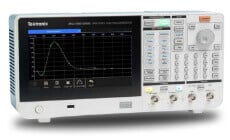
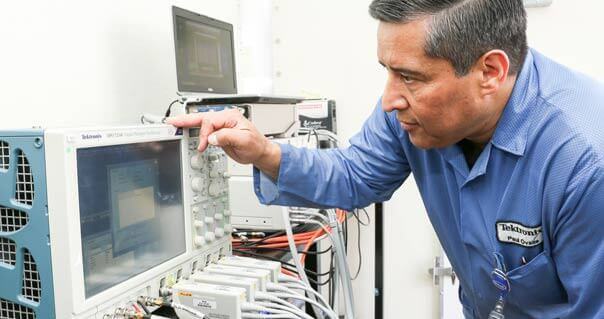
The most straightforward method to create a specific signal is to use the record/playback technique. A live signal is recorded into the memory of a digital oscilloscope. The record is transferred to the AWG for playback. This method is expedient but has limited flexibility. Creating and editing a customized signal is a more powerful technique and is the focus of this note. The first step is to create the basic magnetic channel signal. The next step is to edit the basic signal by modifying amplitude and timing parameters to simulate non-linearities and aberrations. In this note we use the AWG 2041 because it provides the signal generation capabilities most suitable for present and evolving drive application requirements. The AWG 2041 also has the built-in creation and editing functions relevant to disk drive applications. For waveform capture and analysis, we use the Tektronix TDS 744A digital oscilloscope, which complements the capabilities of the AWG 2041. |
|