|
1. The Read Channel SignalTraditional function generators only satisfy the basic characterization requirements of read channel circuits. The real-world signals presented to the read channel circuits are much more sophisticated and contain aberrations that are virtually impossible to create with traditional instruments. But, using the basic magnetic channel waveform as a building block, it is remarkably easy to develop a wide variety of realistic test signals. Virtually all magnetic disk drives use saturated recording, where each "bit" interval on the media is polarized in one of two states. Information is implicit in the transitions between states. That is, data is encoded by simply changing the sign of the current in the write head, which flips the polarity of the magnetic media below it. Later, the read head senses the flux reversals on the media and generates a response to the transition. A read channel signal can be modeled as a string of transition responses. Thus, the first fundamental component in building the read channel waveform is the transition response. |
|||||||||
|
The second component is the digital data pattern, which defines the locations of the transitions. This pattern can range from a simple 1F or 2F single-frequency pattern to a 2n 1 maximal length pseudo-random pattern. The two components are then combined to create the channel waveform.
A popular and effective model of the transition response in longitudinal recording is the Lorentzian pulse. This is the voltage response at the output of the read head in response to an isolated transition on the media. The sign of the pulse alternates for successive flux reversals. Equation 1 shows the basic Lorentzian function, where t is time and x is a parameter which controls the pulse width. The pulse has a maximum value at t=0 and symmetrically decays to zero about t=0. Equation 2 is a slight modification that allows direct entry into the AWG 2041's equation editor. The parameter t0 shifts the pulse so that it is non-zero for only positive time. The pulse peak now occurs at t=t0. PW50 represents the pulse width where the amplitude is 50% of the peak level. The "dummy" parameter, T, inserted in the numerator and denominator of the squared term represents the bit interval. This insertion permits the system design ratio, PW50/T, to appear as an explicit term in the equation. ![]()
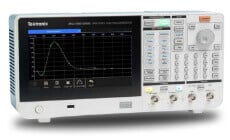
Figure 1. The Lorentzian pulse with T=20 ns and PW50/T=1.2. This is our model of the read-head voltage response to a write-current transition. Figure 1 plots the Lorentzian function for a bit interval of T=20 ns and a PW50/T ratio of 1.2. Larger values of PW50/T spread out the pulse. A total duration of 256 ns adequately represents the transition pulse. The pulse was centered at t0=128 ns. Note that the response to an instantaneous write-current transition extends beyond the bit interval in which the transition occurred. |
|